Just being aware

This quote, from a essay by Anne Dilliard, is as good a description of the simple  – but difficult – act of paying attention, that moment before we add words to what we are experiencing. It is something which we keep working at, slowing down the continual commentary which accompanies everything in our mind, working on our capacity to just let thing be:

This is it, I think, this is it, right now, the present, this empty gas station, here, this western wind, this tang of coffee on the tongue, and I am petting the puppy, I am watching the mountain. And the second I verbalize this awareness in my brain, I cease to see the mountain or feel the puppy. I am opaque, so much black asphalt. But at the same second, the second I know I’ve lost it, I also realize that the puppy is still squirming on his back under my hand. Nothing has changed for him. He draws his legs down to stretch the skin taut so he feels every fingertip’s stroke along his furred and arching side, his flank, his flung-back throat. I sip my coffee. I look at the mountain, which is still doing its tricks, as you look at a still-beautiful face belonging to a person who was once your lover in another country years ago: with fond nostalgia, and recognition, but no real feeling save a secret astonishment that you are now strangers. Thanks. For the memories. It is ironic that the one thing that all religions recognize as separating us from our creator – our very self-consciousness – is also the one thing that divides us from our fellow creatures. It was a bitter birthday present from evolution, cutting us off at both ends.

Annie Dilliard, Pilgrim at Tinker Creek

Tired eyes

I was recently away on retreat in Massachusetts and noticed that, as it has before, travelling stimulated the senses and moved the mind to notice new things – or things with fresh eyes. I was reflecting on this as I passed through different airports, when I always find that impressions are more intense. Or it could be that I am more open. Because it seems to me that being in airports and travelling is an exercise in “who I am” and identity, an experience in which the normal containers in which I act, and am perceived by others,  gets moved around and suspended for a while, until I land and get back into reasonably familiar places, like hotels, and into roles and routines that I can determine myself. In the airport I find myself in a space where I am not – and nobody else really is – “at home”:  everything is fluid, my identity reduced to that of a person-in-movement, defined only by passport and boarding card. The normal familiar people, places and roles that hold my life together are not around. And mostly I find it a very open, stimulating experience.

So I emerged from a flight, through the scrutiny of passport control and various checks, to stand with the others to wait for that other comforting element of my identity to slot back into place, the suitcase. Opposite me were two small twin brothers, travelling with their parents. They were lively and excited, and for the first moment my mind labelled the delighted sounds they were making as “too much noise”. However, soon their excitement focused on the conveyor belt and each tumbling-down piece of luggage brought cheers of surprise and delight. Not just the first one, but the tenth and the twentieth brought gasps of amazement and amusement as they waited for their one to arrive. It was very funny to see their faces and their wonder at the technology, seeing it probably for the first time.

And it struck me how much wonder we lose at the things which happen everyday,  simply out of force of habit or being in a hurry. Now, I am not saying that we should get back to a condition where routine things, like the operation of a conveyor belt, fills us with surprise and awe each time we see them. It is simply not possible to get back into that fresh state.  But it did impress on me that we miss so much, either out of familiarity,  or due to  the wariness with which we approach strange situations,  or maybe because of the fact that life has betrayed and hurt us and we have learned not to open our hearts. Thus, sadly, the innocence, openness and wonder of children is not normally our everyday mode of relating to things.

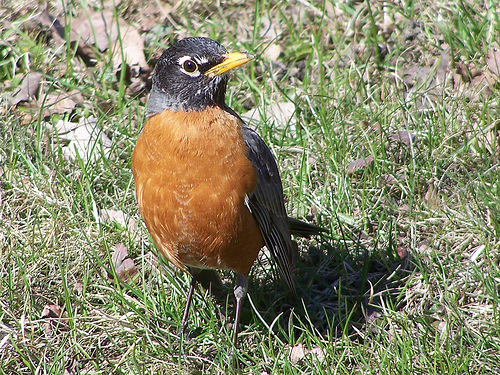
Thankfully from time to time something new, or something of beauty, comes along and cuts through the habitual mind and the defensive heart. Like this American Robin which I saw foraging for food every morning as I sat on a bench after breakfast in rural Massachusetts. I have been an amateur birdwatcher since my childhood, so seeing a new species is always interesting.  And the movement of this bird – although called a robin in homage to its redbreast – reminded me of the European thrush with which I am more familiar. It appeared each morning, always timid, searching for worms with some success.  So this hesitant bird,  which for some reason has evolved to be wary and cautious, became my companion for the days of retreat, and its tender vulnerability  helped me to see with new eyes and a more open heart.

Maybe this is the key. Moments of beauty  and changes from fixed patterns open the heart, making it gentle and vulnerable. But not only the beautiful or the surprising. It struck me that I should be also be open to the arrival of unexpected difficulties or to upsets in life,  as moments which challenge the habitual, and force new ways of thinking. They too come to visit me, maybe to stir me up and  allow me see where I am stuck. Where I have gotten too much into a routine. In some ways,  life will never cease to provide me with occasions for growth if I can just be awake to what is presented. I do not have to go out of my way to seek them. I just have to have fresh eyes that can see.

Giving the mind a break

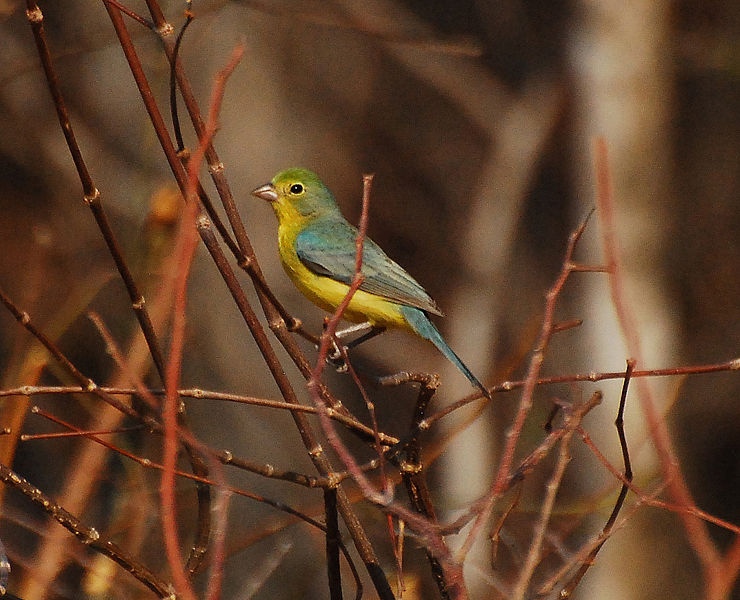
The first of the basic practices to which I was introduced as a child – which most teachers introduce to beginning students … is known as “shamatha”. “Shama” may be understood in a variety of ways, including “peace”, “rest” or “cooling down” from a state of mental, emotional or sensory excitement. Maybe a modern equivalent would be “chilling out”. In other words, “shamatha” means abiding in a state that is rested or “chilled out”, which allows the little bird to just sit on one branch for a while.

Most of us, when we look at something, hear something, or watch a thought or emotion, have some sort of judgment about the experience. This judgment can be understood in terms of three basic “branches”: the “I like it” branch, the “I don’t like it” branch or the “I don’t know” branch. Each of these branches spread out into smaller branches: “good” branch;  “bad” branch; “pleasant” branch; “unpleasant” branch; “I like it because…” branch; “I don’t like it because…” branch; “could be nice or not” branch; “could be good and bad, pleasant and unpleasant” branch; and the “neither good nor bad, pleasant nor unpleasant” branch. The possibilities presented by all these branches tempt the little bird to flutter between them, investigating each one.

The practice of shamatha involves letting go of our judgments and opinions and just looking at, or paying attention to, what we see from whatever branch we’re sitting on…. Rest there on one branch. Attending to our experience in this way allows us to distinguish our judgments and opinions from the simple experience of seeing.

Yongey Mingyour Rinpoche, Joyful Wisdom

Not believing our fears

Fear is so fundamental to the human condition that all the great spiritual traditions originate in an effort to overcome its effects on our lives. With different words, they all proclaim the same core message: “Be not afraid.” . . . . It is important to note with care what that core teaching does and does not say. “Be not afraid” does not say that we should not have fears — and if it did, we could dismiss it as an impossible counsel of perfection. Instead, it says that we do not need to be our fears, quite a different proposition.

Parker Palmer.

Seeing thoughts as less substantial…

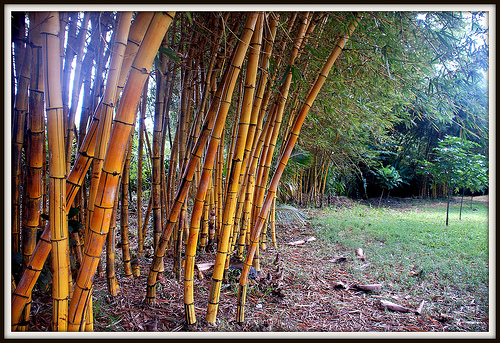
The wind whistles in the bamboo and the bamboo dances.

When the wind stops, the bamboo grows still.

A silver bird flies over the autumn lake.

When it has passed,

the lake’s surface does not try to hold on to the image of the bird.

Huong Hai

Then – stopping the stories comparisons provoke

Do you notice a tendency to measure or compare yourself with others or with the easy happiness which is portrayed in the media?

We hear, imagine and watch so many stories! Our life is becoming more and more inundated with TV shows, movies, magazines, and newspaper articles that seem to show us what life is like. And then the inevitable comparisons arise: “My life isn?t like that” or “I wish it were” or “It is exactly like that”. The moment we notice painful or sad feelings arising from thoughts like “I’m unloved. I feel separate and isolated” can we immediately stop, look and listen,  instead of going on weaving fancy narratives about ourselves? Can we stop and ask “Where is this feeling coming from?” Right now. Asking right this moment. Becoming more transparent to thoughts and images that evoke these feelings and then deepen,  embellish, and propagate them.

Toni Parker, The Silent Question