
Noticing the space around

Most of our suffering comes from habitual thinking. If we try to stop it out of aversion to thinking, we can’t; we just go on and on and on. So the important thing is not to get rid of thought, but to understand it. And we do this by concentrating on the space in the mind, rather than on the thought.

Our minds tend to get caught up with thoughts of attraction or aversion to objects, but the space around those thoughts is not attractive or repulsive. The space around an attractive thought and a repulsive thought is not different, is it? Concentrating on the space between thoughts, we become less caught up in our preferences concerning the thoughts. So if you find that an obsessive thought of guilt, self-pity, or passion keeps coming up, then work with it in this way — deliberately think it, really bring it up as a conscious state, and notice the space around it. This way, we begin to have a perspective on the impermanent nature of thinking.

Ajahn Sumedho
An Invitation to happiness

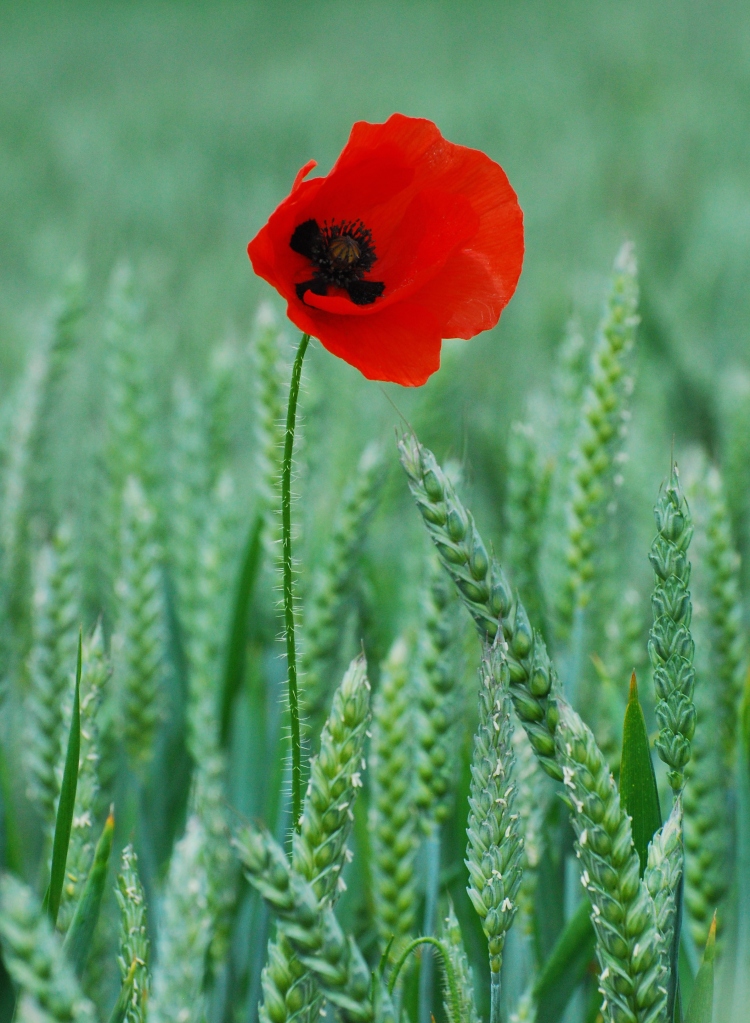
I love this time of year when the poppies grow alongside and inside the fields of wheat. With the wind of today and yesterday they sway, attracting our attention as we walk along the lanes.  They are a splash of colour on a grey day. However they do more. They are, as Mary Oliver says, an invitation to happiness. And then it dawns on me that innumerable things each day are the same.  Sure. like every one of us, I am tempted,  from time to time, to  “drown” in moments of darkness, but so many things  – like these flowers – remind me that I am given opportunities each day to collect  moments of colour, little miracles of light , that give me courage to go on and renew my  joy. They invite me to not just live life, but to celebrate it.

The poppies send up their orange flares; swaying
in the wind, their congregations
are a levitation

of bright dust, of thin and lacy leaves.
There isn’t a place in this world that doesn’t

sooner or later drown in the indigos of darkness,
but now, for a while, the roughage

shines like a miracle as it floats above everything
with its yellow hair.
Of course nothing stops the cold, black, curved blade from hooking forward—
of course loss is the great lesson.

But I also say this: that light is an invitation
to happiness, and that happiness,

when it’s done right, is a kind of holiness,
palpable and redemptive.
Inside the bright fields,

touched by their rough and spongy gold,
I am washed and washed in the river
of earthly delight—

and what are you going to do—
what can you do about it—
deep, blue night?

Mary Oliver, Poppies

Image by John Ecker | Pantheon Photography.

The beams of love

A huge change in the weather yesterday and today, and objectively it is much grayer here. However, had a number of meetings with people who reveal an inner light and a courage in the face of difficulties. It is love which brightens each day and the capacity to appreciate what we have, not wishing things be different.

We are put on earth a little space,
That we may learn to bear the beams of love.

William Blake

How to truly live well

The art of living…is neither careless drifting on the one hand nor fearful clinging to the past….on the other.  It consists in being sensitive to each moment, in regarding it as utterly new and unique, in having the mind open and wholly receptive.

Alan Watts, The Wisdon of Insecurity: A Message for an Age of Uncertainty

Starting with the now

Meditation begins now, right here.  If you wish to free yourself from the frantic television mind that runs our lives, begin with the intention to be present now. Nobody can bring awareness to your life but you.

Meditation is not a self-help program – a way to better ourselves so we can get what we want.  Nor is it a way to relax before jumping back into busyness. It’s not something to do once in a while, either, whenever you happen to feel like it.  Instead, meditation is a practice that saturates your life and in time can be brought into every activity. It is the transformation of mind from bondage to freedom. In practicing meditation, we go nowhere other than right here where we now stand, where we now sit, where we now live and breathe. In meditation we return to where we already are – this shifting, changing ever-present now.

Steve Hagen

The roots of our unhappiness

Loss of mindfulness is why people engage in useless pursuits,

do not care for their own interests,

and remain unalarmed in the presence of things which actually menace their welfare.

Buddha