Times when we learn most

bubbles

There comes a time when the bubble of ego is popped and you can’t get the ground back for an extended period of time. Those times, when you absolutely cannot get it back together, are the most rich and powerful times in our lives.

Pema Chodron

The experience of the self is always a defeat for the ego

Jung

Waiting for us to make time

quiet_place

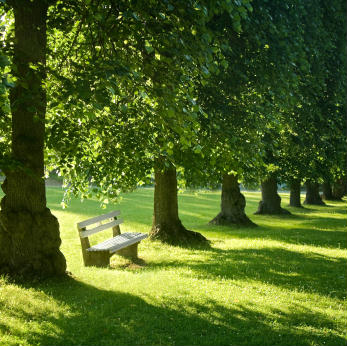
When I was a child in New York City in the 1940s there were laws that attempted to legislate the Biblical injunction “Remember the Sabbath and keep it holy.” Businesses were closed. Shopping stopped. There were no convenience stores. People needed to remember, in advance of the Sabbath, to provide for the upcoming day of rest and spiritual reflection so that, on that day, they could rest. The community collectively caught its breath. Family members spent time with each other. They renewed connections. They visited neighbors.  I like to imagine that, whether or not people went to religious services, there was the possibility in that period of a pause for reflection. “What am I doing with my life?” “Is what I am doing good for me?” “Is it good for other people?” “Does my life make a difference in the world?” “Could my life make more of a difference in the world?”

All of the important fundamental questions in life seem to be waiting, so to speak, next on-line at the top of the mind’s agenda, if only we give them the time and the space to present themselves.

Sylvia Boorstein

Like working with a committee

File:Senate budget committee.JPG

There are many different ideas of “you” in your mind, each with its own agenda. Each of these “you’s” is a member of the committee of the mind. This is why the mind is less like a single mind and more like an unruly throng of people: lots of different voices, with lots of different opinions about what you should do. Some members of the committee are open and honest about the assumptions underlying their central desires. Others are more obscure and devious. …One of the purposes of meditation is to bring these dealings out into the open, so that you can bring more order to the committee — so that your desires for happiness work less at cross purposes, and more in harmony as you realize that they don’t always have to be in conflict.

Thanissaro Bhikku

A simple way to find balance each day

DSC_0464

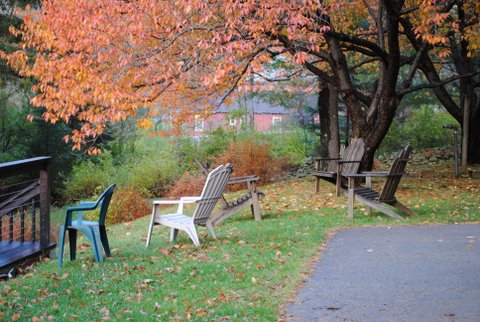
A change in the weather in Ireland this morning –  gone noticeably cooler – but it still remains bright and clear. A perfect  day for a Autumnal walk, to appreciate the changing colours.  Tuning into the change in nature’s rhythms is good for our internal sense of balance, as we see that things arise and pass away, and that life cannot be composed only of periods of growth and achievement. However, walking has significant physical health benefits also, as studies show that being out in natural light increases serotonin levels in the brain, as even on a cloudy day the light outside is normally greater than what can be achieved indoors. Thus,  a break away from the desk or the computer helps us to let go of some of the stresses that each day brings and see things in perspective:

When despair for the world grows in me
and I wake in the night at the least sound
in fear of what my life and my children’s lives may be,
I go and lie down where the wood drake
rests in his beauty on the water, and the great heron feeds.
I come into the peace of wild things 
who do not tax their lives with forethought
of grief. I come into the presence of still water.
And I feel above me the day-blind stars
waiting with their light. For a time
I rest in the grace of the world, and am free.

Wendell Berry, The Peace of Wild Things

Always wanting more

flower in rocks

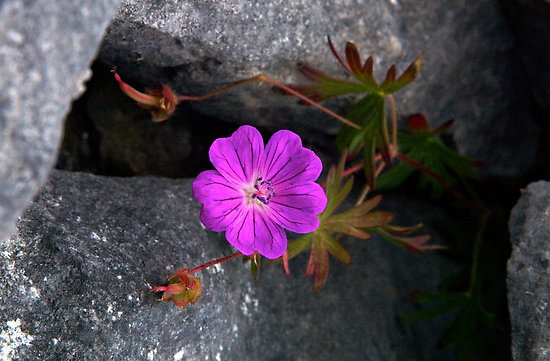
I do not talk of the beginning or the end. 

There was never any more inception than there is now, 
Nor any more youth or age than there is now, 
And will never be any more perfection than there is now, 
Nor any more heaven or hell than there is now. 

Urge and urge and urge, 
Always the procreant urge of the world.

Walt Whitman, Song of Myself

Allow life to be a conversation

two people 3

The conversational nature of reality means that whatever you want from life will not occur in exactly the way you’d like it to. But, also, whatever life wants from you – society wants from you, your parents want from you, your partner wants from you, your children want from you – will also not occur.  And that what occurs is this third quality which is more like a meeting and a dynamic of the two, a conversation between the two.  I’d like to speak about the life that can actually be conversation in its essence, where we don’t choose too early in the process and we allow things to come to fruition in a surprising, nourishing, and generous way.

David Whyte, What to Remember when Waking