Not looking outside our lives….

We all have a tendency to look outside for someone or some idea which will answer the questions which our lives pose, or in the face of changes which we do not expect. The current ongoing economic crises, news of natural or man-made disasters, unusual weather patterns,  or even ancient calendars  can mean that this New Year  continues the ongoing sense of fear and uncertainty which has characterized the last few years. This exterior climate inevitably has an effect on our interior state of mind and the confidence we feel.  It is not easy living in a time of fear, and it means we are more likely to seek solutions and changes proposed by others which seem to offer a more solid footing. Now we all receive guidance from other people and from reading the works of experienced teachers. However, when the external environment is tinged with fear, we often become more security-oriented in our lives,  and the fear can prompt us to seek simple,  quick certainties .

In general, mindfulness practice tells us that the best way to work with change is to look inside, and to slowly increase our interior freedom in the face of our fearful thoughts. It allows us to go beneath the surface level of reactive experience, which is frequently filtered through conditioning and  emotions. It places our confidence in the working of the mind, not in looking excessively to heroes or gurus or the latest, quick-fix solutions. In this way, its slow confident progress is at odds with a rapidly changing world, which loves quick solutions and neat, happy endings.

This encouragement to look within applies to all, even to the best of teachers. In this story, the great Thai teacher, Ajahn Chah, takes advantage of Ajahn Sumedho’s complaints to make the point that, no matter what is going on in our lives or in the world, we have within us a capacity to work with it. We can apply this in our lives today, whenever we notice our tendency either to blame people or factors outside our mind for our moods or wishing for some magical change to come in the future.

Through the early years of his life as a monk with Ajahn Chah, Ajahn Sumedho was full of inspiration and could find no flaw in his teacher. As time went by and the glamour wore off somewhat, more and more cracks started to be seen in Ajahn Chah’s perfection. After some time Ajahn Sumedho could not hold back any longer and decided to broach these criticisms with the Master. Even though such face-to-face criticism is much avoided in Thai society, Ajahn Sumedho was an all-American boy and decided to talk straight.  He went to Ajahn Chah and asked permission to recount his grievances, to which Ajahn Chah listened carefully and receptively.

When Ajahn Sumedho reached the end of his litany of complaints, Ajahn Chah paused for a few moments and then said: “Perhaps it’s a good thing that I’m not perfect, Sumedho, otherwise you might be looking for the Buddha somewhere outside your own mind”

How to live with what is

The way of wisdom is not the way of “why”, but the way of “what”. The Hebrew word [for wisdom] – chochma –  can be read as choch ma – “what is”. Wisdom will not tell you why things are the way they are, but will show you what they are and how you can live in harmony with them.

Rabbi Rami Shapiro, The Divine Feminine in Biblical Wisdom

From time to time,check in with the senses

To orientate ourselves to the present moment we can do this simple exercise. We pay attention to the doors of the eyes, ears, nose, mouth and body to see what exactly is happening there. Just as the captain of a ship checks his compass to determine his position; so we can check each of the sense-doors to determine our position – which is, of course, the present. If we are not careful, these inner worlds of ours easily become choked with troublesome thoughts, perceptions, memories and characters. But are these private worlds we drag around a true reflection of the outside world? Aren’t they just based largely on our own mistaken perceptions? How many times do we pass judgement on something, only to have it promptly overturned moments later? Our inner worlds are – for the most part – disconnected from reality, from what is actually going on right now.

And so it is crucial that we learn to be mindful of what is happening around us; that we pause to pay attention to what is occurring, in the present, at each of the sense-doors. The sense-doors are our windows to the world, and to stop the creation of more mental proliferation we must be vigilant and learn to just observe. To be mindful of what is actually happening around us puts a break on these meanderings of the mind and we become aware of what is right in front of our noses. This practice serves to help remind us of the simplicity of the moment.

Ajahn Manapo, Dhamma Diary Blog

Today, Notice what goes right

Each of us is like a mosaic, with lots of lovely tiles, some that are basically neutral, and a few that could use a little – ah – work. It’s important to see the whole mosaic. But because of the brains negativity bias, we tend to fixate on what’s wrong with ourselves instead of what’s right. If you do twenty things in a day and nineteen go fine, what’s the one you think about? Probably the one that didn’t go so well.

Your brain builds new structures based on what you pay attention to. Focusing on the “bad” tiles in the mosaic that is you keeps feeding an underlying sense of being mediocre, flawed or less than others. And it blocks the development of the confidence and self-worth that comes from recognizing the good tiles. These results of the negativity bias are not fair. But they’re a big reason why most of us have feelings of inadequacy or self-doubt.

Rick Hanson, Just One Thing

All the time in the world

Wherever we are, from one day to the next, the Earth is moving at the same speed. Yet in the modern world, we’ve convinced ourselves that the world is moving faster, and that speed is the way to make our life work. Under the pressure of schedules and commitments, we think we can accomplish more if we speed through our day. Speed gives life a frantic quality. It is an anxious state of mind that keeps us from settling into whatever we are doing. There is always something more important than what we’re doing now. We’re double-parked outside a store, trying to find what we need, while talking to our mother on the cell-phone. Rather than accomplishing our activity well, we are nullifying it, because we aren’t really there for it.  Speed comes from being overly ambitious. We aren’t content with our own mind, so we become aggressive in how we conduct our life. In an effort to match a concept of what success might be, we fill our calendars and spend the whole day holding on to our “to do” list. We chase after appointments, phone calls and meetings with jealousy, competition, fixation and irritation — whatever it takes to get us where we think we need to go. When life still won’t match our concept, we get mad — mad that others are late, or mad that we are early.

The practice of meditation offers us the opportunity to slow down for a short time every day. This is how we can begin to step out of the cycle of speed. In sitting still and focusing our mind, we are declaring daily that this human life is precious. Taking time to appreciate it comes from our own determination and wisdom. Through this discipline, we simplify our life. We regain the space to appreciate it, having lost nothing but speediness. We learn how to float aloft, carried by the winds, appreciating what we see in every direction. We learn to relax.

Sakyong Mipham Rinpoche, Slow Down, You Move Too Fast

Seeing things from a different perspective today

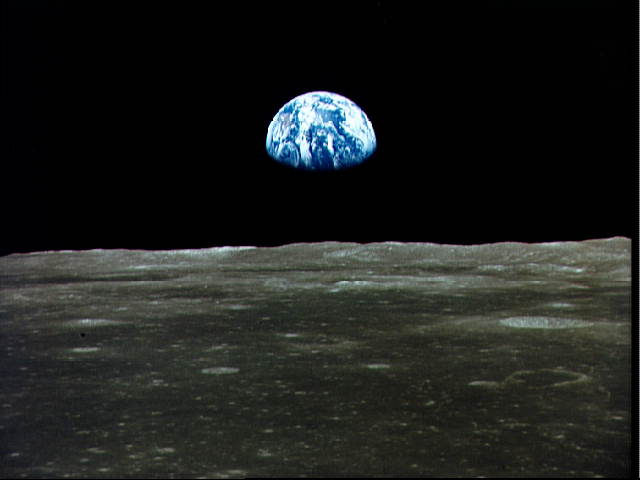
My favorite picture is earthrise as seen from the moon. It’s perfect. A great blue and green ball floating in vast black space, hanging right there in its orbit. From that vantage point,  the scene on earth is awesome. creatures being born, other ones dying; plants blooming on one side, plants withering on the other; snow snowing, winds blowing, volcanoes erupting, earthquakes shivering, people talking, music playing. From the moonview, its incredible cosmic drama. From our usual view, inside the drama, looking up at the moon, it’s a different story. It changes from the drama to my drama and gets to be a problem. If you’re far enough away, it’s not your story – its one of the six and a half billion stories.

Sylvia Boorstein: It’s Easier than you Think