The light is everything

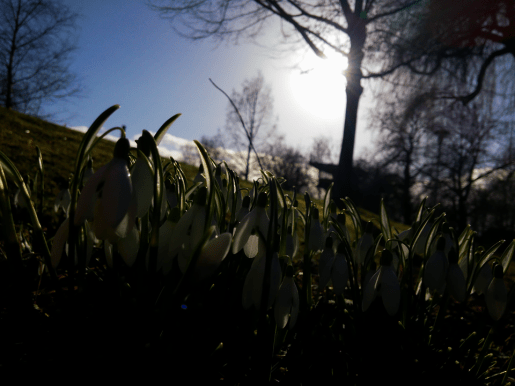
The weekend, which allows the possibility to get out in nature, is a good time to share some of Mary Oliver’s poetry.  This one is about flowers and how some are less “perfect” than others. But it is also about  relationships and what hopes we have for our heart, about a greater beauty that embraces the clearly imperfect and allows us cast away the hassles of the everyday which are not us. We are nourished.

Shared moments, flowers, meanings and the stories that feed us.

What in this world
is perfect?

I bend closer and see
how this one is clearly lopsided–
and that one wears an orange blight–
and this one is a glossy cheek

half nibbled away–
and that one is a slumped purse
full of its own
unstoppable decay.

Still, what I want in my life
is to be willing
to be dazzled —
to cast aside the weight of facts

and maybe even
to float a little
above this difficult world.
I want to believe I am looking

into the white fire of a great mystery.
I want to believe that the imperfections are nothing —
that the light is everything — that it is more than the sum
of each flawed blossom rising and fading. And I do.

Mary Oliver, The Ponds

Keep going

Posted this once before but I really like the encouragement at the end of a working week which contained 10,000 things arising and passing away:

He has shown you what is good,  and what is required of you: To do justice, to love kindness, and to walk humbly with your God. Micah 6:8


Do not be daunted by the enormity of the world’s grief. 

Do justly, now.  Love mercy, now.  Walk humbly, now. 

You are not obligated to complete the work,

but neither are you free to abandon it.

The Talmud

Forgiving our life


A lot of us find it hard to extend real kindness towards ourselves. Our default position is that we are much more critical of ourselves – and how our life history has developed – than we are of others. 

And if we forgive life for not being what we told it to be, or expected, or wished, or longed for it to be,

we forgive ourselves for not being what we might have been also.

And then we can be what we are, which is boundless

John Tarrant, The Zenosaurus Course in Koans

What cows do you need to let go of?

The area where I live, south Kildare, has some of the finest pasture land in Ireland and it is a lovely place for a walk at the weekend.  So it is easy to be reminded of this old story about cows, retold here by Thich Nhat Hanh. Like all parables it can speak to us in different ways at different moments in our lives.

Today it reminds me that I should stop trying to hold onto my idea of what life should be like, and instead move towards what life actually is like.

This can become a simple daily practice – we can repeat the words “let go” –   letting go of what we think we need for happiness and the external conditions we believe must be fulfilled in order for happiness to come.

Hopefully it may speak to you in some way today

One day the Buddha was sitting in the forest with some monks when a farmer approached them. The farmer said, “Venerable monks, did you see my cows come by? I have a dozen cows and they all ran away. On top of that I have five acres of sesame plants and this year the insects ate them all up. I think I am going to kill myself. It isn’t possible to live like this”  The Buddha felt a lot of compassion toward the farmer. He said “My friend, I am sorry, we did not see your cows come this way”.

When the farmer had gone, the Buddha turned to his monks and said “My friends, Do you know why you are happy? Because you have no cows to lose”

I would like to say the same to you. If you have some cows you have to identify them. You think they are essential to your happiness, but if you practice deep looking, you will see that it is not these cows that have brought about your happiness. The secret of happiness is being able to let go of your cows. You must have the courage to practice letting go.

Thich Nhat Hanh, You are Here

Not trying to get somewhere

The physical universe is basically playful. There is no necessity for it whatsoever. It isn’t going anywhere. That is to say, it doesn’t have some destination that it ought to arrive at. It is best understood by the analogy with music. Because music, as an art form is essentially playful. We say, “You play the piano” You don’t work the piano.

Why? Music differs from say, travel. When you travel you are trying to get somewhere. In music, though, one doesn’t make the end of the composition. The point of the composition. If that were so, the best conductors would be those who played fastest. And there would be composers who only wrote finales.…  Same way with dancing. You don’t aim at a particular spot in the room because that’s where you will arrive. The whole point of the dancing is the dance.

If we thought of life by analogy with a journey, with a pilgrimage, which had a serious purpose at that end, and the thing was to get to that thing at that end. Success, or whatever it is, or maybe heaven after you’re dead.

But we missed the point the whole way along.

It was a musical thing, and you were supposed to sing or to dance while the music was being played.

Alan Watts

A bigger container

Wordsworth invited his readers to abandon their usual perspective and to consider for a time how the world might look through other eyes, to shuttle between the human and the natural perspective.

Why might this be interesting, or even inspiring?

Perhaps because unhappiness can stem from only having one perspective to play with.

Alain de Botton, The Art of Travel