A poem for the start of autumn: to be a witness

File:Apples on Ground (8399553959).jpg

I do not know if the seasons remember their history or if the days and
nights by which we count time remember their own passing.

I do not know if the oak tree remembers its planting or if the pine
remembers its slow climb toward sun and stars.

I do not know if the squirrel remembers last fall’s gathering or if the
bluejay remembers the meaning of snow.

I do not know if the air remembers September or if the night remembers
the moon.

I do not know if the earth remembers the flowers from last spring or if
the evergreen remembers that it shall stay so.

Perhaps that is the reason for our births — to be the memory for
creation.

Perhaps salvation is something very different than anyone ever expected.

Perhaps this will be the only question we will have to answer:
“What can you tell me about September?”

Burton D. Carley, September Meditation

photo leslie seaton


Noticing

File:I see peanuts! (8408863048).jpg

A lesson on really paying attention, from an unusual guide:

“Holmes you see everything!”  Watson exclaimed.

“I see no more than you,

but I have trained myself to notice what I see“, said Holmes.

Sir Arthur Conan Doyle, The Adventure of the Blanched Soldier

photo ian kirk

The gap between words

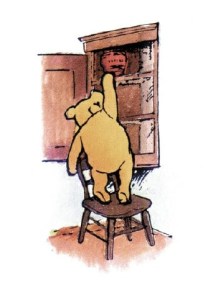
Well,” said Pooh, “what I like best,” and then he had to stop and think.

Because although Eating Honey was a very good thing to do, there was a moment just before you began to eat it which was better than when you were, but he didn’t know what it was called.

A. A. Milne, The House on Pooh Corner

Sunday Quote: Fully alive using the ordinary

File:Gingham teatowel.jpg

Let us come alive to the splendour that is all around us

and see the beauty in ordinary things

Thomas Merton

photo Lewis Ronald

Knowing oneself gently

File:Mmmmm lunch (4977315962).jpg

Dogen Zen-ji said, “To know yourself is to forget yourself.” We might think that knowing ourselves is a very ego-centered thing, but by beginning to look so clearly and so honestly at ourselves—at our emotions, at our thoughts, at who we really are — we begin to dissolve the walls that separate us from others. Somehow all of these walls, these ways of feeling separate from everything else and everyone else, are made up of opinions. They are made up of dogma; they are made of prejudice. These walls come from our fear of knowing parts of ourselves. There is a Tibetan teaching that is often translated as, “Self-cherishing is the root of all suffering.” It can be hard for a Western person to hear the term “self-cherishing” without misunderstanding what is being said. I would guess that 85% of us Westerners would interpret it as telling us that we shouldn’t care for ourselves….. But that isn’t what it really means. What it is talking about is fixating.

Pema Chodron, To Know Yourself is to Forget Yourself

photo U.S fish and wildlife service

Taking things personally

lakes

It’s true that different people have different mind stuff to work with, but essentially there comes about a realization that the core of the feeling of suffering comes from something we all do: we take things personally. And you can’t stop doing this simply as an idea. The practice involves cessation – letting go of “self” through directly knowing “self”. This must occur by feeling out and examining some pretty well-known positions ….”I cant do it” is one of them, and the list goes on through every kind of self-view about “I’m not worthy/good enough”, “It’s not good enough for me” ” I have a lot of karma to work out”…In the course of practice, all of these self-views come and go continually until gradually the realization of their impermanence begins to sink in.

Ajahn Sucitto, The Dawn of the Dhamma