Why it is good to let go of the past

Just as a snake sheds its skin, so we should shed our past, over and over again

The Buddha

There is a lot of wisdom in this quote. From the moment we are conceived we are continually changing. However, this can produce anxiety, and we have a natural tendency to try and reduce this,  by stabilizing our life and looking for as much certainty as possible. We like to have identifiable projects and clear plans,  a coherent narrative, a life story that seems to make sense, at least to ourselves. So we create our own personal myth that will give us a unity and purpose in the world. And one of the difficulties of sitting in meditation just with present moment awareness is that we often prefer to go back to our story, replaying it again and again, believing it to be our life.

However, there may be alternative ways of working with life.  Our story is frequently selective, it emphasizes certain themes and ignores others. The mind has a negativity bias, and it often prefers to hold onto things that have gone wrong and which have been stored in our unconscious as worry and anxiety. Thus, it may be best to let those things go. Also when we have been hurt and let down it is good to discover the freedom that  comes from letting go. Practice draws attention to the fact that all things arise and pass away: all things are impermanent.  The past is not really happening any more, except in our minds. Our life is continually changing and it may be better to see our selves as a succession of selves and just rest in how we are, in this moment. We can drop the story, the continual commentary on how we are doing, the wondering how we measure up in terms of this myth we – or others – have crafted for us. It is good to move on.

This can save us from the tendency we have to compare.  We compare ourselves with versions of ourselves at other times – how we “should” be now –  or compare by noticing the loss of what we no longer have, such as youth, activities, friends, relationships. We also instinctively compare our stories to others or the dominant stories in society, which tell us what “success” or “happiness” should be. This can lead us to overlook the fact that happiness in life comes not from holding onto the past but by living in the present with appreciation. If we see this we resist the tendency to make things permanent – this always has to be so – and free ourselves to delight in life as it presents itself each day.

Most of our troubles are due to our passionate desire for and attachment to things that we misapprehend as enduring entities.

Dalai Lama

More on repetition and getting stuck

Something similar to last weeks post on repeating patterns in our lives, or what Freud termed the Repetition Compulsion, where he noticed people repeating – sometimes in a disguised way – the experiences which  were difficult or distressing in their earlier life.  He saw that people do not necessarily remember clearly what was happening in childhood, but still act it out in relationships later, without knowing that  they are  repeating it. Unconscious dynamics which were formed in childhood and which were adaptive then – such as not allowing anyone get too close, or having to “make” others love them – are repeated in adulthood, even if they are self-destructive.  So the past is repeated in a new form, but in the hope that this time the original wound may be healed.

On a day-to-day level this tends to manifest as the story of our life which we have allowed to take hold and which we repeat to ourselves. We can see this idea in this piece from the Tibetan Soygal Rinpoche, writing from a meditation perspective:

As we follow the teachings and we practice, we will inevitably discover certain truths about ourselves that stand out prominently: There are places where we always get stuck; there are habitual patterns and strategies which we continuously repeat and reinforce; there are particular ways of seeing things – those tired old explanations of ourselves and the world around us – that are quite mistaken yet which we hold on to as authentic, and so distort our whole view of reality.

When we persevere on the spiritual path, and examine ourselves honestly, it begins to dawn on us more and more that our perceptions are nothing more than a web of illusions. Simply to acknowledge our confusion, even though we cannot accept it completely, can bring some light of understanding and spark off in us a new process, a process of healing.

We grow our own future


The heart is like a garden.

It can grow compassion or fear, resentment or love.

What seeds will you plant there?

Buddha

The choices we make, each day

We create ourselves by our choices.

Kierkegaard

Facing ourselves in our relationships

Each day, as we grow older, we are challenged to live as the person we would like to be. This is not always easy when we are stressed or we are hurt or let down. And also we can, at times, choose selfishness rather than genuine care for others. And what I increasingly notice is how much of our behaviour has it roots in fear.

The places where these fears are most often activated is in relationships with others. Frequently we instinctively act in defensive ways to protect our hearts. Relationships have the capacity to trigger our deepest fears, which often reflect patterns established in our childhood. I notice this when a strong emotional reaction is triggered, and automatic,  deeply believed – often fearful – thoughts dominate, which are very easy to take as the truth. Normally my first move is to maximize distance in order to protect myself and act as if the other person is a threat to the security of my deepest self.  Relationships open our hearts and expose our needs. Sometimes we clearly feel that is not safe. And when that happens we all follow some strategy to escape feeling the fears that silently run our life.

However, the truth about relationships is that they reflect closely our relationship with ourselves and reveal a lot about the clarity or confusion in our inner life. In fact our relationships with others can never be better than the relationship we have with ourselves. We often project on to the other what is going on inside ourselves, often what we are unable to manage properly, and this is at the root of our fears, and the reason they are so strong. Thus we can blame the other for confusion which is actually inside ourselves.

I have noticed this often in myself recently. Therefore I am now trying, when strong fears are triggered, to turn towards them and let them in, looking on them as a ‘what’ instead of as ‘me’. Instead of running story lines of anger and blame, I try and just stay with the original feeling of hurt. Even if the fear triggered is strong, if I manage to do this soon afterwards, I notice the fear loses its power quickly and a more open response can emerge. The fear can thus becomes a teacher, hopefully leading to understanding rather than paralyzing.

Fear tells us to stop, to stay within the boundary of our protected cocoon-world. Yet when we feel fear, if we take even one small step toward it rather than yielding to our habitual pulling away, we move one step closer to the vast mind that lies beyond. When we feel fear instead of saying ‘I’m afraid,’ thus reinforcing our identification with our fear as who we are, we can simply say, ‘Fear is present.’  Thus fear’s power gradually dissipates, and we begin to free ourselves from it. When we simply experience fear just as it is — without our opinions, judgments, and reactions — fear is not nearly so frightening.

Ezra Bayda, Saying Yes to Life (Even the Hard Parts)

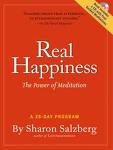
Book Review: Real Happiness

This is a really excellent book and highly recommended. Sharon Salzberg,  one of the leading Buddhist teachers in the United States and co-founder of the Insight Meditation Centre in Barre, Massachusetts, has written here one of the best introductions to meditation as well as an easy-to-grasp introduction to the whole science behind mediation and wellbeing.   Despite the fact that there are quite a few books out there on meditation, it is hard to find one that will help those starting off establish a practice in a way that is clear, well-written and experiential. Well, finally, here is such a book. It is written as a 28-Day Programme – or rather “experiment” –  for readers to try to see if they notice the beneficial effects in their lives. It includes a CD with guided meditations.

The book explains the science behind meditation and happiness, leads the reader through meditation practices for each day and then goes deeper into some of the assumptions which operate in our lives and which may get in the way of a full and compassionate life. We are led to bring these assumptions into awareness so as to loosen their grip on us:  Meditation teaches us to focus and to pay clear attention to our experiences and responses as they arise, and to observe them without judging them. That allows us to detect harmful habits of mind that were previously invisible to us. For example, we may sometimes base our actions on unexamined ideas (“I don’t deserve love, you just can’t reason with people, I’m not capable of dealing with tough situations”) that keep us stuck in unproductive patterns. Once we notice these reflexive responses and how they undermine our ability to pay attention to the present moment, then we can make better, more informed choices. And we can respond to others more compassionately and authentically, in a more creative way. (Page 10f)

This is why we practice meditation – so that we can treat ourselves more compassionately; improve our relationships with friends, family and community, live lives of greater connection and even in the face of challenges, stay in touch with what we really care about so that we can act in ways that are consistent with our values. One of the things I have always found so interesting about the meditation practice is that the arena can seem so small – just you in a room – but the life lessons, the realizations and understandings that arise  from it can be pretty big.