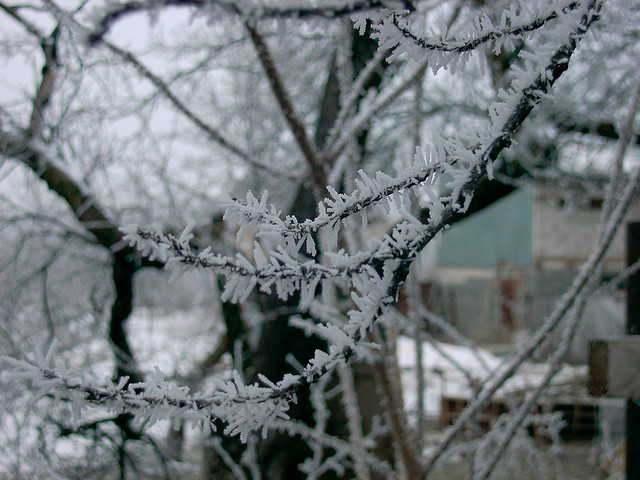
Remember, when your heart is frozen

Pema Chodron also reflects here on snow and ice. She  reminds us to touch in with the springs of warmth which still exist inside us, no matter how cold a place we find ourselves in. When we are in an emotional or psychological midwinter, it is hard to believe that warmth and growth will return. We are tempted to disconnect or detach, to bury ourselves even deeper.  However, we are encouraged here to keep the heart open, by allowing our deepest self stay in connection with the deepest self of another person or thing. In this way we allow ourselves receive warmth from the presence or thought of another person when it is hard to generate warmth in oneself.

Our habits and patterns can feel just as frozen as ice. But when spring comes, the ice melts. The quality of water has never really disappeared, even in the deepest depths of winter. It just changed form. The ice melts, and the essential fluid, living quality of water is there. Our essential good heart and open mind is like that. It is here even if we’re experiencing it as so solid we could land an airplane on it.

When I’m emotionally in midwinter and nothing I do seems to melt my frozen heart and mind, it helps me to remember that no matter how hard the ice, the water hasn’t really gone anywhere. It’s always right here.

So I work on melting that hardness by generating more warmth, more open heart. A good way for any of us to do this is to think of a person toward whom we feel appreciation or love or gratitude. In other words, we connect with the warmth that we already have. If we can’t think of a person, we can think of a pet, or even a plant. Sometimes we have to search a bit. But as Trungpa Rinpoche used to say, “Everybody loves something. Even if it’s just tortillas.” The point is to touch in to the good heart that we already have and nurture it.

Pema Chodron, Shambala Sun, 1998
You are not alone

There are no quick fixes to some of the problems which people can face. Sometimes they can seem even greater by the sense of isolation which they produce.  Fear can close us in on ourselves. However, through remaining open to others and sharing, we realize that there is no law that states that we have to go through problems all alone.

The human story is both personal and universal. Our personal experiences of pain and joy, grief and despair, may be unique to each of us in the forms they take, yet our capacity to feel grief, fear, loneliness, and rage, as well as delight, intimacy, joy, and ease, are our common bonds as human beings. They are the language of the heart that crosses the borders of “I” and “you”. In the midst of despair or pain you may be convinced that no one has ever felt this way before. Yet there is no pain you can experience that has not been experienced before by another in a different time or place. Our emotional world is universal.

Christina Feldman. Compassion: Listening to the Cries of the World

Challenges

A full life is not made up of an uninterrupted succession of pleasant sensations
but really comes from transforming the way we understand and work through the challenges of our existence.

Matthieu Ricard, The Art of Meditation

When fear approaches

When your mind is reeling in confusion, breathe deeply into the centre of your chest.

Connecting to ther core of your being this way extends loving kindness to yourself , even when there is none in sight.

Ezra Bayda

Sunday Quote: On Transitions

The real art of conducting consists in transitions

Gustav Mahler

Passing away

November is traditionally the month for remembering those who have passed away. It is a practice in harmony with this time of year, as the days shorten and the cold of winter approaches. There seems to be a broad antropological basis for this awareness,  as it can be found in the Celtic calendar around this time also.  Keeping an awareness of the impermanence of all things is one of the basic practices in most of the wisdom traditions. One of the reasons that we struggle is that we give things more solidity than we should, including the problems and worries which pass through the mind as thoughts or emotions. I think the most important lesson learned in sitting meditation is that nothing stays the same for long, including the activity of the mind. Learning the truth of that in a real, felt way,  leads to equanimity. Trying to hold onto things that are changing, even good things, pinning our happiness onto things being exactly as they were, leads us to be less present with how things actually are. However, I do not find this practice easy or something I realize in a once-off manner. I would love if enlightenment came that way. However, for me it is a slow-learned knowledge, that I am working with day-to-day. Looking out on the mountains around my house this morning gently teaches me. The trees let go of their leaves, the mountain allows the mist to descend and rise. I too try to let go, not trying to make this or that moment last forever.

In the deepest forms of insight we see that things change so quickly that we can’t hold onto anything, and eventually the mind lets go of clinging.

Letting go brings equanimity. The greater the letting go, the deeper the equanimity. In practice we work to expand the range of life experiences in which we are free.

U Pandita