 When your mind is reeling in confusion, breathe deeply into the centre of your chest.
Connecting to ther core of your being this way extends loving kindness to yourself , even when there is none in sight.
Ezra Bayda
When your mind is reeling in confusion, breathe deeply into the centre of your chest.
Connecting to ther core of your being this way extends loving kindness to yourself , even when there is none in sight.
Ezra Bayda
 We are looking out there all the time, and not at ourselves.
The fact that all the news channels around the world devoted significant airtime to the announcement of the engagement of Prince William and Kate Middleton shows that we have not lost our fascination with fairy tales. Most fairy tales, including those about the noble prince marrying the princess for love, can be seen as symbols of inner experiences and provide insight into human longings. Our choice of stories says a lot about us. When we identify with characters in a story we strengthen those aspects in ourselves. The British press is already looking forward to the wedding as a moment to help the nation look beyond its problems, have its spirits lifted and its wounds healed. It is as if the nation believes in this before-and-after story, looking to a hero to transform their circumstances, from inner poverty to riches. By what, you may ask. By just a wedding, or a wedding that has to carry all the hopes and dreams we all have for love and for life?
We too have a huge capacity to look outside ourselves for something to fulfill us. Most fairytales are quests to find out if there is a place elsewhere that has the something else that we feel we need. The biggest difficulty with this approach is that it divides the world into me and everything outside of me. And this gives rise to the tendency to look outside for something or some change in circumstance to respond to and heal the unease inside of us. We can look for a career, or a inspiring teacher, or a religion or a practice……..something, someone, to whom we can hand over the confusion and lack of direction we find inside ourselves. And often the place we do this most is in the relationships we seek to establish. We look to another person to fulfill us, to soothe the feelings of anxiety we find inside. We frequently place upon the other a wish to make our own lives more meaningful, more rich. We see the other person as the one who will fulfill our lacks, and often expect them to be able to heal our deepest wounds also. And yet relationships do go a long way to touching the core parts of our being, especially when we find someone capable of deep sensitivity and selfless caring. However, drawing close to another inevitably brings our wounded places into sharper focus, and it can be quite a challenge to keep opening up the heart and allowing another person into our deepest self.
In my experience, I find that trying to live my life in a way that leads to my deepest happiness is something that requires constant attention. I do not know if I get the balance right between outer and inner. I know that this fulness of life has something to do with living from my deepest inner capacities for loving and all that means. But often my experience is that I stumble and fall in my attempts at full expression of that capacity. Despite the desire to connect, to relax with others, I frequently hold back and check to see if they can actually hold my heart and my fears. I often pull back. I know that I am not alone in this: in my work I also encounter people who do not know how to show the love that they feel, or request the love that they need, the love whose absence makes a wound of this world and of so many lives.
Real life is more complex than enchanted fairy tales. It demands in some way that we become disenchanted, not necessarily in a bad sense, but in the sense of being freed from the spell which promises some magical saving from outside. We have to discover that there are no perfect people, perfect job, perfect set of circumstances in which to live. We have to be disenchanted in order to realize where true happiness lies. Happiness is an inside job, as a book reminds us, based on us looking inside rather than looking out., without however using that as a way of running from our need for love. The original root of the word nobility comes from the greek word gnosis, meaning knowledge or wisdom. Our true nobility does not come from some outside prince, but from knowing how to live in harmony with an open heart.
The way to true happiness isn’t through trying to make everything right and pleasant on the external dimension, but to develop the right understanding, the right attitude towards ourselves.
Ajahn Sumedho
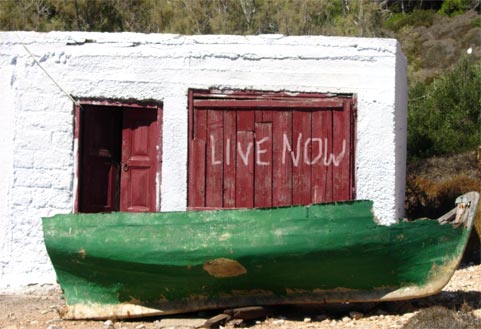 The seed of mindfulness is in each one of us, but we usually forget to water it.
We think that happiness is only possible in the future – when we get a house, a car, a Ph.D. We struggle in our mind and body, and we don’t touch the peace and joy that are available right now – the blue sky, the green leaves, the eyes of our beloved.
Thich Nhat Hahn
 The more Jung worked with people, the more he came to believe that the key problems facing most who came to him for therapy were not psychological illnesses but whether they were in touch with the deepest parts of their being. This is probably even more true today, as more and more of peoples’ material needs are fulfilled and yet more and more people express unhappiness with their lives. In Jung’s view, most suffering today stems from the fact that we have lost a connection with the mythic dimension of life. Our capacity to be in a relationship with something more profound than what is seen is what makes for real, ongoing growth. We have a depth dimension and to become fully human requires that we keep an openness to this in our work and in our relationships. When we find ourselves in situations where this aspect is not reflected we feel impoverished and unfulfilled, often without knowing why. Life can seem too short to be spending our time on activities that are too narrow, or too trivial to nurture our roots. This is true for relationships also; they are most alive when they include space for something beyond the self. Relationships which are truly fulfilling have a luminous quality and as such they make us feel fully alive.
The decisive question for man is: Is he related to something infinite or not? That is the telling question of his life…. Only if we knew that the thing which truly matters is the infinite can we avoid fixing our interest upon futilities, and upon all kinds of goals which are not of real importance. The more a man lays stress on false possessions, and the less sensitivity he has for what is essential, the less satisfying is his life. He feels limited because he has limited aims, and the result is envy and jealousy. If we understand and feel that here in this life we already have a link with the infinite, desires and attitudes change. In the final analysis, we count for something only because of the essential we embody, and if we do not embody that, life is wasted. In our relationships to other men, too, the crucial question is whether an element of boundlessness is expressed in the relationship.
Jung, Memories, Dreams, Reflections.
 [Some] people feel that their real identity is working on themselves, and some work on themselves with such harshness. Like a demented gardener who won’t let the soil settle for anything to grow, they keep raking, tearing away the nurturing clay from their own heart, then they’re surprised that they feel so empty and vacant. Self-compassion is paramount. When you are compassionate with yourself, you trust in your soul, which you let guide your life.
Your soul knows the geography of your destiny. Your soul alone has the map of your future, therefore you can trust this indirect, oblique side of yourself.
If you do, it will take you where you need to go, but more important it will teach you
a kindness of rhythm in your journey.
John O’Donoghue
 Only from the heart
Can you touch the sky
Rumi

