Another Saturday Autumn poem

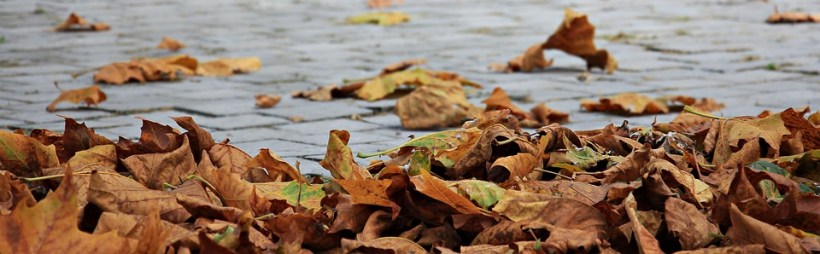
The leaves are falling, falling as from far, 
from wilting in the heavens’ distant gardens: 
They’re falling to deny the summer’s mirth. 

And in the nights the heavy Earth 
falls into solitude from star to star. 

We all are falling. See my hand: it is falling. 
And look at others: It’s in all their calling. 

And yet there’s One, who’s holding all this falling,  
with endless tenderness, in His upturned hands.

Rilke,  Autumn


Not holding on

Things are continually changing and change in ways that we do not expect. The human tendency is to fix ourselves and each moment into something expected and define it by how it has to be, rather than how it is evolving. The great adventure is to live each moment fully, as a gift which has arrived without us expecting it.

A person who has clarified their real state sees only

each thing,

each thing,

each thing,

and lets go of understanding an underlying nature for each thing.

Dogen, Uji

The preciousness of our lives.


To love life means to love its vulnerability, asking for care, attention, guidance, and support. Life and death are connected by vulnerability. The newborn child and the dying elder both remind us of the preciousness of our lives. Let’s not forget the preciousness and vulnerability of life.

Henri Nouwen

A story about fear

Today is the feastday of St Francis of Assisi (1182 – 1226), a town I visited just a month ago, so a story from his life about working with difficult emotions.

We are told that there was a wolf terrorizing the town of Gubbio, attacking and killing several people. The townsfolk locked their doors, afraid to leave their homes. Francis heard about this and went to Gubbio . When he came upon the wolf, it lunged at him, about to bite. Francis stood calmly and greeted the wolf, calling him “Brother Wolf” and told it not to harm him. The wolf stopped and lay down at his feet. Then Francis and the wolf made a deal: the town would provide food for the wolf for the rest of its life, in exchange for the wolf’s ceasing to attack. We are told the wolf placed its right paw into Francis’ hand, and lived in peace with the people of Gubbio for the rest of its life.

These legends speak to the different parts of our lives. We all have many fears that push us to close our doors and withdraw. And we have emotions that arise within us and scare us, like anger, jealousy and the stuff that relationships bring up in our lives. Our normal first response is to be disturbed or frightened by these strong emotions and we move to push them away. However, in themselves, these are not the problem, but it is our mind’s relationship to them that is. So what we learn from Francis is to approach the things that frighten us – the frightening wolves within us –  by looking at them directly, as if they are part of the family – “brother wolf”, “brother anger” “brother fear” – and welcome them to the table. This is the practice: to first experience the anxiety as an embodied feeling, with no shoulds or shouldn’ts about it. Our fears do not need to become a moment for showing ourselves further violence.

We can let the circumstances of our lives harden us so that we become  increasingly resentful and afraid, or we can let them soften us and make us kinder and more open to what scares us. .
We always have this choice
Pema Chödrön, The Places that Scare You

Life bears fruit

Sometimes, things planted many years only make sense and bear fruit much later. Autumn teaches the virtue of waiting:

Ripeness is
what falls away with ease.
Not only the heavy apple,
the pear,
but also the dried brown strands
of autumn iris from their core.

To let your body
love this world
that gave itself to your care
in all of its ripeness,
with ease,
and will take itself from you
in equal ripeness and ease,
is also harvest.

And however sharply
you are tested – 
this sorrow, that great love  –
it too will leave on that clean knife.

Jane Hirshfield, Ripeness

Time to take your turn

Giving up some conditioned behaviour patterns is also good:

You didn’t come onto this earth as a perfectionist or control freak. You weren’t born a person of cringe and contraction. You were born as energy, as life, made of the same stuff as stars, blossoms, breezes. You learned contraction to survive, but that was then. You have paid through the nose — paid but good. It is now your turn to reap.

I never used to take my turn. I always gave my turn away. I helped others have a great turn. I must have had a clipboard by the time I was six, because by then I had a whole caseload of people to keep track of. After they had all gotten a turn, then maybe I could go, if there was time and it didn’t bother anyone.

Now I take my turn, as a radical act.

Anne Lamott, Stitches