The shortest, darkest day of the year

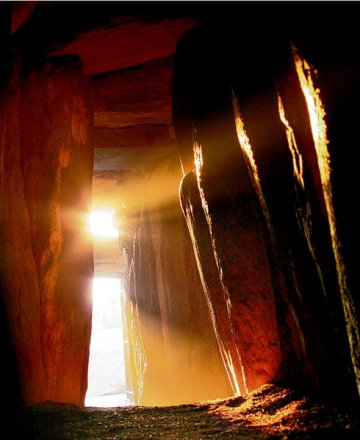
Today is the Winter Solstice, the shortest day of the year in the Northern Hemisphere. It is a day that has always held significance for humans, as can be seen by the major Celtic and Christian feasts that are celebrated around this time, and whose symbols are still used today, even if their true meaning is long-lost. The Ancient Celts seemed to follow closely the passage of the sun and linked it to the sacredness of certain days. On this day,  in the burial chamber of Newgrange in Ireland  – built some 500 years before the pyramids of Giza and more than 1,000 years before Stonehenge –   they ensured that the rising sun penetrated right into the place where their loved ones were buried. In this way they marked the turning point of the year, even when times were difficult, where the days gradually grow longer and move the countryside back towards the warmth and rebirth of spring.

We can learn from the fact that there have always been rituals of light in the darkness, cycles of growth after periods of rest,  hope returning when all seemed lost. There is a deep wisdom in understanding these ways of nature deep in our own bones. No matter how dark a place we find ourselves in from time to time,  or how deeply we feel buried,  we come to know how light can still enter and illuminate. If we come to see that all circumstances change and pass away,  we get in touch with a deeper, more ancient wisdom, no matter how frozen we feel at any particular moment.  This wisdom holds onto the fact that we are complete in ourselves, no matter what our passing thoughts  tell us, or if we cannot feel it at that time.

Because our moods change constantly, we might not understand that cheerfulness is in fact an inherent quality of mind. Within the meditative tradition, cheerfulness is considered to be the natural, harmonious and wholesome expression of our truest self. This kind of cheerfulness helps the mind to move forward, beyond the distortion and torment of emotions. Cheerfulness comes naturally with meditation. It is a quality of space created within the mind. When there’s space in the mind, the mind relaxes, and we feel a simple sense of delight. We experience the possibility of living a life in which we aren’t continuously bombarded by emotions, discursiveness and concepts about the nature of things.

In dark times  when we feel even more burdened and insecure, we should be contemplating our true nature more than ever. It can cheer us up on any day. Despite all the ups and downs of our life, we are fundamentally awake individuals who have a natural ability to become compassionate and wise. Our nature is to be cheerful. This cheerfulness is deeper than temporary conditions. The day does not have to be sunny for us to be cheerful. We are free of having to depend on something else to make us happy. We can bask freely in the natural radiance of our mind.  This is the equanimity of true cheerfulness—nothing more, nothing less.

Sakyong Mipham Rinpoche, A Simple Sense of Delight

The monastery of your daily life

Many people fail to distinguish between their true nature and their personality traits, particularly their less desirable traits. The fact is you are not the worst characteristics of your personality. It is the nature of the untrained mind to want what it perceives as advantageous and to fear or hate what seems painful. Discovering how your heart and mind can work together to use these feelings allows you to move beyond them. [But..]It is not an easy task. You may feel overwhelmed by the circumstances of your present life or bound by past traumatic events. Again, this is a failure in perception. They are just mind-states which can be known. They can be seen as impermanent and not belonging to you and, therefore, they do not ultimately define your true nature. A spiritual practice can provide you with the knowledge and discipline to investigate and work with these conditions.

You can do this investigation within the parameters of your present life. There is no need to wait until you can go to a monastery or get your life more together. The intensity of your desires and fears can be a source of energy that propels you to look more deeply for that which really matters. Life delivers you a series of challenges in the form of small and large good fortune, as well as petty and great misfortune. In the struggle to learn how to respond to the resulting joy, pain, and confusion, you are repeatedly challenged to seek and to act from your essence.

Phillip Moffit, Realizing Your True Nature

Where we focus the mind


Sometimes a lot of our thoughts and feelings can be connected with what we do not have, or by what has been done to us. The mind seems to have a great desire to hold on to things or events,  and this is the same no matter if the experience is positive or negative. We can see this when we find ourselves remembering negative words spoken years ago, or encounter people holding decades-old grudges. If we focus on what we do not have, we frequently  compare our condition to other more “desirable” conditions.  And when we look at our life in terms of what did not work out for us, we can feel a deep sense of lack and go on to cultivate a profound sense of dissatisfaction. However, if we are spending ongoing time noticing what we have lost or do not have, rather than what we actually have, it is clear that, paradoxically, it is not truly lost, but is still present and recurring in a transformed form, to remind us or even haunt us with its presence. Meditation is essentially a practice of de-grasping- of working with a mind that likes to push away or hold onto reality – by patiently sitting with conditions as they actually are. 

Losing too is still ours;
and even forgetting still has a shape in the kingdom of transformation.

When something’s let go of, it circles;
and though we are rarely the center of the circle,
it draws around us its unbroken, marvelous curve.

Rilke, For Hans Carossa

A basic sense of groundlessness

Some reflections on the basic human condition – similar to the idea of groundlessness in Pema Chodron this morning –  this time in a commentary on a phrase from Karl Rahner, one of the greatest Catholic theologians of the last century. Learning to sit with this is the basic work of meditation. Running away from it, or taking it to mean that something is wrong with us is at the root of most of our problems.

In the torment of the insufficiency of everything attainable,we eventually learn that here, in this life, all symphonies remain unfinished.  Karl Rahner

What does it mean to be tormented by “insufficiency of everything attainable?” How are we tortured by what we cannot have? We all experience this daily. In fact, for all but a few privileged, peaceful times, this torment is like an undertow to everything we experience; beauty makes us restless when it should bring us peace, the love we experience with our spouse does not fulfill our longings, the relationships we have within our families seem too petty and too domestic to be fulfilling, our job is hopelessly inadequate to the dreams we have for ourselves, the place we live in seems boring and lifeless in comparison to other places, and we are too restless to sit peacefully at our own tables, sleep peacefully in our own beds, and be at ease within our own skins. We are tormented by the insufficiency of everything attainable when our lives are too small for us and we live in them in such a way that we are always waiting, waiting for something or somebody to come along and change things so that our lives , as we imagine them, might begin. ….. To be tormented with restlessness is to be human.

Ron Rolheiser

Thoughts as arising and passing away

All conditions are impermanent. By the word “condition”, we mean a formation of the mind, such as a thought or opinion. Men and women are conditions. Similarly, Jews and Gentiles, Buddhists and Christians, Asians and Europeans, Africans, the working class, the middle class, the upper class-all these are only formations that go through the mind. They aren’t absolutes. They are merely conventions that are useful for communication. We must use these conventions, but we must also realize that they are only conventions – not absolutes. In this way, our minds are no longer fixed in our views or opinions. Views and opinions are seen simply as conditions that arise and cease in the mind, because that’s what they really are. All conditions are impermanent; they arise and cease.

Ajahn Sumedho, The Mind and the Way

Not dwelling in thoughts

When we learn to move beyond mistaken concepts and see clearly, we no longer solidify reality. We see waves coming and going, arising and passing. We see that life, composed of this mind and body, is in a state of continual, constant transformation and flux. There is always the possibility of radical change. Every moment – not just poetically or figuratively, but literally – every moment we are dying and being reborn, we and all of life.

Sharon Salzberg, Loving-Kindness – The Revolutionary Art of Happiness