Accepting our uncertainty

Two writers, from different traditions, speaking of our most important journey – coming to terms with the basic restlessness and unease at the core of our being – and being able to rest there.

To live an inner life we must first find the courage to enter into the desert of our loneliness and to change it by gentle and persistent efforts into a garden of solitude. The movement from loneliness to solitude, however, is the beginning of any spiritual life because it is the movement from the restless senses to the restful spirit,  from the outward-reaching cravings to the inward-reaching search, from the fearful clinging to fearless play.

Henri Nouwen, Reaching out

As I look out of my eyes at the world, I see that a lot of us are just running around in circles pretending that there’s ground where there actually isn’t any ground. And that somehow, if we could learn to not be afraid of groundlessness, not be afraid of insecurity and uncertainty, it would be calling on an inner strength that would allow us to be open and free and loving and compassionate in any situation. But as long as we keep trying to scramble to get ground under our feet and avoid this uneasy feeling of groundlessness and insecurity and uncertainty and ambiguity and paradox, any of that, then the wars will continue.  It’s like the matrix of creative potential. The matrix of the spiritual life. It’s like if we could rest there, which I suppose would be the description of enlightenment or the mystic, you know. Rest in that place, and is completely happy. That’s why, you know, they always say, with someone who’s very, very awake… the walls could start crumbling in and they wouldn’t like freak out or something. Because they’re kind of ready for anything to happen.

Pema Chodron, Interview with Bill Moyers, Faith and Reason, 2006.
Midway

Every man has to learn the points of compass again as often as he awakes, whether from sleep or any abstraction. Not till we are lost, in other words not till we have lost the world, do we begin to find ourselves, and realize where we are and the infinite extent of our relations. Thoreau, Walden

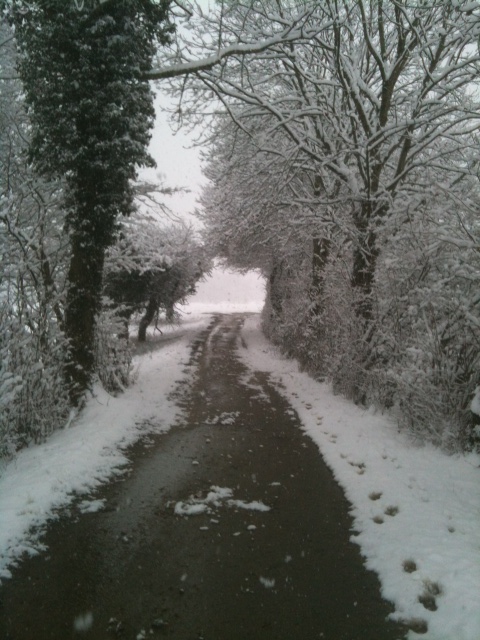
In the old Celtic and Gaelic calendar,  today,  February 1st, is the start of Spring. It was the Celtic feast of Imbolc,  which centred around the lighting of fires, celebrated because it is halfway between the winter and the spring solstices.  Similarly tomorrow,  the feast of Candlemas,   traditionally involved a procession of candles and the blessing of candles for use in the home. It would seem that there was a need for people to remind themselves of warmth and light around this midway point – when the cold weather can return with a vengeance as it has this year –   as encouragement that  new growth will soon be here. It is the same for us today, for we all can find ourselves at midway points from time to time, not sure where we are arriving,  but too far away from where we started from to recognize it and go back.  We have no overall map for this journey, we can lose our sense of direction and easily get lost. It can feel,  as Dante says, as if we are “midway in this way of life we’re bound upon …. in a dark wood, where the right road was wholly lost and gone”.

It is no surprise that journey narratives appear so frequently in all wisdom traditions and mythologies. We are never really in just one place, even when things are quite stable, but always somewhat in-between. Still,  whenever we’re moving into anything new we often feel a hesitancy within and tension or unease  arises because we prefer to stay as we were, where we felt comfortable. And the brain tends to  interpret our underlying unease as anxiety and therefore as negative, leading us to be afraid because something new is demanded. And this can feel like darkness and being lost. However, what these ancient feasts remind us is that this darkness is often the gateway from one place to another, and a natural part of a cycle that leads to new depths. Trust is needed as is mindfulness, which allows us to hold the feeling of unease in awareness, without reactivity, and without the need to run away or fix it.  We can thus tolerate the experience of being lost  without believing the story of being lost. This holding of awareness is like holding a candle in the darkness – it allows us stay in the darkness without fear until it teaches us what we need to learn.

Keeping our attention firm, no matter what experiences we have

Sometimes you may feel that you have amazing, tremendous meditation, and at other times you may feel that you have no meditation at all. This characterizes experience, which fluctuates a great deal. Realization, which is distinct from experience, does not change, but experiences can fluctuate a great deal or alternate between good and bad. There will still be times when you will have what you regard as good experiences and, in contrast, what you regard as bad experiences. When that occurs, just keep on looking. Don’t get distracted or sidetracked by the experience. Whatever meditation experience arises, you should recognize that it is transitory. As is said, “meditation experience is like mist, it will surely vanish.”

Khenchen Thrangu Rinpoche

Not waiting for some future perfection

Maybe we think that someday we will have gained perfect maturity from the lessons of our lives. Subconsciously,  we are lured by the expectation that we will reach a stage where we don’t have to fix anything ever again. One day we will reach “happily ever after” We are convinced of the notion of “resolution”. It’s as if everything that we’ve experienced up until now, our whole lives up to this moment, was a dress rehearsal. We believe that our grand performance is yet to come, so we do not live for today. For most people this endless managing, rearranging, upgrading is the definition of “living”. In reality we are waiting for our life to start. When prodded, most of us admit that we are working toward some future moment of perfection – retirement in a log cabin in Kennebunkport or in a hut in Costa Rica. Or maybe we dream of living out our later years in the idealized forest landscape…serenly meditating …..overlooking a waterfall and koi pond.

Dzongsar Jamyang Khyentse, What makes you not a Buddhist.

Freedom comes from accepting limitations

When the stories of our life no longer bind us, we discover within them something greater. We discover that within the very limitations of form, of our maleness and femaleness, of our parenthood and our childhood, of gravity on the earth and the changing of the seasons, is the freedom and harmony we have sought for so long. Our individual life is an expression of the whole mystery, and in it we can rest in the center of the movement, the center of all worlds.

Jack Kornfield, A Path with Heart

All seasons are needed for growth

Our inner life is complex and multifaceted, like a vast and varied landscape requiring diverse experiences to cultivate it. At times we are challenged to walk and run, at other times to stay and sit. Disappointment is as crucial to our inner life as reliability, the same way that cold is as necessary to the life of a lilac bush as is the sun….Beings like us could never stay in bloom in a tropical world of uninterrupted satisfactions. We need all seasons for a fully realized human experience. Only in a world with shadows can our inner life flourish. The challenge is a ruthless fealty to the seasons of life and change. This includes losses, abandonments and endings chosen or imposed…Disappointment may also be a grace, “the fastest chariot to enlightenment” as the Tibetan saying goes.

David Richo, How to be an Adult in Relationships.