
The hardest thing I’ve learned,
and still struggle with,
is that I don’t have to be finished in order to be whole.
Mark Nepo, The Book of Awakening
photo of Michelangelo, Rebellious Slave, by Hay Kranen
The hardest thing I’ve learned,
and still struggle with,
is that I don’t have to be finished in order to be whole.
Mark Nepo, The Book of Awakening
photo of Michelangelo, Rebellious Slave, by Hay Kranen
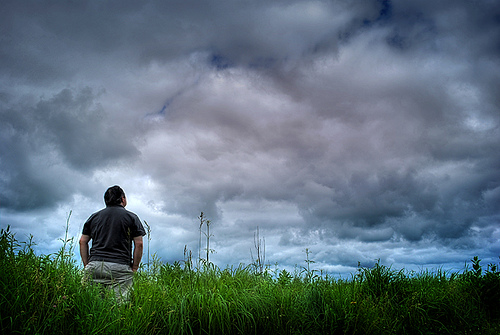
A student came to Zen Master Bankei and said: “Master, I have an ungovernable temper – how can I cure it?” “Show me this temper,” said Bankei, “it sounds fascinating.” “I haven’t got it right now,” said the student, “so I can’t show it to you.” “Well then” said Bankei, “bring it to me when you have it.” “But I can’t bring it just when I happen to have it,” protested the student. “It arises unexpectedly, and I would surely lose it before I got it to you.” “In that case,” said Bankei, “it cannot be part of your true nature. If it were, you could show it to me at any time. When you were born you did not have it, and your parents did not give it to you — so it must come into you from the outside.”
While anger is happening, if you suddenly become conscious it drops. Try it. Just in the middle, when you are feeling very hot and would like to commit murder, suddenly become aware, and you will feel something has changed: a gear inside – you can feel the click. Something has changed, now it is no more the same thing. Your inner being has relaxed. It may take time for your outer layer to relax, but the inner being has already relaxed. The cooperation is broken; now you are not identified.
Osho, And the Flowers Showered
Bankei, 1622 – 1693, was a hugely influential Japanese Zen Master, who emphasized our Original Mind – the natural, unchanging, goodness within – which he felt we simply had to tune in to, and not identify with the different moods which pass through each day.

Beyond this shore and the farther shore,
Beyond the beyond,
Where there is no beginning, No end.
Without fear, go.
The Buddha
We live with many options. If we get bored with looking at a painting, we read something; when that becomes boring, we go for a walk, perhaps visit a friend and go out for dinner together, then watch a movie. The pattern is that each new arising, or “birth” if you like, is experienced as unfulfilling. In this process of ongoing need, we keep moving from this to that without ever getting to the root of the process. Another aspect of this need is the need to fix things, or to fix ourselves — to make conflict or pain go away. By this I mean an instinctive response rather than a measured approach of understanding what is possible to fix and what dukkha (suffering) has to be accommodated right now.
Then there’s the need to know, to have it all figured out. That gets us moving too. This continued movement is an unenlightened being’s response to dukkha. That movement is what is meant by … “the wandering on” – within this life, we can see all these “births,” — the same habit taking different forms. And each new birth is unsatisfactory too, because sooner or later we meet with another obstacle, another disappointment, another option in the ongoing merry-go-round. High-option cultures just give you a few more spins on the wheel.
Ajahn Sucitto, Turning the Wheel of Truth


If you don’t look at things through your concepts, you’ll never be bored.
Every single thing is unique.
Every sparrow is unlike every other sparrow despite the similarities.
It’s a great help to have similarities, so we can abstract, so that we can have a concept.
It’s a great help, from the point of view of communication, education, science.
But it’s also very misleading and a great hindrance to seeing this concrete individual.
If all you experience is your concept, you’re not experiencing reality, because reality is concrete.
The concept is a help, to lead you to reality, but when you get there,
you’ve got to intuit or experience it directly.
.
Anthony de Mello. sj.
photo david friel

Last week I visited the remains of the ancient Irish Celtic monastery at Clonmacnoise, founded in 546 by Saint Ciaran and which had a significant impact upon European learning in the following Centuries. All that visibly remains now are the ruins of some churches and two beautiful High Crosses. While there I remembered a poem by Seamus Heaney which refers to a marvellous story from 748 AD when a ship floated by in the sky. (The heavenly realms were frequently imagined as an ocean in those times, and were seen to be as real as life on earth). The monks were at prayers, they looked up, and watched the ship go by in the sky. Then, out of the ship, came an anchor, which fell and hooked itself to the altar.… the ship finds itself stuck, it cannot go forward. A sailor climbs down the rope, to try to un-hook the anchor, but began to “drown” in our air. The monks realized this, and hurried to free the anchor, and they helped the man back up to the ship.
Heaney’s poem sees in this story the mingling between worlds. His beautiful words – “out of the marvellous” – strikes us, as it shows that, for the sailor from “up there”, the world “down here” is new and wondrous. In all of Heaney’s later poems we see everyday miracles and otherworldly wisdom in the ordinary of every day. Our mundane world of meetings and conversations is full of depth, if we pay attention. We are reminded: there are enough marvels in this world, if we have the eyes of wonder to see them.
The annals say: when the monks of Clonmacnoise
Were all at prayers inside the oratory
A ship appeared above them in the air.
The anchor dragged along behind so deep
It hooked itself into the altar rails
And then, as the big hull rocked to a standstill,
A crewman shinned and grappled down the rope
And struggled to release it. But in vain.
‘This man can’t bear our life here and will drown,’
The abbot said, ‘unless we help him.’ So
They did, the freed ship sailed, and the man climbed back
Out of the marvellous as he had known it.
– Lightenings viii, 1991
photo from the blog richie abroad

