Focus on what you can do

File:Brown County Indiana - Handcraft (2957376914).jpg

I first heard the phrase “just start over”  from  Sharon Salzburg….who told us about her own struggle with learning to meditate – how she would become lost, distracted, and discouraged and would constantly second-guess herself and her teachers. Gradually she learned to pay no attention to the mental and emotional chatter and to just start over by meditating on her breath as she had been instructed. “Just start over” became her mantra, which she now teaches to her students.

As you know if you’ve ever tried to meditate, the mind is constantly being pulled away from its object of concentration by bodily sensations and mental activity, causing you to lose awareness of the present moment. In this same way, when strong feelings arise during your daily life, you get swept up in the story they create. You lose the awareness that enables you respond skillfully to events and that gives you peace of mind in the face of difficulty….. You have the mistaken notion that you must know why you have a problem and must get rid of it before you can act in a more self-empowering manner. “Starting-over” practice takes a different approach. It switches your focus away from dwelling on those characteristics that limit you and redirects it toward recognizing your strengths from which you can realize your potential…. In so doing, you free yourself from your judging mind that thinks it can control results and creates the grandiose expectation that you can do more than you can do in the present moment. You become a more effective person by simply learning to use your time and energy to do what you can do right now.

Phillip Moffitt

photo serge melkei

Doing less today

File:Items on a Wikipedian's office desk - 20060403.jpg

We do less by taking the time to rest mentally and physically in between or outside of our usual activities, perhaps instituting a regular practice of meditation, retreats, breaks, and reflection.

 We do less by pausing in the midst of activities: mindfulness practice (such as coming in touch with our breath in between reading or sending emails) and walking meditation are two examples.

 We do less by identifying and reducing unnecessary activities. In this case, “unnecessary” means those things that are not in alignment with what we want to accomplish.

Marc Lesser, Accomplishing More by Doing Less

photo shinealight

Concepts of how I should be

looking out  window

Self-love involves a yes to myself in whatever I am going through, instead of holding on to some concept of what or how I should be. Any idea I have about who I am or who I should be is never accurate, for it always falls short of the living presence that I am, as this unfolds freshly in each new moment. Who I am is not a fixed entity but a dynamic stream of experiencing that is alive in every moment – when I let myself happen.

John Welwood

Living too many lives

OLYMPUS DIGITAL CAMERA

“Ain’t you thinkin’ what’s it gonna be like when we get there? Ain’t you scared it won’t be nice like we thought?”

“No”, she said quickly. “No, I ain’t. You can’t do that. I can’t do that. It’s too much – livin’ too many lives.

Up ahead they’s a thousan’ lives we might live, but when it comes, it’ll on’y be one”.

John Steinbeck, The Grapes of Wrath

Take a step back

File:Flickr - Nicholas T - Floored.jpg

The engine that makes this go is taking a step back and trusting the body, trusting the breath, trusting the heart. We’re living our lives madly trying to hold onto everything, and it looks like it might work for awhile but in the end it always fails, and it never was working, and the way to be happy, the way to be loving, the way to be free is to really be willing to let go of everything on every occasion or at least to make that effort. So the practice really works with sitting down, returning awareness to the body, returning awareness to the breath. It usually involves sitting up straight and opening up the body and lifting the body so that the breath can be unrestrained. And then returning the mind to the present moment of being alive, which is anchored in the breath, in the body. Then, of course, other things happen. You have thoughts, you have feelings. You might have a pain … memories, reflections. All these things arise, but instead of applying yourself to them and getting entangled in them, you just bear witness to it, let it go, come back to the breathing and the body, and what happens is you release a whole lot of stuff in yourself.

Normal Fischer

photo nicholas a. tonelli

An inner voice

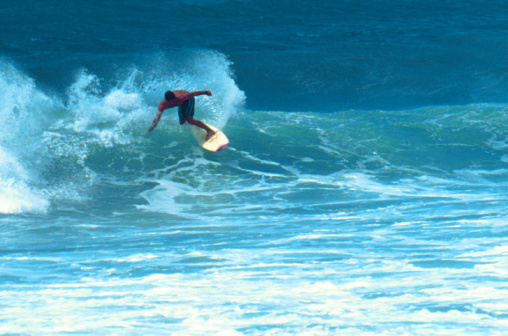
surfing

Don’t ask what the world needs.

Ask what makes you come alive, and go do it.

Because what the world needs is people who have come alive.

Howard Thurman, African-American author and Civil Rights leader, in conversation with Gil Bailie