Learning to surf

As human beings we have a tendency to scramble for certainty whenever we realize that everything around us is in flux. In difficult times the stress of trying to find solid ground – something predictable and safe to stand on – seems to intensify. But in truth the very nature of our existence is forever in flux. Everything keeps changing, whether we are aware of it or not. So this is where we find ourselves, right in the middle of a dilemma. And it leaves us with some provocative questions: How can we live wholeheartedly in the face of impermanence…? What is it like to realize that we can never completely and finally get it all together? Is it possible to increase our tolerance for instability and change?

Pema Chodron, Living Beautifully with Uncertainty and Change

Put very simply

I define mindfulness as the practice of being fully present and alive, body and mind united. Mindfulness is the energy that helps us to know what is going on in the present moment. I drink water and I know that I am drinking the water. Drinking the water is what is happening.
Mindfulness brings concentration. When we drink water mindfully, we concentrate on drinking. If we are concentrated, life is deep, and we have more joy and stability. We can drive mindfully, we can cut carrots mindfully, we can shower mindfully. When we do things this way, concentration grows. When concentration grows, we gain insight into our lives. The principle of the practice is simple: to bring our minds back to our bodies, to produce our true presence, and to become fully alive.

Thich Nhat Hahn, The Moment is Perfect

Getting comfortable with uncertainty


Living is a form of not being sure, not knowing what next or how. The moment you know how, you begin to die a little. The artist never entirely knows, We guess. We may be wrong, but we take leap after leap in the dark.

Agnes George de Mille, American dancer and Choreographer.

Finding a deeper dimension to life

To begin with, one needs to cultivate a practical conviction of the primacy of being over doing.  Our society values what one can do and this becomes the gauge of who one is.  The contemplative dimension of life is an insight into the gift of being human and inspires a profound acceptance and gratitude for that gift. Our culture is at a critical point because so many structures that supported human and religious values have been trampled upon and are disappearing. To find a way to discover Mystery in the midst of secular occupations and situations is essential, because for most people today it is the only milieu that they know.  Humanity as a whole needs a breakthrough into the contemplative dimension of life.  The contemplative dimension of life is the heart of the world.  If one goes to one’s own heart, one will find oneself in the heart of everyone else, and everyone else, as well as oneself, in the heart of ultimate Mystery.

Fr. Thomas Keating

Being curious and interested

Whatever the scenery the practice is the same. Our practice is to face everything life is, and everything life isn’t. Everything we think and feel and everything we don’t. Wall gazing is a very thorough practice in facing the fleetingness of things, and not getting trapped in momentary apparitions. All apparitions, as it turns out, are momenttary.When your eyes are open and you are intimately engaged with what appears in front  of  you, it’s hard to stay bored because nothing stays one way for long.

Karen Maezen Miller, Booooring….

Semi-conscious living

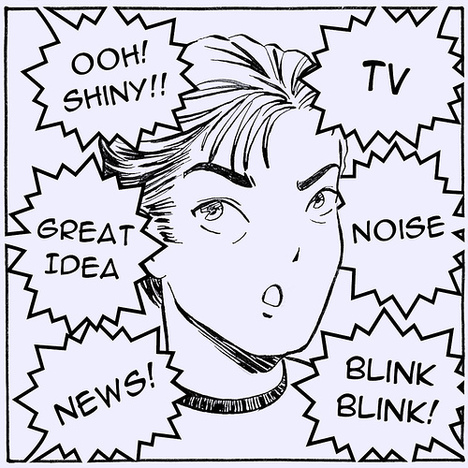
Considering that Merton died in 1968, these words have even more weight in the sense that the level of semi-attention and noise back then was tiny in comparison to what we experience now.

Now let us frankly face the fact that our culture is one which is geared in many ways to help us evade any need to face this inner, silent self. We live in a state of constant semiattention to the sound of voices, music, traffic, or the generalized noise of what goes on around us all the time. This keeps us immersed in a flood of racket and words, a diffuse medium in which our consciousness is half-diluted: we are not quite ‘thinking,’ not entirely responding, but we are more or less there. We are not fully present and not entirely absent; not fully withdrawn, yet not completely available. It cannot be said that we are really participating in anything and we may, in fact, be half conscious of our alienation and resentment. Yet we derive a certain comfort from the vague sense that we are ‘part of’ something – although we are not quite able to define what that something is – and probably wouldn’t want to define it even if we could. We just float along in the general noise. Resigned and indifferent, we share semiconsciously in the mindless mind of Muzak and radio commercials which passes for ‘reality.’

Thomas Merton,  Essential Writings