
Finding space in our inner chatter

Silence, a stilling of not only the voices outside but the inner voices, the roof brain chatter. Now, without the babble or words – inner and outer – I watch my mind, notice when a thought arises. I turn my attention inward, asking, “Who is thinking this thought?” As the mind turns to look, the thinker seems to disappear. But a focus comes from asking, a clearing, a deepening. No “me,” but a presence. Awareness.

When I first worked in a restaurant, I used to daydream of a mute helper, someone who had no interest whatsoever in speaking, She…wouldn’t tell about her plans for vacation, the fights with her mother, the ins and outs of her most recent relationship. In my daydream of a mute helper, I was envisioning a future version of myself, of course. My imagination was sending directions, subtle hints as to how to proceed. How to glimpse the sky, how to open into vastness. The odd thing is that in addition to this sense of spaciousness, I’m starting to feel close to people, to understand and sympathize with them on a new level, to participate in their lives in unexpected ways, to notice those around me as something more than irritants, as subjects rather than objects.

Kimberly Snow, In Buddha’s Kitchen

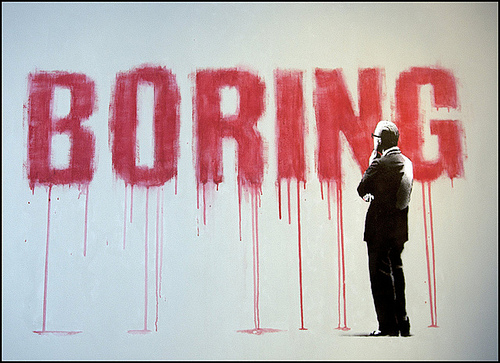
When boring becomes interesting

Like anger and other emotions, boredom most often fools us into diverting our energies entirely to an external situation. This it keeps us from liberating ourselves by seeing our relationship to the emotion itself. We make a big mistake about boredom when we think that it comes because of a particular person or situation or activity. So much of our restlessness in meditation practice and in our daily lives comes from this fundamental misunderstanding. How often do we try to find something new to recapture our interest, something more stimulating or more exciting? 

To realize that boredom does not come from the object of our attention but from the quality of our attention is truly a transforming insight. Fritz Perls, one of those who brought Gestalt therapy to America, said, “Boredom is lack of attention”. Understanding this reality brings profound changes in our lives. Then boredom becomes a tremendously useful feedback for us. It is telling us not that the situation or person or meditation  is somehow lacking, but rather that our attention at that time is half-hearted.

Joseph Goldstein, Insight Mediation

Creating places of no noise

Since noise is increasing in all directions, the psychology of silence has taken on a special meaning. We are already so adapted to an abundance of screeching sound that we are surprised when stillness suddenly envelops us. Not that this happens very often. We begin to see that the whole question of our relation to the world, both positive and negative, centers in something like silence. So our service to the world might be simply to keep a place where there is no noise, where people can be silent together.

Thomas Merton, The Springs of Contemplation

Something to remember today


Life is not a problem to be solved,

but a Mystery to be lived.

Gabriel Marcel

Trusting in the solitude within

Silence is one of the major thresholds in the world. . . . Meister Eckhart said that there is nothing in the world that resembles God so much as silence. Silence is a great friend of the soul; it unveils the riches of solitude. It is very difficult to reach that quality of inner silence. You must make a space for it so that it may begin to work for you. In a certain sense, you do not need the whole armory and vocabulary of therapies, psychologies, or spiritual programs. If you have a trust in and an expectation of your own solitude, everything that you need to know will be revealed to you. These are some wonderful lines from the French poet Rene Char: “Intensity is silent, its image is not. I love everything that dazzles me and then accentuates the darkness within me.” Here is an image of silence as the force that discloses hidden depth.

John O Donohue, Anam Chara

A very good practice

The present moment is where life can be found, and if you don’t arrive there you miss your appointment with life. You don’t have to run anymore. Breathing in, we say, “I have arrived.” Breathing out, we say, “I am home.” This is a very strong practice, a very deep practice.

Thich Nhat Hanh,  The Present Moment