Support in times of difficulty

This week celebrates the feast of Saint Anthony, the founder of monastic practice in the Western Church. He went out into the desert at a young age to remove himself from some of the normal distractions in order to pay attention to what is really necessary. Most wisdom traditions have some reference to desert places, or retreats,  as a time for deepening or as a symbol for certain periods in our lives. We can have periods when we enter our own deserts and are forced to re-evaluate what is important and see what is really needed.

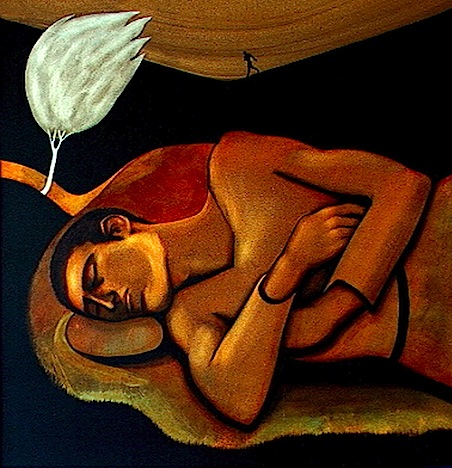
Deserts can be lonely and bleak places, however. So one of my favourite desert stories is that of Elijah who, in a period of danger, ran away into the barren desert. Elijah was a strong, forceful character, but after a setback in his ministry, he lost heart and became frightened. He  had no more motivation and lay down in the shade of a tree, wishing he would die. However what he found was that an  angel touched him gently and gave him bread baked on coals and water, telling him to eat in order to continue on his journey. He ate but had only the energy to sleep again. Again the angel gently touched him and encouraged him on his journey. Eventually Elijah rose and walked for forty days and nights to the Mountain of God.

As I have said before, these stories can be read on a number of levels.  Elijah is like a lot of us when events or people turn against us. It can lead us to doubt ourselves and the direction we have taken. Sometimes we feel we cannot go on anymore.  We may feel totally alone in the world. It is at that point, that frequently an “angel” comes to comfort and support us, someone whose encouragement or understanding simply gives us the strength to go on. An angel is a companion on our journey, sometimes a person, sometimes  other circumstances.  This angel is gentle and wakes Elijah up slowly. In our lives we notice that often others do not give up on us as easily as we give up on ourselves.  They are patient with us. I have found that they come into our lives at moments of difficulty, when we need consolation and comfort, restoring our trust, bringing us back to ourselves. At our deepest level having someone to share our hopes and fears with is what refreshes us most.

This presence becomes the nourishment we need at that time. In the story the angel brings bread baked on coals, symbolizing the ashes of the past experience. The angel opens our eyes and shows us what is right beside us to eat, which we had not seen up to that point. We have strengths within us that we are unaware of. Even in the desert of our difficulties there is bread. With the support from others, encouraged, we move on for forty days –  forty being the biblical number for transformation – leaving behind the past, moving on to a deeper sense of self.

Picture: Elijah in the Desert, Michael O’Brien.

Changing the colour of your day

Depending on who you believe, either yesterday, the 17th, or next Monday, the 24th is “Blue Monday” – the most depressing day of the year. This fact was based on rather dubious “scientific” evidence and was originally part of an advertisement campaign by a Travel company hoping to encourage the early booking of summer holidays. However, the notion has found its way onto  reputable news services and even gotten some support in mental health circles. Indeed, one of them has gone so far as to say that, given the economic climate, 2011 is gloomy enough to merit  having two Blue Mondays, this week and next week.

It is an idea that fits into one understanding of happiness, namely, that most of our happiness depends on our circumstances. Because January is normally cloudy, and people spent too much money at New Year, and being back at work reveals that nothing has changed in their lives, therefore this must mean unhappiness. We have a deep-rooted instinct to seek happiness out there, either in a perfect job or career, a perfect relationship or friendship, a perfect place to live. If we accept this and because most of us have some level of imperfection in at least one of these areas, which was not magically resolved this over the holiday period,  we are bound to hit a wall of depression.

However, research has shown that only a small part of our happiness comes from these types of external conditions.  The models of happiness we get in the media tend to be happiness-in-the-perfect life, the perfect relationship, all white with no shades of grey.  However, normal human life and happiness is always relative, and never unchangingly absolute.  Furthermore, modern society tends to favour the disposal of situations or people whom we no longer have time for or have gotten complicated or difficult. Seeing this we frequently fall in to the trap of comparing our life to outside models, finding it lacking and thinking a quick fix is the answer. When this is not forthcoming we get disappointed and down, not realizing that  happiness is possible even when things are not perfect, if we know where to seek it.

What meditation practice reveals is that most emotional agitation and suffering is, in fact,  caused by the mind, not by external circumstances and certainly not by something as arbitrary as a date in January.  It is part of the human condition to frequently feel – and not just on January 17th – that life is not offering us enough, or that we are not doing enough in it, or that we are under pressure with what we have to do. Some level of difficulty occurs to everyone from time to time, and it does not mean that something has gone wrong. Mental impression cross the mind frequently, and our happiness depends on how we work with them.  Rather than chasing after happiness, meditation practice trains the mind to turn to whatever is happening at any particular moment, and to rest in that. Over time we gradually we get the strength to sit with the thoughts without getting hooked in them.  As the old saying goes, difficulties may be inevitable – such as the weather or the blues on an January morning – but it is how our mind deals with this that determines what colour the day turn out.

Everything is material for the seed of happiness, if you look into it with inquisitiveness and curiosity. The future is completely open, and we are writing it moment to moment. There always is the potential to create an environment of blame — or one that is conducive to loving-kindness.

Pema Chodron

Growing old but not growing hard

There are different ways of saying the same thing when we speak about being mindful. We can say, as Jon Kabat Zinn frequently does,  that we try to stay just in this moment, because this moment is the only moment we have to work with, as we “are  only alive in this moment”. Or we can say that we try to approach each experience with a “beginner’s mind” or the “eyes of a child“-  always fresh, not stuck in our preconceived ideas. Or we can pay attention to what is happening in the body and in the mind at any given time. Or simply we stay with this breath, and then the next breath, and the next breath.

All of these say the same thing. We define ourselves in each moment as something new, something fresh. We welcome each moment like a child – experiencing each new event in life as directly as possible without always mediating it through our thinking about it. The more I work with this,  the more I realize that life is best seen as a series of experiences, which arise one at a time and then pass away immediately. We can experience great freedom and compassion when we see things this way – a series of moments of consciousness arising in succession. What we present to the world as something solid – our ongoing “identity” – is in actual fact subjective events experienced in the mind and the body. We like to tell our life story as a coherent narrative. What we notice when we sit in meditation is that we frequently go back to the story we are telling about our life, embellishing it, with its villains and victims. To us it constitutes a solid reality, but it is worth reflecting on what elements we have chosen to solidify.

For example, by which elements from our past do we allow ourselves be defined today? Research shows that the brain has a preference for storing and recalling negative experiences, bringing them to the mind in thoughts about ourselves and the reliability of others,  and as an emotional tone towards events. Hurts or disappointments from the past can feel so real, and leave a mark in such as way that they can dominate the mind in a solid fashion, and cause us to identify with them. Because of this,  the story we tell about ourselves today can be strongly coloured by the negative events and words of the past, even those which happened when we were very young and which now have an influence deep within our cells.

If you look at it more closely, this negative identification is often fixed in nature – almost frozen and solid – and it resists attempts to approach it by signalling anxiety. Thus we can have a tendency to stay the same through time, not to heal past hurts, not to look forward but to be hooked in the past. If the event is recent or can be recalled clearly, then moving on is tough because the hurt,  pain and sense of betrayal caused reminds the mind that it is not safe to go back, even in our thoughts.

Now,  it is right to have regret about past actions, when we have been in the wrong or hurt others. But it is also good to distinguish between the emotions connected to an event in the past and the way they influence our sense of self in the present – producing self-judgements which are experienced now as lack of self-esteem or worthlessness. We tend to place great importance on some experiences, thus making someone or something from the past responsible for our present life. So it is good to let go of some of the solidity we put into thoughts and emotions from the past, and see them as energies that arise and can pass away. In other words, we can stop getting lost in what happened  and simply learn to observe the effects in this present moment. As Charlotte Joko Beck reminds us in Everyday Zen , there is a big difference between saying “He (or she) really let me down” and “Having a thought that he (or she) really let me down“.

If we stay with the first way of seeing things, we allow situations harden and define us. We attach some of our  identity to them  – and the narrative that accompanies them – and become stuck. If we work with the second way of seeing things, we remain fluid and soft, and let go more easily. We have more energy and space to see each new moment freshly. We are here, now, not trapped in our story. It stops us wasting time in this short life on regrets and opens us up to the fulness of life as it is available to us.

Another factor we cultivate in the transformative process of meditation is attention to this very moment. We make the choice, moment by moment, to be fully here. Attending to our present-moment mind and body is a way of being tender toward self, toward other, and toward the world. This quality of attention is inherent in our ability to love. Coming back to the present moment takes some effort but the effort is very light. The instruction is to “touch and go.” We touch thoughts by acknowledging them as thinking and then we let them go. It’s a way of relaxing our struggle, like touching a bubble with a feather.

Pema Chodron

Sunday Quote: Life is Wonderful

From wonder into wonder existence opens.

Lao Tzu

Wisdom begins in wonder

Socrates

Photo: Mont Blanc, early morning, Jan 14th

Celebrate life: Jump in rain puddles – Christina Taylor Green

The little girl Christina Taylor Green who was killed in the Arizona Shootings last weekend was born on  September 11th, 2001. Along with other babies born on that day, she was featured in a book called “Faces of Hope.”  In it we see a photo of her, with, on either side, simple wishes for a child’s life. She expresses the wish,  “I hope you jump in rain puddles.It is a lovely thought, made all the more poignant by the tragic nature of her passing.

This probably would not be my normal response when coming across a puddle on the path. “Jump in, splash around“? My sensible mind would protest: “It would ruin my shoes. People will be watching. I would look daft”. We have a sense of  wonder and adventure in us as children before we cover it over as we “mature” and divide ourselves into what is seen and what we keep to ourselves. Somewhere along the way to adulthood we learn to hide ourselves, to appear reasonable, not spontaneous, to prefer order and routine to surprise. We become preoccupied the day-to-day problems of our lives and set out in the morning with a set of implicit or explicit goals. When the unexpected happens, like snow or rain puddles, it is seen as an inconvenience or a detour.  We get so goal-orientated, as if everything has to be won, that we do not see the fun that can be had in simply playing the game. Things can become difficulties or obstacles and not opportunities for play and spontaneity. We even can treat our recreation or sport as something to be “done”, serving some other aim.  It is as if being surprised or spontaneous is dangerous or makes us weak. We mask our sense of play out of fear of being judged as immature or too emotional.

Keeping the heart open with the eyes of a child is the key:  Enlarging our vision of all the  things that happen in the day- for surprise and for wonder –  even  the things we see a thousand times. And then giving voice to that sense of astonishment. To jump into the things that life brings, without holding back.  To be open to all, even that which we would prefer to avoid. The gospel tells us that the kingdom of heaven – the fulness of life –  belongs to those who welcome it like children. The shortness of little Christina’s life reminds me not to let life pass me by, to let go of those things which block my heart, to see things and people as if for the first time, to stop dwelling in the hurts of the past or the schemes of the future and to see wonder now.

We inhabit ourselves without valuing ourselves, unable to see that here, now, this very moment is sacred; but once it’s gone – its value is incontestable.

Joyce Carol Oates

Happiness is found wherever we are

What we have to do is really feel the motivation that arises, not from trying to change ourselves but from trying to be ourselves as fully as we can.

Barry Magid, Ending the Pursuit of Happiness