Comfort for the soul

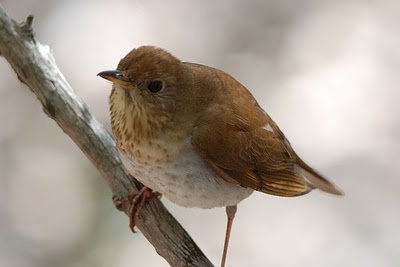
Like Saint Francis yesterday, Mary Oliver finds comfort in the singing of a bird. For us too, nature is a great place to find comfort in our moments of difficulty. Sometimes we get glimpses of a deeper reality, when our heart opens wide and time seems to stand still:


….. finally I heard him among the first leaves—
then I saw him clutching the limb

in an island of shade, with his red-brown feathers, all trim and neat for the new year.

First, I stood still

and thought of nothing.
Then I began to listen.
Then I was filled with gladness—
and that’s when it happened,

when I seemed to float, to be, myself, a wing or a tree—
and I began to understand what the bird was saying,

and the sands in the glass
stopped
for a pure white moment

while gravity sprinkled upward

like rain, rising, and in fact
it became difficult to tell just what it was that was singing—
it was the thrush for sure, but it seemed

not a single thrush, but himself, and all his brothers,
and also the trees around them,
as well as the gliding, long-tailed clouds
in the perfectly blue sky— all, all of them

were singing.
And, of course, yes, so it seemed,
so was I.
Such soft and solemn and perfect music doesn’t last

for more than a few moments.
It’s one of those magical places wise people
like to talk about.
One of the things they say about it, that is true,

is that, once you’ve been there,
you’re there forever.
Listen, everyone has a chance.
Is it spring, is it morning?

Are there trees near you,
and does your own soul need comforting?
Quick, then— open the door and fly on your heavy feet; the song
may already be drifting away.

Mary Oliver, Such Singing in the Wild Branches (2003)

Richard Davidson’s new project

We have already written about the work of Richard Davidson and his work at the Laboratory for Affective Neuroscience in the University of Wisconsin, Madison. He was featured in an interesting article last week in the New York Times where the Dalai Lama contributed 50,000 dollars to his recently established Centre for Investigating Healthy Minds. The short article is worth reading and charts the increasing scientific interest into the effects of meditation on the brain.

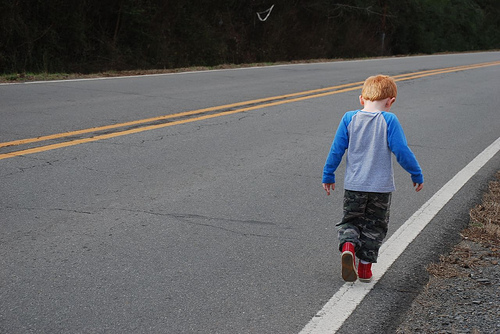
The center  is now working on an exciting new project, teaching meditation skills to school children in Madison. Based on earlier research,  they wish to see what the effects of teaching compassion and loving-kindness meditation has on the children. The children are led in meditation  focusing on kindness thoughts toward loved ones, strangers, even enemies. Previous research by Barbara Friedrickson would indicate that this will boost positive emotions and a general sense of well-being in life. The research which Davidson has commenced is longitudinal,  and so the children will be followed into middle school to see how their behaviour compares with a control group of non-meditators.

For the fully article check out www.nytimes.com/2010/09/27/us/27happy.html?_r=3&th&emc=th

Photo taken from the New York Times

Welcoming wolves to the table

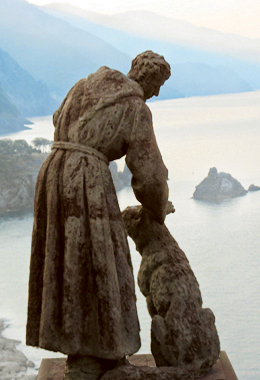
Today is the feastday of St Francis of Assisi (1182 – 1226), perhaps the most popular and likeable Christian saint. The example of his extraordinary heart reminds us of the joy that can be found in a life of meaning and service. Unlike some other saints he seems approachable. In his connection to nature he opens us out to all of creation. I am reminded of two stories from his life, both, not surprisingly, involving animals.

The first is the famous story about the wolf which was terrorizing the people of the town of Gubbio. It had killed several people, and they were now afraid to leave their homes. Francis heard about this and decided to go approach the wolf . When he came upon the wolf, it lunged at him, mouth open wide, about to bite. Francis simply, gently,  greeted the wolf as “Brother Wolf” and spoke to it, telling it not to harm him.  It stopped and lay down at his feet.  Francis and the wolf made a deal: the town would provide food for the wolf for the rest of its life, in exchange for the wolf’s ceasing to harm them. We are told the wolf  placed its right paw into Francis’ hand, and so the wolf lived in peace with the people of Gubbio for the rest of its life.

It is clear Francis was a peacemaker and reconciler – in this case helping the people in a society deal with what pushed them in fear to close their doors and withdraw. But I like to think of this story as a way that we can deal with our fears, the emotions that arise within us and scare us, like anger, jealousy and dislike of others. The stuff that relationships bring up in our lives.  Our normal first response is to be disturbed or frightened by these strong emotions and we move to push them away. However, in themselves,  these are not the problem, but it is our mind’s relationship to them that is. So what learn from Francis is to approach the things that frighten us – not to be afraid of the frightening wolves within us – but to begin by simply, gently looking at them directly. What would it be like to experiment with seeing them just as part of who we are at that moment and instead of pushing them away, to invite them to come close and to stay. As if they are part of the family – “brother wolf”, “brother anger” “brother fear” – and welcome them to the table? This is the practice: to first experience the anxiety you are going through – if it is not too overwhelming – as an embodied feeling, with no shoulds or shouldn’t about it. Our wounds – even the most frightening,  shameful, or self-inflicted ones – do not need to become a moment for showing ourselves further violence. They are, like all our practice, to be occasions of self-compassion and a letting go of judgment.

A second story tells us that Francis and Brother Leo were about to eat when he heard a nightingale singing. Francis seemed to have a special fondness for birds. So he suggested to Leo that they should also sing out their love along with the bird. Leo made the excuse that he was no singer, but Francis lifted up his voice and, line after line, sang a duet with the nightingale, until, late into the night, he tired and had to admit that the bird sang out his joy better than he could. I love the way that Francis opened his heart with all of creation and did not let the self- conscious, doubting “I am not a singer” story – which we all tell ourselves – get in the way. His heart naturally wanted to share and he did not let his fears get in the way.

Our dis-ease

The nature of our dis-ease is this: we continually judge, reject and turn away from certain areas of our experience that cause us discomfort, pain or anxiety. This inner struggle keeps us inwardly divided,  creating pressure and stress and cutting us off from the totality of our experience.

We first learnt to reject our experience when we were growing up. As children our feelings were often too overwhelming for our fledgling nervous system to handle, much less understand. So when an experience was too much, and the adults in our environment could not help us relate to it, we learnt to contract our mind and body, shutting ourselves down, like a circuit breaker. This was our way of preserving and protecting oursleves…….In time, these contractions  form the nucleus of an overall style of avoidance and denial.

Thus our psychological distress is composed of at least three elements: the basic pain of feelings that seem overwhelming, the contracting of mind and body to avoid feeling this pain; and the stress of continually having to prop up and defend an identity based on this avoidance and denial.

John Welwood, Toward a Psychology of Awakening

Seeing the Space

Between stimulus and response, there is a space.

In that space lies our freedom and power to choose our response.

In our response lies our growth and happiness.

Viktor Frankl

Clearly seeing absolute and relative

The practice of meditation leads us to seeing things as they really are. In other words, we come to appreciate the continual changing nature of things as they are directly experienced in the present,  the patterns which are beneath our choices, and the way we react, without thinking,  to certain factors.  When we do not see clearly the nature of what drives us and the nature of reality as changing, we seek happiness in mistaken ways and in the wrong places. We can persist in unsatisfactory ways of behaving. When we have a “wrong view” as to how things are, we persist in thinking that certain behaviours will guarantee us satisfaction and we remain fixed in them. We mistakenly believe that absolute  contentment can be found in things that we acquire or in the relative aspects of our lives which are subject to change and decay.  This can be true in so many areas of our lives, some of which are hugely emphasized in today’s society, such as our career, possessions and our relationships.

Ordinary human love is always relative, never consistently absolute. Like the weather it is always in continual dynamic flux. It is continually rising and subsiding, waxing and waning, changing shape and intensity.

….This may seem totally obvious. Yet here’s the rub. We imagine that others – surely someone out there! – should be a source of perfect love by consistently loving us in just the right way. Since our first experiences of love usually happen in relationship to other people, we naturally come to regard relationship as its main source. Then when relationships fail to deliver the ideal love we dream of, we imagine something has gone seriously wrong. And this disappointed hope keeps reactivating the wound of the heart and generating grievance against others. This is why the first step in healing the wound and freeing ourselves from grievance is to appreciate the important difference between absolute and relative love.

John Welwood, Perfect Love, Imperfect Relationships