The Basics of practice 2: Be patient with the mind

File:Monkey Leap.jpg

The biggest hindrance to (mindfulness) is constant intrusive thoughts. This is normal for everyone and from the beginning you should expect it. The nature of our mind is to think, and it is childish to imagine that we can simply turn that process off when we wish to.

Our minds have been almost completely out of control for most of our life. Recognizing this can help us to be practical and patient — it may take us some time and a lot of skillful practice to tame the crazy “monkey mind.”

Bob Sharples

photp mahbub shaheed

Like bubbles

File:First Time Bubble (4718544475).jpg

One of the funny things about learning to look into the mind is that normally that’s the last place we ever look! If you consider the way we normally think, we carry on an endless dialogue with ourselves full of memories, justifications, anticipations, commentaries, fantasies, daydreams and so on. We just keep thinking, comparing, analyzing. And we believe what we think. I have  my beliefs, they are true because that’s what I believe! What I like must be good because I like it!…..The aim of meditation practice is to first teach us how to quiet the mind and then to look into the mind itself. It teaches us how to distance ourselves from our thoughts and emotions and to see them as just thoughts and emotions. They are mental states. They arise for a short time, then they disappear, then another state arises. They are like bubbles. Our problem is not that we have thoughts and emotions but that we identify with them.

Ani Tenzin Palmo, Reflections on a Mountain Lake

photo serge melki

How it is right now

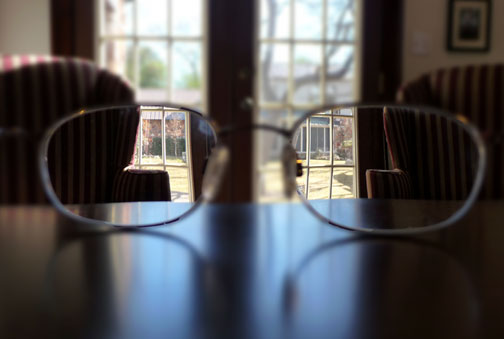
glasses-see-clearly-7

What does it mean to see each other exactly as we are? Past memories about ourselves and each other are not how we are right now. Memory is an incomplete and inaccurate recording of the past. Now is something entirely different. Quietly looking and listening now is not memory. It is an entirely different mode of being, It is a cleansing of perception.

Toni Packer, The Work of this Moment

Is it good or bad?

File:S1-.jpeg

We can never fully know the meaning of what is happening to us now. Life-defining moments often become clear only in hindsight. We often miss what is in front of us by leaning too far into the future, or having too fixed a plan for our life. Cultivating a “Don’t Know” mind helps us allow things unfold in their own time.

There was an old man with a small farm in China many years ago. He had one son, who did most of the work on the farm and a neighbour, himself old with a son.

One day the old man’s horse ran off, and the neighbour, seeing this, said, “How terrible, your horse has run off, now work on your farm will be so difficult.” To this the old man replied, “Maybe good, maybe bad, we’ll see.”

The next day the old man’s horse returned leading a group of wild horses, and the neighbour, seeing this, said, “How wonderful! You have many horses, now you have great wealth and may live easily.” To this the old man replied, “Maybe good, maybe bad, we’ll see.”

The next day the old man’s son was thrown from one of the wild horses and broke his leg, and the neighbour, seeing this, said, “How terrible, your son has broken his leg, now your work will be doubled as nurse and farmer.” To this the old man replied, “Maybe good, maybe bad, we’ll see.”

The next day the king’s men came to the farms seeking all able men to fight a distant battle, and the neighbour, sobbing as his son marched off, said “How fortunate you are for having an injured son, mine will surely perish.” To this the old man replied, “Maybe good, maybe bad, we’ll see.”

A Taoist Tale

How not to get swept away in reactions

File:Blue in green.JPG

Mindfulness practice is not just paying attention, but involves a certain evaluation. In reality this involves paying attention to whatever enters through the senses and seeing what arises and passes away in each moment. One of the reasons we do this is to ensure that what arises is held lightly, and does not trigger off unskilful patterns of thinking based on our history and our emotional schemas. For example, if we see a certain reaction on a persons face it can easily trigger memories of the same reaction  in the past and that lead to us feeling less appreciated or judged. The simple contact today can lead to a proliferation of thoughts from the past. Thus we are mindful of each thing as a separate moment, without turning it into a story about how good or bad our lives are.

A person who has clarified their real state sees only

each thing,

each thing,

each thing,

and lets go of understanding an underlying nature for each thing.

Dogen, Uji

photo maitreya maitreyen

Practice creates space

When all thoughts
Are exhausted
I slip into the woods
And gather
A bunch of shepherd’s purse.

Like the little stream
Making its way
Through the mossy crevices
I, too, quietly
Turn clear and transparent.

Ryoken