Continually judging

Boring2

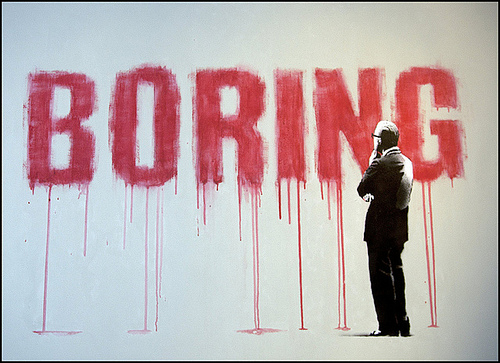
We are taught to make sense of things by imposing our judgement on everything in front of us. Naturally, as we grow up, we question some of the judgements and interpretations thrown our way, we agree with some and we disagree with others, and fit our personal understanding with our experience. But we rarely question the act of judging itself. Without much analysis we simply keep interpreting and reinterpreting reality as good or bad, right or wrong, useful or detrimental,  fun or boring, constantly tweaking our conceptions as new experiences  reinforce or undermine what we think we “know”

Karuna Cayton, The Misleading Mind

Becoming the observer

Movie hobbies
The reason we often can’t see the true nature of things is thatwe’re involved with them too subjectively and are afraid of whatthey might reveal about our egos. But if we step back from these phenomena, they become not so much ‘my story’ as just ‘a story’. It’s similar to watching a movie that’s extremely enjoyable – when it ends you can say, ‘Well, that’s not my story. That’s not me.’ You may have been taken through all kinds of impassioned human emotions (if the film is really good), but then you can go peacefully back to your own ordinary life.
Ajahn Thiradhammo, Contemplations on the Seven Factors of Awakening

Clear, open space

File:Prairie Homestead.jpg

We might think of the mind as being like clear, open space. All kinds of things arise there, but the space is not affected….In meditation  and in our lives, it is not so important what particular experience arises. What’s important is how we relate to it. By learning to relate well with whatever arises, we open to the full range of human experience, to what the Taoists call “the ten thousand joys and the ten thousand sorrows”.

Joseph Goldstein, A Heart Full of Peace

photo chitrapa

Seeing through thoughts

window dirt

Most of us are trained to believe that if we think something is good, it is good, and if we think something is bad, it is bad. But as we practice simply watching our thoughts come and go, such rigid distinctions begin to break down. If we continue to simply allow ourselves to be aware of the activity of our minds, we’ll very gradually come to recognize the transparent nature of the thoughts, emotions, sensations and perceptions we once considered solid and real. It’s as though layers of dust and dirt were slowly being wiped away from the surface of a mirror

Yongey Mingyur Rinpoche

The bridge

File:Puente de hamaca.JPG

Breath is the bridge that connects life to consciousness, the bridge that unites your body to your thoughts. Whenever your mind becomes scattered, use your breath as the means to take hold of your mind again

Thich Nhat Hanh

photo: chixoy

Seeing the mind as organizing

File:LEGO-02.jpg

The brain freezes the world into discrete mind moments, each capturing a barely adequate morsel of information, then processes these one by one in a rapid linear sequence. The result is a compiled virtual world of experience, more or less patterned on what’s `out there,’ but mostly organized around the needs and limitations of the apparatus constructing it. It is like the brain and its senses are hastily taking a series of snapshots, then stringing them together into a movie we call `the stream of consciousness.’

Andrew Olenszki, Unlimiting Mind: The Radically Experiential Psychology of Buddhism