Finding serenity within

The nature of the mind is comparable to the ocean.

The incessant movement of waves  on the surface of the ocean prevents us from seeing its depths.

If we dive down there are no more waves;

there is just the immense serenity of the depths….

Pema Wangyal Rinpoche

Why stillness is difficult, and movement is easy

A central ingredient in most forms of practice is stillness…. [But…] It takes time to really see that thoughts and emotions are mere movements of the mind. They are, after all, the fabric of who we think we are, and everything we do is an expression of thought and emotion. We take them so seriously. But take a closer look, test this against your own experience, and see for yourself. If we can gain this recognition, we are on our way to freedom,  for instead of being sucked into the contents of our mind and acting out everything that arises within it, we will watch those contents melt like snowflakes on a hot rock.

According to the Bon tradition… we have about eighty thousand thoughts a day, which means the mind moves eighty thousand times a day. We can feel the velocity of this movement within the first five minutes of sitting meditation. This discovery then leads to the next: the voluntary and involuntary movements that constitute our life are just the mental extensions of the voluntary and involuntary movements of our mind. We move physically because we move mentally. Our fundamental addiction to movement, therefore, is habituation to the movement of mind. We are addicted to thought.

Andrew Holecek, The Power and the Pain.

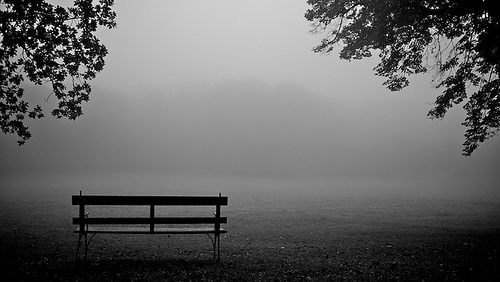
Still water

We can make our minds so like still water that beings gather about us that they may see, it may be, their own images, and so live for a moment with a clearer, perhaps even with a fiercer life because of our quiet.

W.B. Yeats, The Celtic Twilight

The basic goodness of the mind

Meditation is based on the premise that the natural state of the mind is calm and clear. It provides a way to train our mind to settle into this state. Our first reason for meditating might be that we want some freedom from our agitated mind. We want to discover the basic goodness of our natural mind. To do this requires us first to slow down and experience our mind as it is. In the process, we get to know how our mind works. We see that wherever the mind is abiding — in anger, in desire, in jealousy, or in peace — that is where we also are abiding. We begin to see that we have a choice in the matter: we do not have to act at the whim of every thought. We can abide peacefully. Meditation is a way to slow down and see how our mind works.

Sakyong Mipham Rinpoche

Being with and not rejecting

Meditation is not a means to suppress “thinking”. A calm mind is not without thoughts but one in which we are able to investigate our thoughts in a non-judgmental, compassionate and calm way. When we do this, we improve our capacity to think and reflect with clarity. Inner simplicity is born of willingness to learn how to let go. Meditation is fundamentally about listening without prejudice to our minds. The liberation of being able to listen to our minds without rejecting, interpreting or judging beings clarity and calm.

Christine Feldman, Beginners Guide to Buddhist meditation

How to deal with our inner commentator

A great distraction at times are so-called “running commentary” thoughts such as, “Now I am not thinking of anything,” “Things are going very well now,” “This is dreadful; my mind just won’t stay still” and such like……..All such thoughts should simply be noted as “Thinking,” and, as Huang Po says, “dropped like a piece of rotten wood.” “Dropped,” notice, not thrown down. A piece of rotten wood is not doing anything to irritate you, but is just of no use, so there is no point in hanging on to it…Nor is there any need to try to retrace the links in a chain of associated thoughts, nor to try to ascertain what it was that first started the chain. Any such impulse should itself be noted simply as “Thinking,” and the mind should revert to the breathing. However badly things have just been going, one should take up again at the only place one can – where one is – and go on from there.

Bhikku Mangalo, The Practice of Recollection