Last weekend, I attended a very interesting seminar run by Dr Rich Hanson, author of Buddha’s Brain, The Practical Science of happiness, love and wisdom. So I will post one or two reflections on the brain, its relationship to happiness, and ongoing research on it.
Over millions of years the brain evolved to be sensitive to threats and opportunities. Threats provoke a more immediate response but opportunities and new information also produce an excited reaction in the brain. One thing which happens is that the neurotransmitter dopamine is released, which is connected to the pleasure system in the brain. Dopamine gives rise to feelings of enjoyment and reinforcement which motivates us to do or to continue to do certain activities. As such dopamine can be addictive, and when people get used to its activity, its absence can be felt as boredom or restlessness.
Recent developments in technology have hugely changed the environment in which the brain has to work, and it was not necessarily designed to cope rapidly with all the challenges it is facing. In particular, media use seems to be triggering this dopamine reaction, creating a type of addictive effect. It is not unusual now for a person to have open at the same time a document they are writing, a computer page they are reading, an instant messaging or social networking site, while texting or listening to music at the same time. A recent Stanford study* seems to suggest that the more we use these different sources of content at the same time – such as e-mail, SMS, Instant Messaging and Social networking sites – the more we are stimulating this neural activity and this is changing how we think and behave.
The researchers looked at the effects of heavy media multitasking on an individual’s ability to perform cognitive tasks. Maybe not surprisingly, they found that people who used less media performed better on these tasks than self-confessed technology junkies. Worryingly, the study seems to suggest that our ability to focus is being undermined by the constant bursts of information favoured by the push technology seen in most recent forms of communication. Push technology allows information and emails to be updated immediately on a system, giving an almost constant stream of information to the user. Based on their research, the scientists surmised that multitaskers are more responsive to new incoming information; but their ability to focus attention is diminished. Increased distractions may be weakening the brains ability to focus on what is in front of it, and provoke a withdrawal-like longing for more information, even when the computer is turned off. Thus some users have difficulty switching off, even when on vacation or at an important family event, and their capacity to pay attention to real people is fragmented.
As a New York Times article based on the study observed, this can have huge consequences on relationships and family life, as a person finds “ordinary” life less exciting than the buzz created by media multitasking. The article goes on to note that heavy multitaskers actually have more trouble focusing and shutting out irrelevant information, and they experience more stress.
The article goes on to quote Nora Volkow, director of the National Institute of Drug Abuse, who goes as far as to say that the technology is rewiring our brains. She and other researchers look at the lure of digital stimulation as less like that of drugs and alcohol and more like the need for food and sex, which are essential but counterproductive in excess.
The New York Times,”Attached to Technology and Paying a Price”:
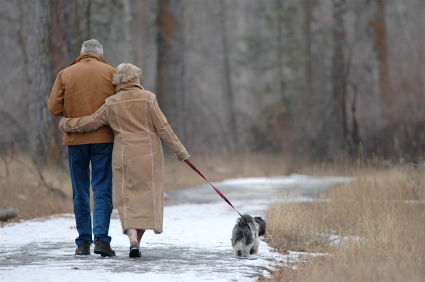 One of the best ways to learn to be mindful is to take the dog for a walk. Dogs are always in the moment. They can take the same walk for 10 years and still experience grass in an entirely new way each day. They’re not worried about the past (“Why didn’t my people give me some of that chicken they had for dinner?”) or the future (” I wonder if my people will give me any chicken when we get home?”). All they think about is what is right in front of them: the smell of the grass, the basset hound in the yard next door, the squirrel in the tree across the street.