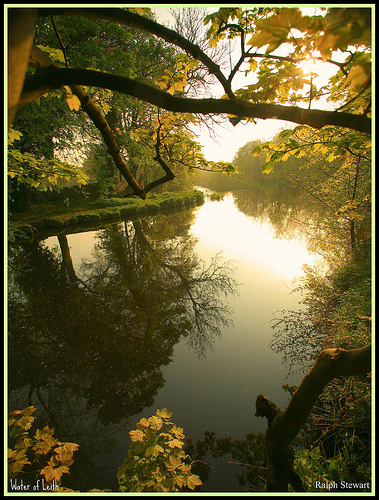
 As we have said before, one do not have to wait to be completely satisfied with everything before one can be content. Similarly, everything does not have to be just as you would like it in your life for you to be grateful. One just has to give up the automatic tendency to judge oneself and ones life, fixing on imperfections, and the interpretations of our life which follow that tendency. Noticing small positive things each day, and being grateful for them, is a skill that can be practiced, and it develops our capacity to be just in the present moment. Being happy for the whole of our lives can start with us appreciating the moments of our life, now. And there are a variety of simple things each day which we can stop to notice and be grateful for – the changing colours on the leaves, a cup of coffee in the morning, a small act of kindness by a colleague, the taste of simple food. Each day presents new opportunities to just notice, no matter what our situation is.
Tag: Nature
Moments when we see
 Sometimes, admittedly, the world can still of a sudden assume a resonance beyond
the one-dimensional, as the sun sometimes breaks through the Irish summer’s ample blanket of cloud cover.
And sometimes even in the rain there comes a moment when
the bird on the neighbouring roof is an ancient symbol or a hieroglyph
in the book of the riddle’s meaning.
And this is poetry, when the bird preaches to you, and you respond
By preaching strictly for the birds.
Ciaran O’Donnell, A Former Franciscan visits Assisi
On learning from nature
 There is often an unspoken assumption that things should go smoothly in life, or that the Universe has a direct plan for us, and that it communicates it easily. Consequently, we get upset that things are not always that straightforward. When things go wrong we can often regard it as a violation of some supposed natural entitlement to order and predictability. However, if we look at the natural world we do not find complete support for this underlying assumption. The recent turbulence in the weather, and the natural disasters of this past year, demonstrate that things in nature are frequently unpredictable and disruptive. So we should not expect anything different in our lives. Bad things can happen and our lives can change, in ways that we cannot predict. Things happen in indirect ways, and reasons are not always immediately evident. Patience is needed if we wish to understand or work out what is our path.
Clouds are not spheres, Mountains are not cones,
Coastlines are not circles and bark is not smooth,
nor does lightning travel in a straight line.
Nature exhibits not simply a higher degree but an altogether different level of complexity.
Benoit Mandelbrot, French-American mathematician.
Sunday Quote: A still mind, not fixing….
God, rest in my heart,
Fortify me
Take away my hunger for answers.
Mary Oliver
On shaky ground
 We often find ourselves blown by this wind or that, unsettled, subject to varying emotions. Inside ourselves we are restless, uncertain, or can feel entangled. This experience is nothing unusual, but rather is at the heart of the human condition. In most moments, even after periods when things go well, there is an underlying hum of disquiet, of shifting ground. Some writers call this ongoing feeling “groundlessness”, others “loneliness”. Our first thought is to consider this as negative and it often leads us to feel disturbed. In today’s culture, the idea that one is unsettled or not completely happy is often considered a sign of failure. It does not harmonize with the media insistence on happy people or the myth of easily established social relationships. So we can react to this inner sense by doing more, seeking to improve ourselves, or by keeping ourselves busy and distracting ourself or by looking to a relationship to take the feeling away. However, at the heart of mindfulness practice is the understanding that life is always shifting and changing, that this change is unpredictable, that we always have some inner sense of incompleteness and that this is ok. It does not mean that there is something wrong with us or our life. It can be a liberation to use this as our starting point. Life has a changing and unsatisfactory character. It is hard to establish a consistent oneness of mind and heart that remains stable in such a way that there is never any disappointment. Accepting this truth opens the way to wisdom.
And this is the simple truth – that to live is to feel oneself lost.
He who accepts it has already begun to find himself to be on firm ground.
José Ortega y Gasset, Spanish Philosopher, Who Rules the World.
Allowing things be as they are
 Letting go of what arises in the mind leads to witnessing the cessation of that which has arisen. Then there is the true peace of allowing things be as they are. No longer are we someone who has to get somewhere, do something, get rid of something or change something. When we’re caught in distracting ourselves with pleasures, then we’re somebody, and somebody who has to find happiness, or have success or become something. No matter how much excitement or pleasure I might experience, I have to have more than that. We are never content with the excitement and adventures of life. They just cause us to be caught up in that movement of having to have more and more – until you get burnt out. Then you go to the opposite extreme where because you are tired and worn out from all the excitement, and stimulation you just break down, fall asleep, get drugged or drunk…. You can only have so much excitement and then you can’t bear it any more.
Ajahn Sumedho, The Way it is.

