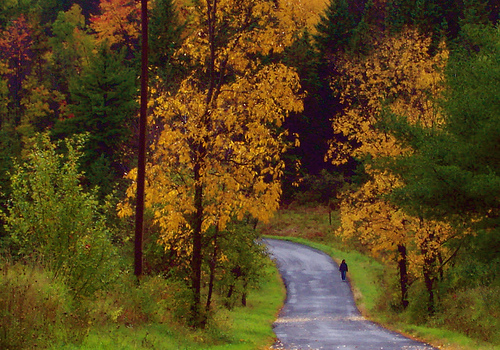
November is traditionally the month for remembering those who have passed away. It is a practice in harmony with this time of year, as the days shorten and the cold of winter approaches. There seems to be a broad antropological basis for this awareness, as it can be found in the Celtic calendar around this time also. Keeping an awareness of the impermanence of all things is one of the basic practices in most of the wisdom traditions. One of the reasons that we struggle is that we give things more solidity than we should, including the problems and worries which pass through the mind as thoughts or emotions. I think the most important lesson learned in sitting meditation is that nothing stays the same for long, including the activity of the mind. Learning the truth of that in a real, felt way, leads to equanimity. Trying to hold onto things that are changing, even good things, pinning our happiness onto things being exactly as they were, leads us to be less present with how things actually are. However, I do not find this practice easy or something I realize in a once-off manner. I would love if enlightenment came that way. However, for me it is a slow-learned knowledge, that I am working with day-to-day. Looking out on the mountains around my house this morning gently teaches me. The trees let go of their leaves, the mountain allows the mist to descend and rise. I too try to let go, not trying to make this or that moment last forever.
In the deepest forms of insight we see that things change so quickly that we can’t hold onto anything, and eventually the mind lets go of clinging.
Letting go brings equanimity. The greater the letting go, the deeper the equanimity. In practice we work to expand the range of life experiences in which we are free.
U Pandita