The energy in nature : a blessed unrest

There is a vitality, a life force, an energy, a quickening that is translated through you into action, and because there is only one of you in all of time, this expression is unique. And if you block it, it will never exist through any other medium and it will be lost. The world will not have it. It is not your business to determine how good it is nor how valuable nor how it compares with other expressions. It is your business to keep it yours clearly and directly, to keep the channel open. You do not even have to believe in yourself or your work. You have to keep yourself open and aware to the urges that motivate you. Keep the channel open. … . [There is] no satisfaction whatever at any time. There is only a … blessed unrest that keeps us marching and makes us more alive than the others.

Martha Graham

Bring your heart to each moment today

The Chinese character for “mindfulness” is nian. It is a combination of two separate characters,  each with its own meaning. The top part of the character means “now” and the bottom part of the character means “heart” or “mind”. Literally, the combined character means the act of experiencing the present moment with your heart. So mindfulness is the moment-to-moment awareness of what is occurring in and around us. By being present and mindful of the present moment, we can accept what is at that moment as it is, allowing change to happen naturally, without struggle, without the usual resistance and judgment that cause us to suffer more.

Thich Nhat Hahn and Dr Lilian Cheung, Savor

Its not in the future, but here today

Mindfulness encourages us to pay attention and rest in what is happening in the present moment.  However, we often prefer to be elsewhere, or that the present moment be other than what it actually is. What we learn through our practice is the key to finding contentment is to be fully present with whatever we are doing, no matter how ordinary. This realization that the fulness of our lives is right in front of us, and not to be found in the future, is an insight found in all wisdom traditions and leads to true contentment .

The everyday tedium of our lives is the desert we wander, looking for the Promised Land. Our relationships, our work, and all the little necessary tasks we don’t want to do are all the gift. We have to brush our teeth, we have to buy groceries. we have to do the laundry, we have to balance our checkbook. This tedium — this wandering in the desert — is in fact the face of God. Our struggles, the partner who drives us crazy, the report we don’t want to write — these are the Promised Land.

Charlotte Joko Beck

Using the weather today as a metaphor for life

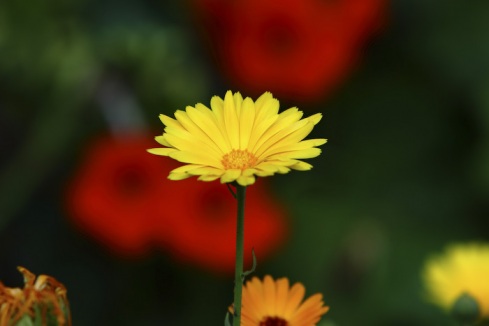
The warmth of the Spring weather this year means that plants and fruits are in bloom ahead of time and any memories of winter is far behind. We can look at the weather and nature today and be reminded of a number of lessons, which help us live our life mindfully:

Spring is a metaphor for transitions. It moves from lifelessness to life and we move from lifelessness to life in each cycle of breathing. If we know change is going to occur we are in a better place to accept it. If we expect things to stay constant we are vulnerable to frustration, disappointment, and resistance.

Spring is also a metaphor for forgiveness. Whatever happened in the last season, life begins anew with no carryover resentment from the past. Spring reminds us, as Pema Chodron says, to start where we are.

Spring shows us the cycle of living and dying on a bigger scale do. Everything comes into being and goes out of being — changing its form.  Spring invites us not to become attached to things, even the most precious things in our life. The invitation is to love things wholeheartedly with the awareness that they will not be with us forever. And, indeed, we, ourselves, will not be here forever. The invitation is to not be afraid to grieve when that grief becomes necessary. Grief is, at times, the admission price to the present moment.

The renewal of spring is the healing from grief, from the inexorable impermanence of things. Spring also demonstrates the tenacity of life and encourages us to persist in whatever we are doing.

So welcome spring and your multifaceted metaphors for mindful living!

Arnie Kozak, on Beliefnet

Moving on into insecurity

As time passes, we are continually called to move out of our comfort zones and take on new challenges. Or  we need to shake ourselves up and leave behind what has become too familiar and comfortable.  At other times, growth may be painful, but we know deep down  that we need to make choices which will lead us in new directions. In every case it is the same, an ongoing, organic process  that has been in place since we were little: we move from an established secure base, stepping out to explore new worlds.  To do this we need to let go of what is certain. It has always been that way. We often sense it deep down. Where do I feel stuck at this moment? What do I need to move on from?

To be human is to create sufficient order so that we can move on into insecurity and seeming disorder. In this way we discover the new.

Jean Vanier

Being mindful of everything today

In our dally lives, we should be mindful. What does it mean to be mindful? It means to be fully aware right here, concentrating on what is going on inside. We are looking at something, for instance, and we try to concentrate on that; then a sound comes, and then a smell, then this and then that-distractions, changes. We say: ‘I can’t be mindful of this environment; it’s too confusing. I have to have a special environment where there are no distractions, then I can be mindful. If I go to one of those retreats, then I can be mindful; no distractions there-peace and quiet-noble silence! I can’t be mindful in Edinburgh or London – too many distractions. And I’ve got family, children, too much noise!’

But mindfulness is not necessarily concentrating on an object. Being aware of confusion is also being mindful. If we have all kinds of things coming at our senses-noises, people demanding this and that-we cannot concentrate on any one of them for very long. But we can be aware of the confusion, or the excitement, or the impingement; we can be aware of the reactions in our own minds. That is what we call being mindful. We can be mindful of confusion and chaos. And we can be mindful of peace and tranquillity.

Ajahn Sumeho