Stand firm

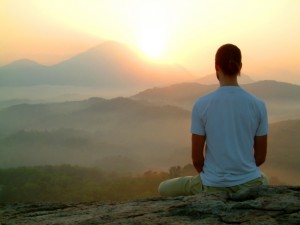
Doing yoga this morning. The warrior pose. Widening the heart. Being open to all possibilities. We can often identify ourself with who we want to be, or could be in the future, or who our worries say we are. We can forget the strength we actually have and who we really are. The present moment is the only one we have. It is there our happiness is worked out. We lose so much of life by refusing to stay in it, preferring to live in our fears and our worries.

Throw away all thoughts of imaginary things

and stand firm in that which you are.

Kabir

Waiting

It’s a transformative experience to simply pause instead of immediately filling up the space.

By waiting, we begin to connect with fundamental restlessness as well as fundamental spaciousness.

Pema Chödrön

Watching it all flow by

Somedays we find ourselves with confusion in our lives. We are not clear about things or wish for more direction. When that happens I often find that I rush to impose order, in order to make me feel better. But confusion often prompts thoughts, worrying and stories about the future. Staying close to the present moment in nature can ground us and give perspective.


I awoke to the confusion of a new day,
The scraps of dreams, memories of yesterday,
And new cravings creeping onto awareness,
The sun spilling its light over all but the shadows and a cacophony of sound.
From outside and in.
What to make order of? What to let go?
And who makes the choice?
I think I will go down to the river and just watch it flow,
It’s been a long time since I have done
something really important.

David Sluyter

Don’t have to change

What this means is that we can find our own happiness and peace of mind
just as we are in this very moment, because it is within us. We don’t have to change our thoughts or change ourselves into someone else.

We don’t need to think that who we are, this “me,” is not good enough, smart enough,  or lucky enough to be happy.

Dzogchen Ponlop Rinpoche, Resting the Busy Mind

With emotions that cause stress, we have a choice

I read an interview with Dr. Jill Bolte Taylor,  neuroanatomist and spokeswoman for the Harvard Brain Tissue Resource Center. She had a stroke that damaged her left hemisphere and for a while she could not walk, talk, read, write, or remember many of the incidents of her life. She underwent major surgery to remove a clot in her brain. She describes her experiences in the book My Stroke of Insight: A Brain Scientist’s Personal Journey.

In the book she draws attention to brain patterns – or “circuity” –  and states that we actually have much greater choice in the circuits we run than we think we have. For example,  when we get sad, angry or afraid she says we have a choice – to run with that circuity or to not identify with it, to step back and observe it. There is not doubt that it can be easier to engage the circuitry. When this happens we identify with the emotion – I am my anger, I am my sadness, I am my fear.

However, there is another approach which is coincidentally developed in mindfulness practice. In it we work at being aware of what is going on in our mind at any moment. We learn to say – I am in this moment running this circuitry; is this the circuitry I really want to run? And how long am I going to run it? Dr Taylor  states that we can have a real choice on which way we want to go. For example, when something happens which provokes us,  we can be aware of the process of anger and see it as the brain working in a certain way. She puts it this way – “I’m running my anger circuitry, I can feel what this is like in my body”. Then we can develop the gap between ourselves and the strong emotion and decide if we want to stay with it or not.

She goes on todescribe some very practical, everyday ways in which we can develop our  capacity to observe our brain circuity. We just need to pay greater attention to what we are doing in this present moment:

I think the most important thing is to consciously choose to bring your mind to the present moment. How do you do that? You decide that you’re going to see what your eyes are looking at; you bring your consciousness to the present moment. When you are going up the stairs, you look at the steps, you look at the handrail. Most of us unconsciously climb the steps, never think about the steps, can’t even say what the color of the carpet is, if there is a carpet, because we’re somewhere else.

Pay attention to the present moment. Bring your mind, bring your ears to the present moment, start savoring the awareness of the information you perceive in the present moment, and let that grow. And it’s like with any circuitry: the more you concentrate on it and experience it, the more it will develop itself.

For more about Dr Taylor you can visit her website:  www.drjilltaylor.com

Quotations taken from interview “Balancing the Brain towards Joy” :

www.spiritualityhealth.com/spirit/archives/balancing-brain-toward-joy

Living life more fully

Many people think that meditation is something strange or esoteric, demanding a special kind of person.

But as Jon Kabat Zinn reminds us in the previous post, it is simply paying attention to all the details of life. This allows us live more deeply our life as it actually is, and enjoy each moment more fully.

Meditation is not something apart from life. When you are driving a car or sitting in a bus, when you are chatting aimlessly, when you are walking by yourself in a wood or watching a butterfly being carried along by the wind—to be choicelessly aware of all that,  is part of meditation.

J. Krisnamurti