Welcoming wolves to the table

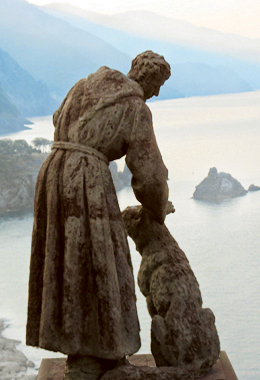
Today is the feastday of St Francis of Assisi (1182 – 1226), perhaps the most popular and likeable Christian saint. The example of his extraordinary heart reminds us of the joy that can be found in a life of meaning and service. Unlike some other saints he seems approachable. In his connection to nature he opens us out to all of creation. I am reminded of two stories from his life, both, not surprisingly, involving animals.

The first is the famous story about the wolf which was terrorizing the people of the town of Gubbio. It had killed several people, and they were now afraid to leave their homes. Francis heard about this and decided to go approach the wolf . When he came upon the wolf, it lunged at him, mouth open wide, about to bite. Francis simply, gently,  greeted the wolf as “Brother Wolf” and spoke to it, telling it not to harm him.  It stopped and lay down at his feet.  Francis and the wolf made a deal: the town would provide food for the wolf for the rest of its life, in exchange for the wolf’s ceasing to harm them. We are told the wolf  placed its right paw into Francis’ hand, and so the wolf lived in peace with the people of Gubbio for the rest of its life.

It is clear Francis was a peacemaker and reconciler – in this case helping the people in a society deal with what pushed them in fear to close their doors and withdraw. But I like to think of this story as a way that we can deal with our fears, the emotions that arise within us and scare us, like anger, jealousy and dislike of others. The stuff that relationships bring up in our lives.  Our normal first response is to be disturbed or frightened by these strong emotions and we move to push them away. However, in themselves,  these are not the problem, but it is our mind’s relationship to them that is. So what learn from Francis is to approach the things that frighten us – not to be afraid of the frightening wolves within us – but to begin by simply, gently looking at them directly. What would it be like to experiment with seeing them just as part of who we are at that moment and instead of pushing them away, to invite them to come close and to stay. As if they are part of the family – “brother wolf”, “brother anger” “brother fear” – and welcome them to the table? This is the practice: to first experience the anxiety you are going through – if it is not too overwhelming – as an embodied feeling, with no shoulds or shouldn’t about it. Our wounds – even the most frightening,  shameful, or self-inflicted ones – do not need to become a moment for showing ourselves further violence. They are, like all our practice, to be occasions of self-compassion and a letting go of judgment.

A second story tells us that Francis and Brother Leo were about to eat when he heard a nightingale singing. Francis seemed to have a special fondness for birds. So he suggested to Leo that they should also sing out their love along with the bird. Leo made the excuse that he was no singer, but Francis lifted up his voice and, line after line, sang a duet with the nightingale, until, late into the night, he tired and had to admit that the bird sang out his joy better than he could. I love the way that Francis opened his heart with all of creation and did not let the self- conscious, doubting “I am not a singer” story – which we all tell ourselves – get in the way. His heart naturally wanted to share and he did not let his fears get in the way.
In between

One practice which I find very useful in helping me stay mindful is to draw my attention to the importance of the times between times. Every day we have innumerable transition times, between the more formal or defined activities that take place. We can be tempted to see these moments as wasted, as having little value while we are anxious for the next thing to happen. For example, we can be waiting for a client who is late or for a meeting to start, waiting for someone to come back from the Post Office, waiting at the airport for a delayed flight or stuck at unexpected traffic works.

The suggestion  is to see these moments as invitations to stop and drop into ourselves before the next activity begins. In other words to create space between activities. The word I use to remind me to do this comes from the Christian monastic tradition, the word statio, meaning the practice of pausing between activities.

This latin word originally came from the Roman Army and meant a state of readiness or alertness.  The soldiers were fully aware because of possible danger. Therefore they stood  on watch, waiting. In the early Christian community, it became associated with a period of fasting in preparation for something important, the pause to prepare a space for what was to come. They compared their fasting to the guard duty of soldiers, seeing their actions as something to be approached with a similar seriousness and alertness of purpose.

Over the centuries this practicve evolved in the monastic communities to mean that we pause and remind ourselves beofre we start new activities. In other words, we create gaps between different activities or different parts of the day. Before we go into a meeting, or as we ring the elevator bell, we pause and form our intention to be aware. Or, for example, when we get home in the evening after work, we pause before entering our house or our apartment. We draw attention to the fact that we are chaging rhythms, from work to home, and we become conscious that we are about to come into contact with those whom we share this space. We wish to be fully present to them so we leave behind, as much as possible, the unfinished work of the workplace in order to be atttentive to them.

It is the time between times. It is a cure for the revolving door mentality that is common in a culture that runs on wheels.The practice of statio is meant to center us and make us conscious of what we’re about to do . . . Statio is the desire to do consciously
what I might otherwise do mechanically.  Statio is the virtue of presence.

We have learned well in our time to go through life nonstop. Now it is time to learn to collect ourselves from time to time so that God can touch us in the most hectic of moments. Statio is the monastic practice that sets out to get our attention before life goes by in one great blur …

Joan Chitchester, Wisdom distilled from the Daily

Stop inviting the future

Don’t prolong the past,

don’t invite the future,

don’t be deceived by appearances,

just dwell in present awareness.

Patrul Rinpoche

Even good and worthwhile,  things have the capacity to pull us away from what we should be doing at this moment, which may seem less exciting in comparison. We do not need to rush the future, just do what is in front of us today.  The different wisdom traditions often tell stories about this. The famous Zen proverb – Before enlightenment; chop wood, carry water.  After enlightenment; chop wood, carry water  – can help us be in the moment and put our whole selves into whatever we are doing. In the tradition of the Church we are often encouraged to remember the example of those who performed their everyday duties with great love, touching the loves of those around them. Sometimes we can get too focused on the special moments, when it is the ordinary things like doing paperwork or making the lunch that count. Or we get deceived by the “appearance” and the imagining of the future in our minds, and are blinded to the actual reality of the task in front of us. As Therese of Lisieux reminds us, Nothing is small in the eyes of God. Do all that you do with love. In the end, it is just another way of reminding us that the present moment is the key to our happiness and our health. We have no place special to go. Happiness is right in front of us.

Me, a Saint?

The Pope is in England for the start of the process of making John Henry Newman a “saint”. Newman was a good man and a very fine thinker, personalifying a gentle, open-minded search for truth. The school I went to in Ireland,  founded in 1867, was influenced by his principles of education. Most wisdom traditions hold up examples of people wo can act as an encouragement to us, such as the Bodhisattvas in the Buddhist tradition or the Saints in the Catholic and Orthodox history. Sometimes, however, the focus is on their extraordinary deeds which can lead us into thinking that full contentment is only to be found there. In this light, I like this quote from Thomas Merton:

For me to be a saint means to be myself.

Therefore the problem of sanctity and salvation is,  in fact,

the problem of finding our who I am and discovering my true self.

Thomas Merton, New Seeds of Contemplation

Encouragement

I have always liked the person of Barnabas in the New Testament. He was known as the “Son of Encouragement”. I have always felt that I would love to be known like that, as one who encourages. We all need encouragement and know what it feels like when someone believes in us. Someone who sees us, not as we are, but as we have the potential to become. That gives us courage.

…… If I accept the other person as something fixed, already diagnosed and classified…then I am doing my part to confirm this limited hypothesis. If I accept him as a process of becoming, then I am doing what I can to confirm or make real his potential.

Carl Rogers

When we fall down

We are often conscious of our failings and our lack of ability to do some of the things which we have to do. This can cause confusion and doubts in our mind. Sometimes we just have to sit with that. Mindfulness does not mean calmness. Being aware of our confusion is also mindfulness. We work with each moment as it is, even those we would probably prefer not to have.

Sometimes too we stumble and fall. Things can get too hard for us. In those moments we start over, trying not to add any judgement to the event, just being gentle with ourselves.

A monk looking for some guidance and encouragement went to Abba Sisoius and asked:

“What am I to do since I have fallen?” The Abba replied “Get up”

“I did get up but I fell again.” “Get up again.”

“I did, but I must admit that I fell once again. What should I do?”

“Do not fall down without getting back up”.

Sayings of the Desert Fathers