A mind that looks and does not think

One must have a mind of winter
To regard the frost and the boughs
Of the pine-trees crusted with snow;

And have been cold a long time
To behold the junipers shagged with ice,
The spruces rough in the distant glitter

Of the January sun; and not to think
Of any misery in the sound of the wind,
In the sound of a few leaves,

Which is the sound of the land
Full of the same wind
That is blowing in the same bare place

For the listener, who listens in the snow,
And, nothing himself, beholds
Nothing that is not there and the nothing that is.

Wallace Stevens, The Snow Man

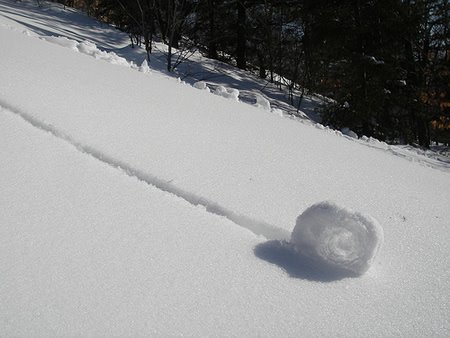
Like a snowball gathering speed

To start the new year, back to basics….A lovely text on how the mind proliferates on the basis of a simple feeling and makes a whole story out of it. We will probably get a lot of opportunity to practice with this  as we return to work this week and the holiday excitement fades. So this Monday, like every day, we start over again….. becoming more and more aware of this process, and creating a gap.

The outflowing of the mind is what one is witnessing in meditation when the mind surges off into sights and sounds, opinions, thoughts or feelings. It is most important to get acquainted with what that is like for the mind: the attention pouring out into different things. One can see how, first of all, there is just a vague thought of a memory, or a shape that you notice, and it is quite ephemeral; there is nothing very much there, you just remember some event. Then it catches our attention and, as the mind goes into it, suddenly what was just a vague and insubstantial thing comes to life – and our attention has brought it to life. We have breathed life into that thought with the act of attention.

As we give attention to it and it comes to life, then the whole flow of feeling along with that increases and develops – whether the feeling is pleasant or painful or whatever. If there is no mindfulness, then that feeling conditions self-centered desire; if it is a pleasant feeling, a desire for more of it; if it is a painful feeling, a desire to get away from it. Then that desire turns into attachment and the attachment turns into what is called ‘becoming’   – like a wave gathering strength.  Then, as the attachment and the becoming increase, we find ourselves thoroughly caught up with some melodrama and carried away on the whole cycle of birth and death. We are born into a memory, a hope or a worry, born into a piece of music or a feeling; and if we are born into it then we die with it when it comes to an end. Suddenly we find ourselves stranded and lost in another world.

If there is wisdom then we realise – “This is a feeling” –  and we follow it as it goes through its cycle of life. Then, as the feeling fades, there is nothing there creating more momentum around it. The feeling fades like a sound and then there is silence.

Ajahn Amaro, Silent Rain.

Living the moments in front of us

I am thinking, or trying to think, about all the imponderables for which we have
no answers, yet endless interest all the range of our lives,

and it’s good for the head no doubt
to undertake such meditation; Mystery, after all, is God’s other name, and deserves our  considerations surely.

But, but – excuse me now, please;
it’s morning, heavenly bright,
and my irrepressible heart begs me to hurry on into the next exquisite moment.

Mary Oliver, Trying to Be Thoughtful in the First Brights of Dawn

Why resolutions can often just increase problems

Carl Rogers suggested that a lot of the distress or anxiety in our lives comes when there is incongruence between the ideal image of the self which we have,  and our actual lived experience. This anxiety is expressed differently in each person, due to the many ways that the self-image is formed. Around New Years Day we are encouraged, even on some well-meaning sites, to form resolutions for the coming year, to look at the many ways in which we need to change. Now,  reflecting on the discipline needed to establish healthy practices in our lives is a good thing, as is being inspired by other people. And there is often a desire in the winter months to reflect on what brought the deepest joy over the past year and  shed dead wood in preparation for new growth  – or symbolically throw old plates out the window, as the Italians do. So working at our edge gently is always necessary in our lives.  However, over the years, I have come to believe that, instead of helping, a lot of these notions –   and the pre-digested strategies offered –  actually feed the problem, by strengthening the thoughts about an ideal self which we wish to have, and our need to fix ourselves to get it. Ironically, continually setting expectations of sudden growth – frequently encouraged in today’s society – can introduce a subtle violence in how we relate to ourselves and prevent us from deeper happiness, because it feeds three tendencies which our minds have. The first is the temptation to believe that there is a magic time in the future – maybe next year – when we are going to get it “all together”, and our lives will be perfect,  once we do such and such a practice or adopt some latest idea. Second, it encourages us to move away from the life which we actually have , and spend our time in thoughts about the life we would like to have. And,  as we notice again and again in practice, the mind prefers to spend more time in thinking about life than in working with what is actually in front of us, right now.  Thirdly, it stimulates the “comparing mind”, which is happy to evoke a better version of ourselves, which seems a good thing but frequently triggers discouragement and fear rather than a real ability to change. Often making expectations for the future is just a way of running away from relating to the life we actually have.  So,  maybe the best “resolution” is to give up on this notion of fixing oneself, and  rather focus on how we can deepen our lived experiences right now, with all their imperfections.  For most of us, that is where we are called to grow, and our slow commitment to more conscious living is better served by that, rather than by seeking magic changes in the coming weeks which will bring us suddenly to perfection.

Give up on yourself. Begin taking action now, while being neurotic or imperfect, or a procrastinator, or unhealthy, or lazy, or any other label by which you inaccurately describe yourself. Go ahead and be the best imperfect person you can be and get started on those things you want to accomplish before you die.

Shoma Morita

Not panicking when we cannot see clearly the road ahead.

Yesterday we saw a dense fog descend in these parts, reducing visibility and making driving last night a bit precarious, because of the difficulty in seeing signs and markings.  Today dawned bright and clear, even though snow is expected later. Easy to apply this contrast to how we work with emotions in our lives, especially around Christmas and New Year. What I have noticed in conversations over the past few days is that this period has a capacity to make people question where they are,  or to feel insecure in the direction of their lives. For some reason these dates become a time for measuring how we are doing, comparing our progress with either internal ideas or memories of a good Christmas or external images of what a successful or dynamic New Year should be like. We frequently have a concept of what success should be like and measure ourselves against that. And since we always like our mind to be clear and spacious, we get disturbed when some of the thoughts which pass through our mind turn our mood  judgmental or melancholic. And then a commentary can take hold, telling us we have not “achieved” as much as we wanted this past year, or that we are not doing as well as we think we should be.  And this tends to emerge in conversations as justifying – we hear why a person has done such and such or is going to change and do something else – reflecting an inner discussion about the “right” road towards progress.

However, such justifications are not really needed because passing moods are quite normal, and not worth taking too much interest in. Furthermore, realising that we have an underlying sense of dissatisfaction – more pronounced at this time of year – is a necessary stepping stone to wisdom. It is a mistake to think that we will always feel secure inside ourselves.  Even though we are adults,   a sense of feeling lost may lie close beneath the surface of our lives, and is quite normal. It is not an indication that we are doing anything wrong.  As the current weather shows, periods of fog and cold are normal parts of a cycle. Not seeing the road ahead clearly does not mean it is not there.

So what, practically can we do, when these moments of fog and confusion descend? Firstly it is good to notice the underlying tone. If there is a hint of fear in them, we are most likely in the unhelpful presence of forcing and fixing. The second step is to try to see them, like all thoughts, and subsequent emotions,  as things that arise and pass away, and not feed them by paying them too much attention. As always, our thoughts about our life are not the most reliable place to anchor our sense of self.  We cannot really see the road towards the future and we have a proven inability to predict clearly. Therefore we return to the only place we can be sure of, our  awareness of the present, and a curiosity about whatever is going on there, even if it is troublesome emotions. This refuge of awareness is normally much kinder than our fear-driven judgments about the future.

To look for progress is a setup — a guarantee that we won’t measure up to some arbitrary goal we’ve established. Traditional teachings tell us that one sign of progress in meditation practice is that our “kleshas”  – our strong conflicting emotions – diminish. Though the teachings point us in the direction of diminishing our klesha activity, calling ourselves “bad” because we have strong conflicting emotions is not helpful. That just causes negativity and suffering to escalate. What helps is to train again and again in not acting out our kleshas with speech and actions, and also in not repressing them or getting caught in guilt. Progress isn’t what we think it is. We are talking about a gradual learning process. By looking deeply and compassionately at how we are affecting ourselves and others with our speech and actions, very slowly we can acknowledge what is happening to us — which is one sign of progress. We then discover that patterns can change, which is another sign of progress. Basically this is instruction on disowning: letting go and relaxing our grasping and fixation. At a fundamental level we can acknowledge hardening; at that point we can train in learning to soften.

Pema Chodron, Signs of Spiritual Progress

Letting go of our story lines

Meditation practice provides a powerful antidote to the story lines of ego. We become expert in  recognizing when we are holding on to both overt and subtle versions of ourselves. In addition we also come to see how we re-create story lines as a way of pulling back from the very experiences we long for: spaciousness, clarity and compassion.…We may prefer to have a softer edge on reality when experiences arise that disconfirm our favourite story lines. We may subtly rework memories rather than see ourselves in an embarrassing or shameful light. We may also shrink away from our naturally tender and compassionate nature when to stay present means feeling our own pain or recognizing the pain of others……As we come to see our internal narratives for what they are – stories that distance us from our direct experience – they begin to lose their power.

Karen Kissel Wegela, The Courage to be Present