Balance 3: Make time and space for questions

When I was a child in New York City in the 1940s there were laws that attempted to legislate the Biblical injunction, “Remember the Sabbath and keep it holy.” Businesses were closed. Shopping stopped. There were no convenience stores. People needed to remember, in advance of the Sabbath, to provide for the upcoming day of rest and spiritual reflection so that, on that day, they could rest. The community collectively caught its breath. Family members spent time with each other. They renewed connections. They visited neighbors.

I like to imagine that, whether or not people went to religious services, there was the possibility in that period of a pause for reflection. “What am I doing with my life?” “Is what I am doing good for me?” “Is it good for other people?” “Does my life make a difference in the world?” “Could my life make more of a difference in the world?”

All of the important fundamental questions in life seem to be waiting, so to speak, next on line at the top of the mind’s agenda, if only we give them the time and the space to present themselves.

Sylvia Boorstein

Loving life

Aren’t there moments
that are better than knowing something,
and sweeter? Snow was falling,
so much like stars
filling the dark trees
that one could easily imagine
its reason for being was nothing more than prettiness.

I suppose
if this were someone else’s story
they would have insisted on knowing
whatever is knowable – would have hurried
over the fields
to name it – the owl, I mean.

But it’s mine, this poem of the night,
and I just stood there, listening and holding out
my hands to the soft glitter
falling through the air.

I love this world,
but not for its answers.
And I wish good luck to the owl,
whatever its name –
and I wish great welcome to the snow,
whatever its severe and comfortless
and beautiful meaning.

Mary Oliver, Snowy night

Earthquake

The destructive earthquake in Haiti seems to have affected over a third of the population there. It is a terrible tragedy to afflict one of the poorest nations on the planet. It reminds us how the inequality of the world leaves the poorest the most vulnerable. Injustice and suffering like this leads us to wonder why and makes us feel powerless. It also lets us see how trivial some of our day-to-day concerns are in comparison to the life and death struggles of some.

These extreme physical phenomenon also remind us how fragile our physical life is, and how we can never have a certainty of safety. Accidents and illness happen frequently. We can say “goodnight” at the end of a day and are not guaranteed to resume contact again. It reminds us every life is made up of a series of things arising and passing away – beginnings and endings – and that coming to a personal understanding of this is vital in the development of wisdom.

Our mindfulness practice helps. Mindfulness is about seeing things as they actually are not as we imagine them to be, and one of its key insights, which we learn the first time we sit down to meditate, is that things change. However, I do not find it easy to really accept this insight and the calm that it can bring. I prefer to hold onto things, especially those which present themselves as pleasant. Even in simple day-to-day circumstances it is difficult to stay content: I can get easily upset, worry and find it hard to relax. From my work with people I know that I am not alone in this. Each day presents new circumstances. I often have difficulty adjusting to them and can become demanding or be confused. Change can often mean that I do not feel safe, until meditation, time and support soothes the mind and the heart. I find that meditation helps me in facing the big and small changes that afflict my life and when the world’s suffering is brought close. Problems, in my life or in the world, are not necessarily solved but at least I feel more courageous in facing them.

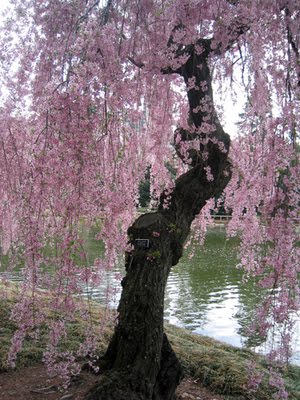
Rain scatters plum petals
Weeping stains the earth
One can only take shelter
And wait for clearing

Tao Te Ching

Footprints

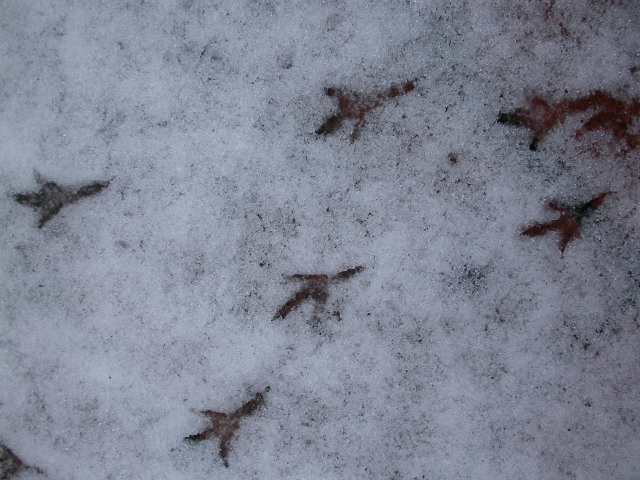
Again Nature provides lessons for the Inner life. The snow which seemed so abundant just days ago begins to melt. Is is sad when we see something, which made the landscape so magical, changing.

To what can our life on earth be likened?
To a flock of geese,
alighting on the snow.
Sometimes leaving a trace of their passage.

Su Shi

Resolutions II: starting over

The cultural cliché of New Year resolutions is, however, based on a deep pattern, reflecting nature at this time. It seems evident that there is a need to mark change at this time, be it at New Year, the Winter Solstice or in Advent. We too look for the new to emerge from what is resting or decaying, just as nature does at this time. Unfortunately our need to participate in this natural rhythm can make us pressured and down, far from the natural growth it intends to imitate.

So how do we work with this good desire for change, without falling into the culturally-driven anxiety around our life or our career, our fitness, or our goals? How can we look at the desire for major life change without falling into self-criticism and judgement? We can best do this by bringing mindfulness and the attitudes which ground it to our desire for self improvement, to prevent us from running after something, no matter how worthwhile it seems, which will just substitute one form of unhealthy striving for another. Change which is not based on the attitudes of kindness and acceptance of self will only lead to a waste of energy and greater frustration.

Bringing mindfulness to our desire for change can help us focus on our intention. Is it to find greater harmony and balance in ourselves? Or is it focused on greater acceptance by others, or a desire to fit into an external story as to what is right, successful or happy? Looking at the story we are telling ourselves behind the desire for change is one of the gifts that mindfulness can bring. The possibility of genuine change begins with accepting oneself at the deepest level of one’s core sense of self. Befriending ourselves, not running away from ourselves, allows any change come in a natural way, and is therefore sustainable.

Thus any aspiration we make these day needs to be firm and realistic without becoming rigid. We can do this by not placing the emphasis on controlling the outcome, but focus on starting out and starting over and over again each time we falter and fail. We practice non-judgement towards ourselves and simply say when things go wrong, “I was doing well and I will start again”. In this way our desire for new growth proceeds in a steady but gentle way, and we do not waste time and energy on criticizing ourselves or getting discouraged.

This shift in focus is attitudinal: You simply do what you care about as well as you can. This is a humble attitude, but it is exactly what’s needed for you to sustain your resolution. In so doing, you free yourself from your judging mind that thinks it can control results and creates the grandiose expectation that you can do more than you can do in the present moment. You become a more effective person by simply learning to use your time and energy to do what you can do right now.

Phillip Moffitt
Ways of seeing

I remember one afternoon as I was sitting on the steps of our monastery in Nepal. The monsoon storms had turned the courtyard into an expanse of muddy water, and we had set out a path of bricks to serve as stepping-stones. A friend of mine came to the edge of the water, surveyed the scene with a look of disgust, and complained about every single brick as she made her way across. When she got to me, she rolled her eyes and said, “Yuck! What if I’d fallen into that filthy muck? Everything’s so dirty in this country!” Since I knew her well, I prudently nodded, hopping to offer her some comfort through my mute sympathy.

A few minutes later, Raphaele, another friend of mind, came to the path through the swamp. “Hup, hup, hup!” she sang as she hopped, reaching dry land with the cry, “What fun!” Her eyes sparkling with joy, she added: “The great thing about the monsoon is that there’s no dust.” Two people, two ways of looking at things; six billion human beings, six billion worlds.

Matthieu Ricard “A Way of Being.”