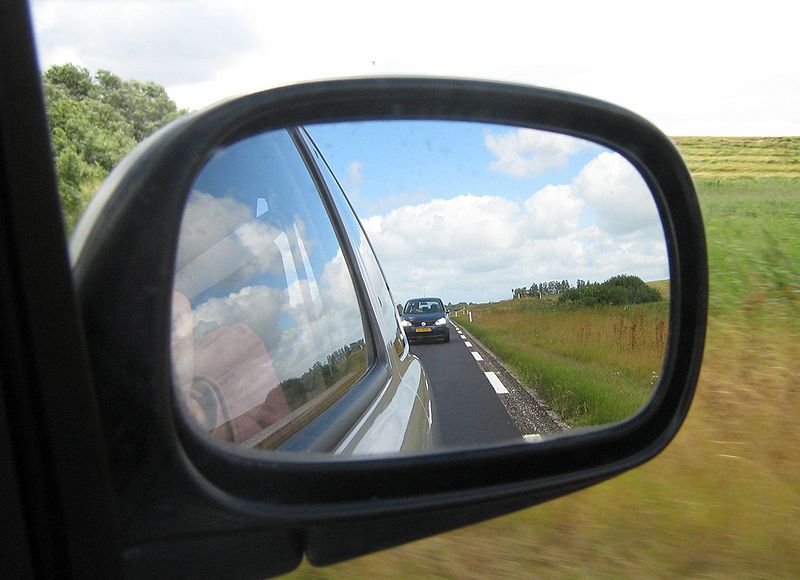
 At any given moment, one part of our life is already gone and the other part of it has not yet happened. In fact, a great deal of our life is gone for good — everything up to this very point in time. If you are thirty, for example, that means that your first twenty-nine years are dead and gone already. They will not be any more or less dead and gone in the future, at the time of your physical death, than they are already. As to the rest of our life, it has not yet happened, and it may or may not ever happen. The boundaries of our life are not so clear cut. We do not actually live in either the past or the future, but in that undefined territory where past and future meet, on the boundary of what is gone and what is to come. The past is at our back, just an instant behind us, nipping at our heels; and the future is totally questionable. We are caught between those two throughout our life, from our first breath to our last. It is as if we were riding the crest of a wave in the middle of a vast ocean. What is immediately behind us is constantly disappearing as we ride the edge of the wave; and as we are propelled forward, we can neither turn back nor slow that wave’s powerful momentum.
The practice of mindfulness is a way to become more familiar with that undefined territory where past and future touch. Through meditation practice, gently, step by step, we learn to make friends with death as it arises in our immediate experience. We begin to reconnect with the immediacy of life and death here and now. Mindfulness practice starts very simply, with what is most close at hand, the breath. What is our experience of each breath, as if comes and goes? The breath is our most simple, and perhaps most profound, connection with life and death….. As a byproduct of the cultivation of mindfulness, we begin to notice similar boundaries and meeting points throughout our experience. We begin to take note of our thinking, for instance, as a process rather than just a collection of thoughts. Thoughts seem to arise out of nowhere: by the time we notice them, they are already there — we don’t know how they got there, they are just there blithering away. But as we settle down and look further, we begin to see that they come and go too, just like the breath.
In subtle and in more obvious ways, the experience of birth and death is continuous. All that we experience arises fresh, appears for a time, and then dissolves. What we are experiencing can be as subtle as the breath or the thinking process, or as dramatic as losing a job, getting a divorce, or losing our life. That arising and falling of experience is our life; it is what we have to work with.
Judy Lief, Riding the Crest of the Wave
 When your eyes are tired the world is tired also.
 Soen Roshi, former abbot of Ryutakaji monastery in Japan used to say that when most of us want to see beauty in a room, we bring in fancy paintings, furniture, precious objects. In Zen, when you want to see beauty in a room, you take everything out, one thing after another. When the room is empty, you can see its original nature. Its beauty shines by itself.
 Mindfulbalance