Staying safe or choosing to grow.

We can go back to sleep in order to resist the forces of change or we can stay awake and be broken open. Both ways are difficult, but one way brings with it the gift of a lifetime. If we can stay awake when our lives are changing, secrets will be revealed to us – secrets about ourselves, about the nature of life, and about the eternal source of happiness and peace that is always available, always renewable, already within us.

Elisabeth Lesser, Broken Open
 

Driving home the other night I met a tiny baby fox on the road. Luckily I saw it on time and slowed the car down. It looked at the car briefly but was clearly frightened and quickly vanished into the field of wheat. It was a lovely glimpse of something I do not see too often.

It is a strange paradox that the heart needs to be afraid at times. It keeps us safe. It is certainly appropriate when we are young and getting to know the world and who can be trusted. The reality that some children experience as they are growing up obliges them to put up protective barriers within their hearts. And, to different extents, all of us carry around some of these wounds and some of the protections. However, sometimes the wise behaviours needed  when young – the need to be very aware of other people’s emotions, the response to other’s ever shifting moods – can become maladaptive and a hindrance as time goes on. Some people continue to scan for danger or be hyper-vigilent even as they grow older and the original danger has passed. Trusting others becomes the defining question of their lives, and doubting people’s’ motives becomes an ongoing survival mechanism. Sometimes the lack of a secure base in childhood leads them to have so little  confidence in themselves  that it is hard to accept that they can be loved, and this leads them –  paradoxically  – to keep people at a distance and do everything possible to make people prove to them that they are reliable. They can never relax. Deep in their hearts they remain the frightened little animal, looking for the slightest thing to show that people were never reliable and thus prove that they were right all along. And in doing this they push people away, repeating the original pattern.

However, when we seek safety as our first strategy we fall into two traps:  Firstly, we  impoverish our life and limit our potential because we miss opportunities to grow. Secondly, we project our fear onto situations and people, thus giving them power to scare us and restrict what we do. It is true that healing these wounds in the heart is not easy. We do not like to admit this fear, to allow it out and be fully present with ourselves. It is easier to turn away from the situations that frighten us. However, it is precisely by taking a non-judgmental interest in what is going on inside rather than running away from it that we grow. By taking this risk our life becomes richer. It could mean reaching out to someone who we are estranged from or going to some activity that raises anxiety at the thought of it. We can only  come to know our true capacity in the context of our struggles, and in how we face the challenges which life presents to us. So today we could look

Once there was a young warrior. Her teacher told her that she had to do battle with fear. She didn’t want to do that. It seemed too aggressive; it was scary; it seemed unfriendly. But the teacher said she had to do it and gave her the instructions for the battle. The day arrived. The student warrior stood on one side, and fear stood on the other. The warrior was feeling very small, and fear was looking big and wrathful. They both had their weapons. The young warrior roused herself and went toward fear, prostrated three times, and asked, “May I have permission to go into battle with you?” Fear said, “Thank you for showing me so much respect that you ask permission.” Then the young warrior said, “How can I defeat you?” Fear replied, “My weapons are that I talk fast, and I get very close to your face. Then you get completely unnerved, and you do whatever I say. If you don’t do what I tell you, I have no power. You can listen to me, and you can have respect for me. You can even be convinced by me. But if you don’t do what I say, I have no power.” In that way, the student warrior learned how to defeat fear.

Pema Chodron

Space for the conditions of life

To free ourselves from our neurotic ego is ultimately to accept the conditions of existence and to see ourselves not as victims or opponents of the givens of reality, but as adults who face up to them honestly. These givens include the following: things change and end; life is not always fair; we pay for growth with suffering; things do not always go according to plan; people are not always loyal or loving.

Accepting the conditions of existence means first of all admitting our vulnerability to them. When we realize that the givens of life – no matter how ferocious – are not penalties, but ingredients of depth, lovability and character, we can let go of the belief that we are immune (or need to be). “That can’t happen to me” or “How dare they do that to me” changes to “Anything human can happen to me and I will do my best to handle it”. The strength to handle challenges, in fact, is directly proportional to how much we let go of entitlement.

David Richo, How to be an Adult in Relationships

Having room for everything and everyone

The silence of the mind is like the space in a room. The spacious mind has room for everything. It is like the space in a room, which is never harmed by what goes in and out of it. In fact, we say “the space in this room,” but actually, the room is in the space, the whole building is in the space. We can apply this perspective to the mind, using the “I” consciousness to see space as an object. In the mind, we can see that there are thoughts and emotions —  the mental conditions that arise and cease. Usually, we are dazzled, repelled, or bound by these thoughts and emotions. We go from one thing to another, reacting, controlling, manipulating, or trying to get rid of them. So we never have any perspective in our lives. We become obsessed with either repressing or indulging in these mental conditions; we are caught in these two extremes. With meditation, we have the opportunity to contemplate the mind and the spacious mind has room for everything.

Noticing the space around people and things provides a different way of looking at them, and developing this spacious view is a way of opening oneself. When one has a spacious mind, there is room for everything. When one has a narrow mind, there is room for only a few things. Everything has to be manipulated and controlled, so that you have only what you think is right  – what you want there – and everything else has to be pushed out.  Life with a narrow view is suppressed and constricted; it is always struggle. There is always tension involved in it, because it takes an enormous amount of energy to keep everything in order all the time. If you have a narrow view of life, the disorder of life has to be ordered for you; so you are always busy, manipulating the mind and rejecting things or holding on to them. 

Ajahn Sumedho

Natural kindness

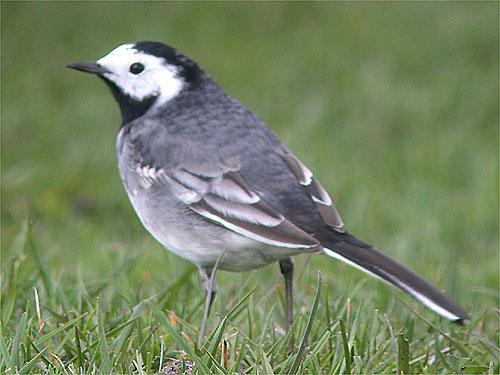
Had some lovely visitors to the garden this morning, as an adult wagtail fed its chicks, probably not long out of the nest. The young ones followed the adult, waiting for food and running across the grass when they saw some being offered. We do not normally get wagtails visiting the garden, even allowing for the fact that they keep a  low profile when nesting. However,  this year we are extremely lucky with the amount of birds we see, especially the blackbirds who are nesting in the trees at the end of the garden. After the thunderstorms of the past two days they love to fill the air with song.

The instinctive tenderness of the adult’s care for the chick was very moving. It seems to me that, when we are not afraid, we have a natural movement of kindness and compassion towards others. It is only when fear enters into the equation that we withdraw and hold back, and our natural desire for caring connection is blocked and gets confused.  At some level, even though we may not be aware of it, this causes a division within, some kind of cognitive dissonance and we deal with this by blaming the other or by justifying ourselves. These stories simply mean that we stay cut off from our deep self and from others, ensuring that we will never be fully happy as most of the energy from that part of our life or our history goes into splitting and withdrawal rather than into kindness.

Mindfulness practice is about cultivating a space in our minds and a harmony with our inner capacity for compassion. This means noticing when the mind is fearful or defensive. When we see this  it is a good practice is to focus on the warmth of our own kindness and direct it first and foremost towards ourselves. We need to have the same tenderness that the mother bird demonstrated this morning towards the hungry,  weak and frightened parts of our own heart. In this way we gradually find strength not to automatically run away from the fear when it arises. We can let go of what we carry within and relax in the more natural condition of love and trust.

The only reason we don’t open our hearts and minds to other people is that they trigger confusion in us that we don’t feel brave enough or sane enough to deal with. To the degree that we look clearly and compassionately at ourselves, we feel confident and fearless about looking into someone else’s eyes.

Pema Chodron

Roots in the past 3: The wound of the heart

It’s in relationships that our unresolved psychological issues show up most intensely. That’s because psychological wounds are always relational — they form in and through our relationships with our early caretakers.  The core psychological wound, so prevalent in the modern world,  forms out of not feeling loved or intrinsically lovable as we are. Inadequate love or attunement is shocking and traumatic for a child’s developing and highly sensitive nervous system. It damages our capacity to value ourselves, which is also the basis for valuing others.  I call this the “relational wound“ or “wound of the heart.”

There is a whole body of study and research showing how close bonding and loving attunement — what is known as “secure attachment”— have powerful impacts on every aspect of human development. Secure attachment has a tremendous effect on many dimensions of our health, wellbeing, and capacity to function effectively in the world: how our brains form, how well our endocrine and immune systems function, how we handle emotions, how subject we are to depression, how our nervous system functions and handles stress, and how we relate to others.

John Welwood

Freshness

We had such welcome rain last night. We are already on water restrictions here. Ok, maybe not good for the planned barbecue, but great for the plants and the garden, and especially for the farmers.  There is a freshness that only comes after a storm, as well as growth that only comes with the rain. The law is universal, not just for Nature but also for our inner life.  There are times we need to shelter a while but in the morning after we  find everything fresher and more alive.

Climb the mountains and get their good tidings. Nature’s peace will flow into you as sunshine flows into trees. The winds will blow their own freshness into you, and the storms their energy, while cares will drop off like autumn leaves.

John Muir