 The third Sunday of Advent, is traditionally called Gaudete Sunday, or Be Happy Sunday. For those preparing for Christmas, this joy comes from knowing that the coming of Jesus is near. which puts the up’s and down’s of daily life be put into context. This exhortation is shared by most wisdom traditions. We are reminded of a fact, sometimes forgotten by earnest religious practioners, that at the heart of all inner practice is joy, which leads us to understand the true nature of happiness.
Joy does not come from having everything perfect as we want it, by having a preconceived perfect day, but by accepting how life actually is and not fighting against it. It is possible even in the midst of difficult moments. It comes from seeing deeper into the heart of things. understanding that it is born from within and not from the external conditions of our lives. It is based on choices we make. It has its roots in the security we find within ourselves and from love:
Joy is the experience of knowing that joy and freedom comes from knowing you are unconditionally loved and that nothing — sickness, failure, emotional distress, oppression, war, or even death — can take that love away.
Joy is not the same as happiness. We are inclined to think that when we are sad we cannot be glad, but ….. sorrow and joy can exist together. That isn’t easy to understand, but when we think about some of our deepest life experiences, such as being present at the birth of a child or the death of a friend, great sorrow and great joy are often seen to be parts of the same experience. Often we discover the joy in the midst of the sorrow. I remember the most painful times of my life as times in which I became aware of a spiritual reality much larger than myself, a reality that allowed me to live the pain with hope. I dare even to say: ‘My grief was a place where I found joy.’ Still, nothing happens automatically in the spiritual life. Joy does not simply happen to us. We have to choose joy and keep choosing it every day.
Joy is what makes life worth living, but for many it seems hard to find. They complain that their lives are sorrowful and depressing. What then brings the joy we so much desire? Are some people just lucky, while others have run out of luck? Strange as it may sound, we can choose joy. Two people can be part of the same event, but one may choose to live it quite differently than the other. One may choose to trust that what happened, painful as it may be, holds a promise. The other may choose despair and be destroyed by it.
What makes us human is precisely this freedom of choice.
Henri Nouwen
 Among all living creatures studied thus far by modern scientists, only human beings can be said with absolute certainty to have been endowed with the ability to make deliberate choices about the direction of their lives, and to discern whether those choices will lead them through the valley of transitory happiness or into a realm of a lasting peace and well-being. Though we may be genetically wired for temporary happiness, we’ve also been gifted with the ability to recognize within ourselves a more profound and lasting sense of confidence, peace, and well-being. Among sentient beings, human beings appear to stand alone in their ability to recognize the necessity to forge a bond between reason, emotion, and their instinct to survive, and in doing so create a universe—not only for themselves and the human generations that follow, but also for all creatures who feel pain, fear and suffering—in which we are all able to coexist contentedly and peaceably.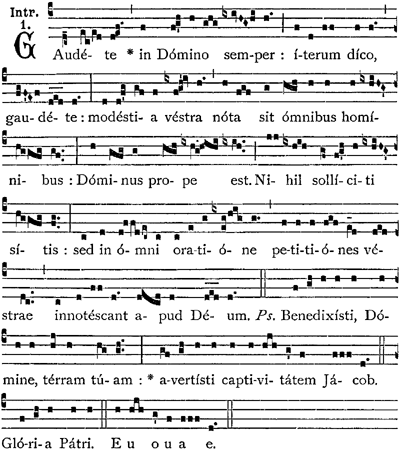


 Mindfulbalance