What holds us back

Just as a snake sheds its skin, so we should shed our past, over and over again.  The Buddha

Today is Ash Wednesday, traditionally the start of Lent – the season of preparation for Easter  The word “Lent” comes from the Anglo-Saxon word “lencten”,  referring to the lengthening of days in the Spring, thus placing the period in the context of growth and life. Lent became a time of reflection on freedom, seeing what the priorities in our life are and what needs to be let go of. As in other wisdom traditions,  it offers us a moment to enlarge our sense of things and go against the ways in which an unreflected life actually shrinks our heart. It reminds us to examine what is not essential, including the stories and habits which we have adopted over the years and which we come to see as fundamental to who we are.  It is an intensification of an insight that we see in our daily practice, namely,  that all things arise and pass away,  all things are impermanent.  So today, just as we begin to see Nature changing in the signs of Spring and new life, we try to internalize the understanding that we too are continually changing. This may mean that we need to let go of some elements of the past – which anyway is not happening any more except in the mind – in order for us to engage more fully with life in the present, in this moment.  It could be that we shed some aspects of what we hold as our solid self, and rather see  that we are more like a succession of selves.  Happiness in life comes not from holding onto the past but by living in the present with appreciation.

Detachment resembles the shedding of a number of coats of skin, until our senses are sharpened, or until “our inner vision becomes keen”. When we learn what to let go of, we also learn what is worth holding on to. Think of it in this way: it is simply not possible to share something precious or even to hold a lover’s hand, when we keep our fists clenched, holding tightly onto something. Detachment is not the inability to focus on things, material or other. It is the capacity to focus on all things, material and other, without attachment. It is primarily something spiritual; it is an attitude of life. And in this respect, detachment is ongoing, requiring continual refinement.

John Chryssavgis, In the Heart of the Desert
Just show up

I sometimes say that our monastery in Santa Fe should have a slogan hanging over the gate “Show up”. That’s all we have to do when we meditate – show up. We bring ourselves and all of our thoughts and feelings to the practice of being with whatever is, whether we are tired, angry, fearful, grieving or just plain resistant and unwilling. It really doesn’t matter what we’re feeling; we just come and sit down.

However unbearable any discomfort seems, ultimately everything we experience is temporary. And please make the wonderful effort to show up for your life, every moment, this moment – because it is perfect, just as it is.

Joan Halifax, Being with Dying

Letting go of old patterns

Once you start to awaken, no one can ever claim you again for the old patterns. Now you realise how precious your time here is. You are no longer willing to squander your essence on undertakings that do not nourish your true self; your patience grows thin with tired talk and dead language. You see through the rosters of expectation which promise you safety and the confirmation of your outer identity. Now you are impatient for growth, willing to put yourself in the way of change. You want your work to become an expression of your gift. You want your relationship to voyage beyond the pallid frontiers to where the danger of transformation dwells. You want your God to be wild and to call you to where your destiny awaits.

John O’Donohue

Noticing what is here, not what we would like to be here

Similar thoughts to yesterday morning’s post – this time from the Zen tradition – on staying close to what is actually happening, moment by moment, rather than worrying about what may happen. Sometimes it may not be what we would want, so our practice is to see if we can open to it and acknowledge it’s happening, even if we do not like it.  It also encourages us to meet every person today with fresh eyes, rather than immediately reducing them to  history which we have had with them, or to what we have come to “expect” from them.

The aim of Zen is to focus our attention on reality itself, instead of our intellectual and emotional reactions to reality – reality being the ever-changing, ever-growing, indefinable something known as “life,” which will never stop for a moment for us to fit it satisfactorily into any rigid system of pigeonholes and ideas.

Alan Watts

All things arise and pass away


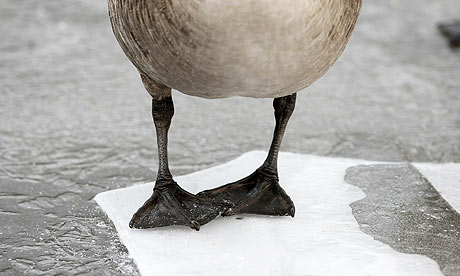
To what can our life on earth be likened?
To a flock of geese,
alighting on the snow.
Sometimes leaving a trace of their passage.

Su Shi (1037 – 1101), Remembrance

Letting thoughts – our own and others – define us

The deep cold continues,  and hardens the snow which fell in the past few days.  I am reminded of this Mahamudra text:

When a wintry wind strikes and stirs up water,
Though soft, it takes the form of stone.
When concepts attempt to disturb mind’s nature,
Appearances become very dense and solid.

In our practice we notice whatever passes through the mind-body in the form of thoughts or emotions. When under pressure we can sometimes turn them into a very solid reality, allowing them define us at that moment, as somehow a bad or defective person.  However, no matter how solid they seem, practice helps us to hold them fluid, seeing them just as energies in the mind,which can be worked with when we hold them in awareness.