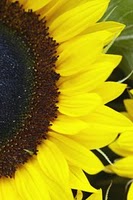
 Exister, c’est changer; changer, c’est mûrir; mûrir,c’est se créer sans cesse.
To exist is to change, to change is to mature, to mature is to go on creating yourself without ceasing.
Henri-Louis Bergson, French Philosopher.
Exister, c’est changer; changer, c’est mûrir; mûrir,c’est se créer sans cesse.
To exist is to change, to change is to mature, to mature is to go on creating yourself without ceasing.
Henri-Louis Bergson, French Philosopher.
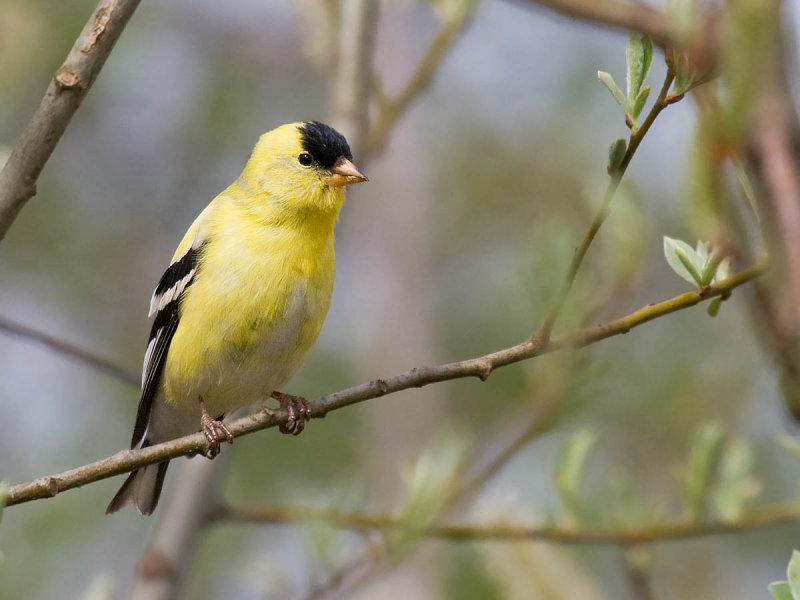
Sometimes ideas can give us insight. Some other times, it can be simple little encounters, when for a brief second, the mind is stilled and we see into the heart of things. Their newness, or their beauty, shock us briefly, giving us relief from the preoccupations in our mind, or the routine of daily activity, and we are nourished within. We try to create some space for such moments today.
There is the heaven we enter
through institutional grace
and there are the yellow finches bathing and singing
in the lowly puddle.
Mary Oliver, Yellow
 For all of us, the experience of our entanglement differs from day-to-day. I know from personal experience how strong the habitual mind is. The discursive mind, the busy, worried, caught-up, spaced-out mind, is powerful. That’s all the more reason to do the most important thing — to realize what a strong opportunity every day is, and how easy it is to waste it. If you don’t allow your mind to open and to connect with where you are, with the immediacy of your experience, you could easily become completely submerged. You could be completely caught up and distracted by the details of your life, from the moment you get up in the morning until you fall asleep at night.
You get so caught up in the content of your life, the minutiae that make up a day, so self-absorbed in the big project you have to do, that the blessings, the magic, the stillness, and the vastness escape you. You never emerge from your cocoon, except for when there’s a noise that’s so loud you can’t help but notice it, or something shocks you, or captures your eye. Then for a moment you stick your head out and realize, Wow! Look at that sky! Look at that squirrel! Look at that person!
Pema Chodron.
 I was recently away on retreat in Massachusetts and noticed that, as it has before, travelling stimulated the senses and moved the mind to notice new things – or things with fresh eyes. I was reflecting on this as I passed through different airports, when I always find that impressions are more intense. Or it could be that I am more open. Because it seems to me that being in airports and travelling is an exercise in “who I am” and identity, an experience in which the normal containers in which I act, and am perceived by others, gets moved around and suspended for a while, until I land and get back into reasonably familiar places, like hotels, and into roles and routines that I can determine myself. In the airport I find myself in a space where I am not – and nobody else really is – “at home”: everything is fluid, my identity reduced to that of a person-in-movement, defined only by passport and boarding card. The normal familiar people, places and roles that hold my life together are not around. And mostly I find it a very open, stimulating experience.
So I emerged from a flight, through the scrutiny of passport control and various checks, to stand with the others to wait for that other comforting element of my identity to slot back into place, the suitcase. Opposite me were two small twin brothers, travelling with their parents. They were lively and excited, and for the first moment my mind labelled the delighted sounds they were making as “too much noise”. However, soon their excitement focused on the conveyor belt and each tumbling-down piece of luggage brought cheers of surprise and delight. Not just the first one, but the tenth and the twentieth brought gasps of amazement and amusement as they waited for their one to arrive. It was very funny to see their faces and their wonder at the technology, seeing it probably for the first time.
And it struck me how much wonder we lose at the things which happen everyday, simply out of force of habit or being in a hurry. Now, I am not saying that we should get back to a condition where routine things, like the operation of a conveyor belt, fills us with surprise and awe each time we see them. It is simply not possible to get back into that fresh state. But it did impress on me that we miss so much, either out of familiarity, or due to the wariness with which we approach strange situations, or maybe because of the fact that life has betrayed and hurt us and we have learned not to open our hearts. Thus, sadly, the innocence, openness and wonder of children is not normally our everyday mode of relating to things.
Thankfully from time to time something new, or something of beauty, comes along and cuts through the habitual mind and the defensive heart. Like this American Robin which I saw foraging for food every morning as I sat on a bench after breakfast in rural Massachusetts. I have been an amateur birdwatcher since my childhood, so seeing a new species is always interesting. And the movement of this bird – although called a robin in homage to its redbreast – reminded me of the European thrush with which I am more familiar. It appeared each morning, always timid, searching for worms with some success. So this hesitant bird, which for some reason has evolved to be wary and cautious, became my companion for the days of retreat, and its tender vulnerability helped me to see with new eyes and a more open heart.
Maybe this is the key. Moments of beauty and changes from fixed patterns open the heart, making it gentle and vulnerable. But not only the beautiful or the surprising. It struck me that I should be also be open to the arrival of unexpected difficulties or to upsets in life, as moments which challenge the habitual, and force new ways of thinking. They too come to visit me, maybe to stir me up and allow me see where I am stuck. Where I have gotten too much into a routine. In some ways, life will never cease to provide me with occasions for growth if I can just be awake to what is presented. I do not have to go out of my way to seek them. I just have to have fresh eyes that can see.
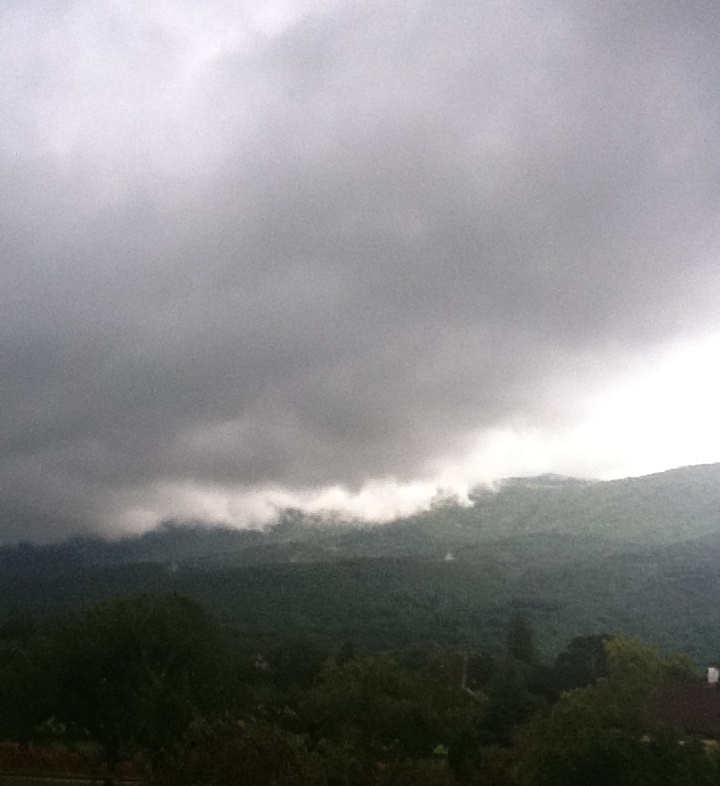 There has been very changeable, even cold, weather these past few weeks, and, as the photo shows, this morning stayed faithful to that, dawning grey and stormy on the Jura. As I have written before, looking at the weather is good practice, especially when it turns unpredictable, as it has been this Summer. Firstly, it helps us remember that there are many things which happen in our lives – the weather, the behaviour of others, or illness, for example—that we cannot control. Thus we place our focus on the things which are within our control – in the areas where we can train stability and constancy – and do not waste energy on what we cannot influence. Setting aside some time in the day and in the week when we can rest and deepen our capacity to be focused is one way of doing that. The second lesson we can learn on a morning like this is somewhat the opposite – how to keep ourselves fluid in the areas that we do not want to make solid. Thus, whenever we notice that we are making certain emotions or judgments fixed and unchanging, we let go of them. Especially when we notice firm negative thoughts about ourselves – which normally flag themselves by beginning with words such as “I always…” or “I am never able to”… – we can go back to the impermanence of the weather and remind ourselves that all things change. Then we can be kind to ourselves by realizing that this applies to us as well. We can let such thoughts pass through, just being aware of them, or hold fearful emotions more lightly, knowing they do not define us or how we are doing in our life.
Our mind is often very self-critical. and replays the faults and shortcomings of our life, over and over again, like a broken record. To work with this, some meditation traditions emphasize that we focus instead on our deep underlying goodness – our true nature – and this focus allows a practical confidence to grow, which counteracts the critical voice. We can see this approach – which shifts the orientation in our life – in the following quotation from the great Zen teacher, Dogen. It helps balance the suggestion that our life would be better if only this or that happened, or indeed, if this or that had not happened to us. It also recalls what is said in the first week of the MBSR programme: No matter where you are in you life, or what difficulties you are going through, there is more right with you than wrong. It is grounded in the belief that everyone, in their very essence, is in one sense fully complete. There is a gentle confidence in this perspective – no one will fall short and all things will come together to achieve that. The practice is to come to know this deeply, by direct experience.
No creature ever falls short of its own completion.
Wherever it stands it does not fail to cover the ground
Dogen
 Mindfulbalance