When things are dark in our lives

File:Candle burning.jpg

In Buddhism, a definition of faith is the ability to keep our hearts open in the darkness of the unknown. The root of the word patience is a Latin verb for “suffer,” which in the ancient sense meant to hold, not to grasp but to bear, to tolerate without pushing away. Being patient doesn’t mean being passive. It means being attentive, willing to be available to what is happening, going on seeing, noticing how things change. When we aren’t wishing for something to be over, or when we aren’t freezing around an idea about what it is we are seeing, we see and hear more. We notice that nature has cycles, that each day is not the same length and quality, and that darkness passes. The meaning of life, the real purpose of our presence here, is being attentive, being willing to go on seeing and keeping our hearts open — not just for our sake but for the sake of others. We make ourselves available to life, opening our hearts to the passing flow of it, knowing we will blunder and get it wrong but sometimes right.

Tracy Cochran (with thanks to make believe boutique) 

photo NCCo

Sunday Quote: On not being blind to what is around us

daff

If your daily life seems poor, do not blame it;

blame yourself,

tell yourself that you are not poet enough to call forth its riches;

for to the creator there is no poverty

Rainer Maria Rilke

Small things

File:US Navy 070316-N-1003P-004 Master Chief Engineman Shannon Thornton feeds a baby boy a bottle of formula while visiting a baby orphanage in Djibouti.jpg

Whenever I stopped long enough to reflect on such questions as “Why am I here?” and “What is my purpose?” the answer seemed pretty clear. I actually found it long ago in some lines by Clarissa Pinkola Estes, words I’ve quoted often because they’ve served me so well as a kind of north star, timeless wisdom by which to navigate:

“Ours is not the task

of fixing the whole world at once

but of stretching out to mend

the part of the world that is within our reach”

Katrina Kenison, Mending the world


Being aware of our patterns

File:Mosaic - Mosquée de Paris.jpg

One reason we strengthen our awareness in meditation is to see more clearly the patterns laid down in our childhood, how we believe these to be our personality and the limiting stories which they often tell us about our abilities.

According to neuroscience, even before events happen the brain has already made a prediction about what is most likely to happen, and sets in motion the perception, behaviors, emotions, physiologic responses and interpersonal ways of relating that best fit with what is predicted. In a sense, we learn from the past what to predict for the future and then live the future we expect.

Regina Pally, The Predicting Brain

photo MarcCooperUK

Saturday: learning by doing nothing

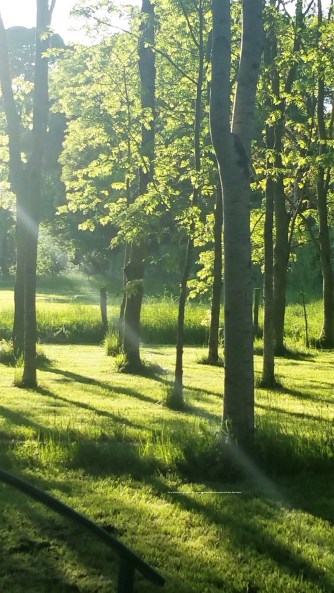
trees quote 1

The dream of my life

is to lie down by a slow river

and stare at the light in the trees –

To learn something by being nothing

a little while but the rich

lens of attention

Mary Oliver, Entering the Kingdom

“If only” this would change …

drop

People [have always] faced the same kinds of  issues we face now, but with different window dressing. In the time of the Buddha,  men and women were arguing, gossiping, judging others, losing their perspective, overreacting, sexualizing their experiences, chasing after greener pastures, obsessing about non-essentials, feeling lonely and creating too many pipe dreams….. Nothing has fundamentally altered.

How many of us  are still convinced, mature as we may be, that if our partner would only change, or if we could meet the perfect person, everything would be fine?  These are the dysfunctional myths and illusions that drive our lives in very dissatisfying directions.  How many people remember the song from the musical Fiddler on the Roof – “If I were a Rich Man…” 

What is your “big if”?  The big “if” that leads you away from wisdom and reality?

Lama Surya Das,  Awakening the Buddha within