The myth of normality

A quote from my favourite book of last year on a similar theme to Monday’s post on loneliness.Wisdom begins with clearly seeing the dynamics which operate in the ways that society portrays happiness.

The common myth that is perpetuated in society is that the normal person is happy, balanced and integrated – otherwise there is something wrong with them; maybe they’re mentally unstable. We’re even alarmed by unhappy people. Everyone in the media is smiling and cheerful. The politicians are all smiling, cheerful. confident; funeral homes even make the corpses up to look smiling, cheerful and confident.

Meanwhile however, perhaps you’re not smiling and you don’t feel cheerful and confident. You know you can’t live up to any of the images of the model person. You don’t have the right appearance or status symbols, your performance doesn’t cut it, you’re out of touch with the latest trends, or maybe you are just poor – someone whom society doesn’t want to acknowledge. Unhappiness in Western culture is often treated as a sign of failure. Others think, “They’re not happy, maybe they didn’t do enough. And maybe they’ll want something from me so I’d better steer away from them”

Ajahn Sucitto,  Turning the Wheel of Truth

Three simple steps towards a more balanced New Year: 3

The third step demands a little more thought: Simplify

Today’s world is full of information and complications. Decide what is essential in your life and make space for that by moving away from as many of the unnecessary things as possible. Focus on one thing at a time. Do less. Get rid of clutter. Say no. Reflect on what is “enough” in your life. Deconnect more.

Our life is frittered away by detail… simplify, simplify. Henry David Thoreau

Three simple steps towards a more balanced New Year: 2

The second step also seems easy: Create Gaps

Take moments during the day to stop and touch in with your breath. Maybe at transition times between activities. Or going to a meeting. Schedule your day so that you have spaces between things. Practice pausing, or creating a gap. If you find things becoming a bit rushed, stop and take a few conscious breaths. Allow some space into your mind and into your body. Touch into life in the here and the now.

Three simple steps towards a more balanced New Year: 1

The first step seems the most evident: Each day set aside at least 5 – 10 minutes just for yourself, to do nothing.

As I have written before, finding quiet time isn’t a luxury; it’s essential for protecting your health.

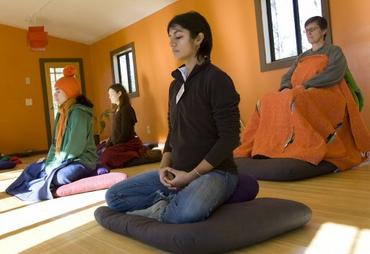
So sometime each day just sit in silence. Go somewhere where you don’t feel pressured to do anything. There is no need to make it complicated, or to think of it as a sacred ritual.  Maybe just sit with a cup of tea or coffee in the morning, before the work day starts. Become aware of your breathing. Become relaxed in the stillness. When your mind wanders,  just come back to the awareness of your breathing. Let go of doing for a few minutes. Be good to yourself.

The benefits of meditation for depression: now available on the NHS

A report in the Sunday Observer newspaper bears witness to the ongoing research being done on the effectiveness of mindfulness meditation in cases of depression, leading to it being offered by the National Health Service (NHS)  in the U.K.  It refers to a new study published in the  December 2010 edition of the journal Archives of General Psychiatry which found that mindfulness meditation was as effective as the use of anti-depressants in remission from major depression. The study involved 84 persons in remission from a major depressive disorder and found that meditation offered protection against relapse or recurrence which was on a par with antidepressants.

The results of this and other studies has led the National Institute for Clinical Excellence to  recommend mindfulness meditation in cases of chronic depression. However, the article goes on to highlight one of the potential dangers coming from this increased popularity, namely, that people will see it as a quick fix. If not understood or practiced correctly there is a danger that people will think that “mindfulness” simply means being a bit more aware and that, with this understanding, it becomes diluted to mean almost anything in life. Suddenly having a nice meal, or seeing a beautiful sunset, becomes an act of mindfulness and the same results are expected from this broader understanding.

The article quotes Florian Ruths, who runs a mindfulness meditation programme at the Maudsley Hospital in south London, who reminds us that the benefits of meditation are best seen when practised properly in a clinical setting. He sees three main benefits in his work, namely, its focus on the present and not future worries, the passing nature of thoughts and the value of compassion towards ourselves.

Stillness and safety

An old soothing lullaby, in Irish,  to calm the baby before sleep, sung here by Altan. The deepest rest comes when we know we are safe and we can let go. The progressive internalization of this safety from consistent parenting in our childhood is crucial for our capacity as adults to be alone.

Dún do shúil, a rún mo chroí
A chuid den tsaol, ‘s a ghrá liom
Dún do shúil, a rún mo chroí
Agus gheobhair feirín amárach

Close your eyes, love of my heart
My worldly joy, my treasure
Close your eyes, o love of my heart
And you will get a present tomorrow