Our dis-ease

The nature of our dis-ease is this: we continually judge, reject and turn away from certain areas of our experience that cause us discomfort, pain or anxiety. This inner struggle keeps us inwardly divided,  creating pressure and stress and cutting us off from the totality of our experience.

We first learnt to reject our experience when we were growing up. As children our feelings were often too overwhelming for our fledgling nervous system to handle, much less understand. So when an experience was too much, and the adults in our environment could not help us relate to it, we learnt to contract our mind and body, shutting ourselves down, like a circuit breaker. This was our way of preserving and protecting oursleves…….In time, these contractions  form the nucleus of an overall style of avoidance and denial.

Thus our psychological distress is composed of at least three elements: the basic pain of feelings that seem overwhelming, the contracting of mind and body to avoid feeling this pain; and the stress of continually having to prop up and defend an identity based on this avoidance and denial.

John Welwood, Toward a Psychology of Awakening

Seeing the Space

Between stimulus and response, there is a space.

In that space lies our freedom and power to choose our response.

In our response lies our growth and happiness.

Viktor Frankl

A Time for Resting

Normally the mind is a whirlwind of thought, and meditation is a practice that calms this down and helps us develop a peaceful state of mind. Not only is our mind busy thinking, we’re usually thinking about the past or the future. We’re either reliving old dramas or imagining what could happen tomorrow or in ten years and trying to plan for it. We usually aren’t experiencing the present moment at all. We can’t change the past, and the future is always ahead of us — we never reach it, have you ever noticed? So, as long as this process continues, our mind never comes to rest. The mind can never just settle down and feel at ease.

When we practice sitting meditation over time, we get better at catching our thoughts and releasing them. Gradually the mind begins to settle naturally into a resting state. This is great because it allows us to be fully present in our lives. When we aren’t being pulled into the past or future, we can just be right here, where we actually live. To be in the present moment simply means to be awake and aware of yourself and your surroundings. That‘s the beginning of peace and contentment.

Dzogchen Ponlop Rinpoche

Allowing ourselves some quiet in our busy lives

Finding quiet time isn’t a luxury; it’s essential for protecting our health.  It allows us to rest the body and the mind in a world that increasingly values speed and distraction.

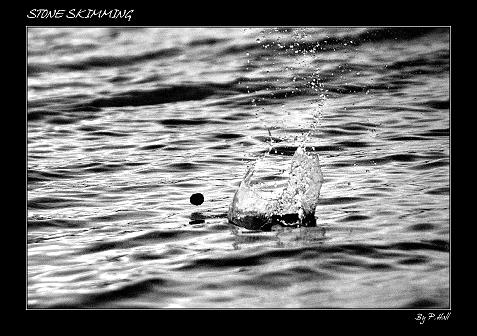
After a pebble touches the surface of the river, it allows itself to sink slowly. It will reach the bed of the river without any effort. Once the pebble is at the bottom of the river, it continues to rest. It allows the water to pass by.

I think the pebble reaches the bed of the river by the shortest path because
it allows itself to fall without making any effort. During our sitting meditation we can allow ourselves to rest like a pebble. We can allow ourselves to sink naturally without
effort to the position of sitting, the position of resting.

Resting is a very important practice; we have to learn the art of resting. Resting is the first part of meditation. You should allow your body and your mind to rest. Our mind as well as our body needs to rest. The problem is that not many of us know how to allow our body and mind to rest. We are always struggling; struggling has
become a kind of habit.

When an animal in the jungle is wounded, it knows how to find a quiet place, lie down and do nothing. The animal knows that is the only way to get healed-to lay down and just rest, not thinking of anything, including hunting and eating.  What it needs is to rest, to do nothing, and that is why its health is restored.  In our consciousness there are wounds also, lots of pains. Our consciousness also needs to rest in order to restore itself. Our consciousness is just like our body. Our body knows how to heal itself if we allow it the chance to do so.

Thich Nhat Hahn

Stop inviting the future

Don’t prolong the past,

don’t invite the future,

don’t be deceived by appearances,

just dwell in present awareness.

Patrul Rinpoche

Even good and worthwhile,  things have the capacity to pull us away from what we should be doing at this moment, which may seem less exciting in comparison. We do not need to rush the future, just do what is in front of us today.  The different wisdom traditions often tell stories about this. The famous Zen proverb – Before enlightenment; chop wood, carry water.  After enlightenment; chop wood, carry water  – can help us be in the moment and put our whole selves into whatever we are doing. In the tradition of the Church we are often encouraged to remember the example of those who performed their everyday duties with great love, touching the loves of those around them. Sometimes we can get too focused on the special moments, when it is the ordinary things like doing paperwork or making the lunch that count. Or we get deceived by the “appearance” and the imagining of the future in our minds, and are blinded to the actual reality of the task in front of us. As Therese of Lisieux reminds us, Nothing is small in the eyes of God. Do all that you do with love. In the end, it is just another way of reminding us that the present moment is the key to our happiness and our health. We have no place special to go. Happiness is right in front of us.

Nothing new here: Stress is bad for you….

A new study confirms what most of us already know. High stress is bad for us and is linked to cardiovascular death even if we do not have a  pre-existing cardiovascular problem. The study, published in The Endocrine Society’s Journal of Clinical Endocrinology & Metabolism (JCEM), shows that the stress hormone cortisol is released when we speed up and are under pressure and its purpose is to help the body recover from stress and regain a state of balance. However, when the stress is persistent, ongoing and chronic, an elevated level of cortisol  is maintained and this, paradoxically, is associated with cardiovascular risk factors. In other words, as we learn about in the MBSR Programme, the body’s own stress response system can become a problem when it remains switched on in response to deep ongoing stress.

Nicole Vogelzangs,  from the  VU University Medical Center in The Netherlands,  states: “Previous studies have suggested that cortisol might increase the risk of cardiovascular mortality, but until now, no study had directly tested this hypothesis“. The results of our study clearly show that cortisol levels in a general older population predict cardiovascular death, but not other causes of mortality.”

So creating a gap in the ongoing rush of your day and paying attention to your life is not just a nice option, but is crucial for your ongoing health. Then,  developing adaptive ways to work with the stress in your life, rather than simplistically wishing to escape to a stress-free world, is the next step. These ways could include looking at your diet, doing exercise such as walking or yoga, structuring your week so as to get some time in nature, making time just for yourself, and developing a meditation practice. If you click on the “Stress ” Category in the blog or on the “Effects of Mindfulness” you will find more posts or research on this subject.