Sunday Quote: Identity


Your identity is not equivalent to your biography

John O Donohue, The Inner Landscape of Beauty

Being patient and starting over

I was thinking about the GPS in my car. It never gets annoyed at me. If I make a mistake, it says, “Recalculating.” And then it tells me to make the soonest left turn and go back. I thought to myself, you know, I should write a book and call it “Recalculating” because I think that that’s what we’re doing all the time. If something happens, it challenges us and the challenge is, OK, so do you want to get mad now? You could get mad, you could go home, you could make some phone calls, you could tell a few people you can’t believe what this person said or that person said. Indignation is tremendously seductive, you know, and to share with other people on the telephone and all that. So to not do it and to say, wait a minute, apropos of you said before, wise effort to say to yourself, wait a minute, this is not the right road. Literally, this is not the right road. There’s a fork in the road here. I could become indignant, I could flame up this flame of negativity or I could say, “Recalculating.” I’ll just go back here. And no matter how many times I don’t make that turn, it will continue to say, “Recalculating.” The tone of voice will stay the same.

Sylvia Boorstein.

Bring compassion to what happens

Meditation is an experiment we are making, bringing us out of our normal habits of intense self-judgment, comparing, and impatience. Mindfulness isn’t about what is happening; it is about how we are relating to what is happening — how much awareness, balance and compassion are bringing to this moment’s experience, whatever it is. For example, it is very likely you will find your attention wandering, not 45 minutes after you first begin, but probably within a few seconds. You get lost in a fantasy, or fall asleep. That is normal and not a sign of failure. What I emphasize is that the critical moment in your meditation is the moment you see you’ve been distracted; instead of falling into our usual habits of self-condemnation, that’s a time we can practice letting go while being kind to ourselves, and work with the renewing power of beginning again.

Sharon Salzberg, Meditation and Mindfulness for All of Us.

A value in being lost

There is immense value in “finding ourselves lost” because we can find something when we are lost, we can find our selves. Indeed, the deepest form of wandering requires that we be lost.  Imagine yourself lost in your career or marriage, or in the middle of your life. You have goals, a place you want to be, but you don’t know how to reach that place. Maybe you don’t know exactly what you want, you just have a vague desire for a better place. Although it may not seem like it, you are on the threshold of a great opportunity. Begin to trust that place of not knowing. Surrender to it. You’re lost. There will be grief. A cherished outcome appears to be unobtainable or undefinable. In order to make the shift from being lost to being present, admit to yourself that your goal may never be reached. Though perhaps difficult, doing so will create entirely new possibilities for fulfillment.

Surrendering fully to being lost –  and this is where the art comes in  – you will discover that, in addition to not knowing how to get where you had wanted to go, you are no longer so sure of the ultimate rightness of that goal. By trusting your unknowing, your old standards of progress dissolve and you become eligible to be chosen by new, larger standards, those that come not from your mind or old story or other people, but from the depths of your soul. You become attentive to an utterly new guidance system.

Bill Plotkin, Being Lost but not lost in Life

Wait and let things settle

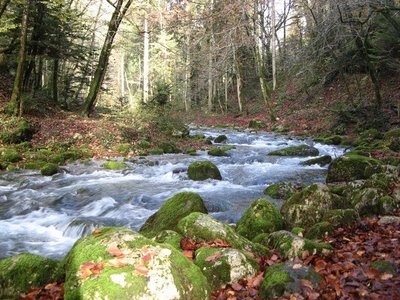
While thinking about our difficulties is useful to a point, we tend to take it too far and become obsessive…. Creating some spaciousness and tranquility in our minds can be a large step towards solving a problem. Consider the “forest pool” metaphor so popular in Buddhism. After inclement weather, the pool is muddy, full of sediment and debris. We cannot clear it by trying to control the contents – that would make the pool worse. We can only wait for all the sediment to settle to the bottom, leaving the pool clear again. So in meditation, by concentrating on the breath or our body or on sounds we can hear in the present moment, we create a space for clarity. We often find that in this spaciousness, an answer to a problem will simply “pop up” to the surface. Sometimes it won’t, but our bodies will thank us for a break from all the worrying.

Sarah Napthali, Stewing

Our habit of running

If we can’t rest,  it is because we have not stopped running. We began running a long time ago. We continue to run even in our sleep. We think that happiness and well-being are not possible in the here and now. That belief is inherent in us. We received the seed of that belief from our parents and grandparents. They struggled all their lives and believed that happiness is only possible in the future. That’s why when we were children, we were already in the habit of running. We believed that happiness was something to seek for in the future. But the teaching…is that we can be happy right here, right now. If you can stop and establish yourself in the here and now, you will see that there are many elements of happiness available in this moment, more than enough to make you happy.

Thich Nhat Hahn, Happiness