Becoming one who sees

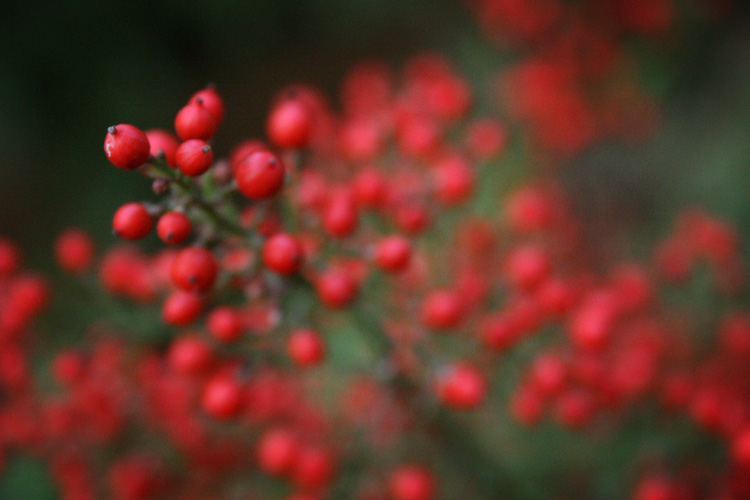
Despite the incredibly warm weather, the berries have appeared on the bushes in the garden. They reminded me of this quote,  and its encouragement to see into the heart of things, happening in each moment of the day. Sometimes we are just to preoccupied and hurried to notice.  We let life – and heaven – pass by,  unnoticed.

Earth’s crammed with heaven,
And every common bush afire with God:
But only he who sees, takes off his shoes…

Elizabeth Barrett Browning, Aurora Leigh


Noting, rather than reacting

Buddhadasa Bhikkhu said, “If there was to be a useful inscription to put on a medallion around your neck it would be ‘This is the way it is’.” This reflection helps us to contemplate: wherever we happen to be, whatever time and place, good or bad, ‘This is the way it is.’ It is a way of bringing an acceptance into our minds, a noting rather than a reaction.

The practice of meditation is reflecting on ‘the way it is’ in order to see the fears and desires which we create. This is quite a simple practice. Many methods of meditation are very very complicated with many stages and techniques – so one becomes addicted to complicated things.  However, the more simple we get, the more clear, profound and meaningful everything is to us.

So with the breath of the body, the weight of it, the posture of it, we are just witnessing and nothing, observing how it is, now, in this moment. The mood of the mind, whether we feel bright or dull, happy or unhappy, is something we can know – we can witness. And the empty mind, empty of the proliferations about oneself and others, is clarity. It’s intelligent, and compassionate. The more we really look into the habits we have developed, the more clear things become for us.

Ajahn Sumedho, The Way it is
Noticing what we see

Another English writer to help us, maybe not as literary as Wordsworth, but just as insightful.

“Holmes you see everything!”  Watson exclaimed.

“I see no more than you,

but I have trained myself to notice what I see“, said Holmes.

Sir Arthur Conan Doyle, The Adventure of the Blanched Soldier

Being genuine

The ancients used to say that God was “simple”, in the sense of wholeness, without parts, just simply being. We strive for that, trying to be coherent and consistent in our words and deeds, and not divided, but fully present in our attention to others.  Here is a nice story from the Zen tradition which shows what it would be like to be genuine in our words and relationships.

When Zen master Bankei died, the old blind man who used to sit outside the temple said how sad he was. ‘You see, since I am blind I cannot watch people’s faces, so I judge their character by the sound of their voices. And it is this way. When most people are given the news of another person’s good fortune or success they, of course, congratulate the fortunate person, but virtually always beneath the words of gladness, I hear another note, a secret note of envy, envy that it is not they themselves who have been so fortunate. Again, when most people are given the news of some calamity that has befallen another person they, of course, express their sorrow towards the afflicted person, but virtually always, beneath the words of sorrow, I hear another note, a secret note of pleasure and satisfaction that it is not they themselves upon whom the calamity has fallen. With Bankei, however, it was not so. When he expressed gladness at another’s good fortune all you heard was gladness. When he expressed his sorrow, all you heard was ­sorrow.’

Sunday Quote: Loving the moment for what it is.

We could learn a lot from what Wordsworth observed in his mother. She did not demand more than what was contained in each moment:

Nor with impatience from the season asked
More than its timely produce; rather loved
The hours for what they are.

Wordsworth, The Prelude, Book Five

Enjoying living

Autumn is a season of maturity, of patience and integration. As I have said before, it reminds us to look at the seasons and growth in our own life, our path towards maturity and greater individualization. This is demanded of us at every stage in our life but comes to the fore more clearly in “mid-life”, when we are asked to let go of some of the typical first half of life thinking patterns and move into a second half thinking style. It is a challenge that everyone faces, although not everyone takes it up. If we do, as Levinson remarks here, we can let go of some of the pressured, achievement-focus drive which is characteristic of the first half of life (and of the modern age) and have the space to notice and enjoy the process of living itself.

Some reduction in illusions is now appropriate and beneficial……According to Jaques, the central issue at mid-life is coming to terms with one’s own mortality: a man must learn now, more deeply than was possible before, that his own death is inevitable and that he and others are capable of great destructiveness…..Bernice Neugarten identifies the basic mid-life change as a growing “interiority” : turning inward to the self, decreasing emphasis on assertiveness and mastery of the environment, enjoying the process of living more than the attainment of specific goals.

Levinson, The Seasons of a Man’s Life.