We prepare to die by pushing ourselves to love less narrowly.
In that sense, readying ourselves for death
is really an ever-widening entry into life.
Ron Rolheiser.
We prepare to die by pushing ourselves to love less narrowly.
In that sense, readying ourselves for death
is really an ever-widening entry into life.
Ron Rolheiser.
 As I have said before, I often find in Ajahn Sumedho’s writings a clarity which cannot be matched. It is the case here. Simply stated, it gets to the heart of the dynamic which causes us so many problems – our tendency to add on to and identify with what passes through the mind and make it into a criticism of ourselves. I recognize these phrases he uses here as ones I use myself and which I frequently hear in talking with people.
You can’t get more simple than mindfulness because it is not anything you can create. It is just a matter of paying attention and being present, it’s not a complicated technique or a complexity. It’s so simple, but we are conditioned for complexity, so we tend to make things complex all the time. You are sitting and observing and then a negative thought arises in your mind and you think “That’s bad”. ‘That’s a compounding. The act of judging it, of putting the label “bad” onto it, makes it more than what it is.
Mindfulness is just aware of presences and absences. It is not concerned whether they are good or bad. It is not looking at them from that critical position. So “bad” is a criticism, or “that’s good”, “that’s right” and “that’s wrong”. And then it goes into “I’m good”, “I’m bad”, “I shouldn’t feel like this” , “I shouldn’t have these thoughts or desires”, ” I should be more compassionate and patient”. So you see it gets increasingly more complicated with judgments, criticisms and a sense of self that is identified with these different conditions. It gets even more complicated. If you have a bad thought you think “I am bad, I am a bad person, I am not very good…[then] These thoughts arise because people are inconsiderate and don’t respect me. And because of their lack of sensitivity and understanding, I have these bad thoughts”, so it gets increasingly more complicated.
Ajahn Sumedho, The Sound of Silence

Spring comes with ten thousand flowers,
Autumn with the moon,
Summer with the cool breeze,
Winter with snow.
When your mind is not filled with unnecessary concerns,
that’s your best season.
Wu-Men, Chinese Chan Master, 1183–1260
 The past is a memory of a former now; the future is a mental projection of an expected now. Strictly speaking, nothing ever happened in the past; it happened in the now. Nor will anything happen in the future; it will happen in the now. It sounds almost simplistic or meaningless, and yet there is a deep truth in it: that life and now are one. Eckhard Tolle
As this quote reminds us, there is a value in staying in the immediacy of the present moment. However, this can be quite difficult. We frequently carry into the present habits and roots from the past, which can be tied up with fearful emotions and inhibit our freedom. Or we find ourselves scanning for danger, warning ourselves about the dangers in proceeding based on past experiences. We find ourselves always moving away from the present moment into an imagined future that we give more importance and credence to, or creating possible scenarios based on how our mood is in this moment. This worrying about the past or living already in the future frequently puts one at odds with the actuality of the present moment.
We all wish to enter fully into life, to live as if our lives can make a difference. However, so many of these mental habits lead us away from fully being here. We often see this moment as a means towards some other end, rather than complete in itself. To work with what is in front of us, in this moment, and then let go and start again, is the way to making the most of our life, not waiting for something dramatic to come along in the future.
 Our blocks of pain, sorrow, anger and despair always want to come up into our mind consciousness, into our living room, because they have grown big and need our attention. They want to emerge but we do not want them to come up because they are too painful to look at. So we try to block their way. We want them to stay asleep in the basement. Because we do not want to face them our habit is to fill the living room with other guests. But whenever we have ten or fifteen minutes of free time these internal guests will come up and make a mess of the living room. To avoid this we pick up a book, we turn on the television, go for a drive, we do anything to keep our living room occupied. When the living room is occupied, these unpleasant internal formations will not come up.
Thich Nhat Hahn, Anger
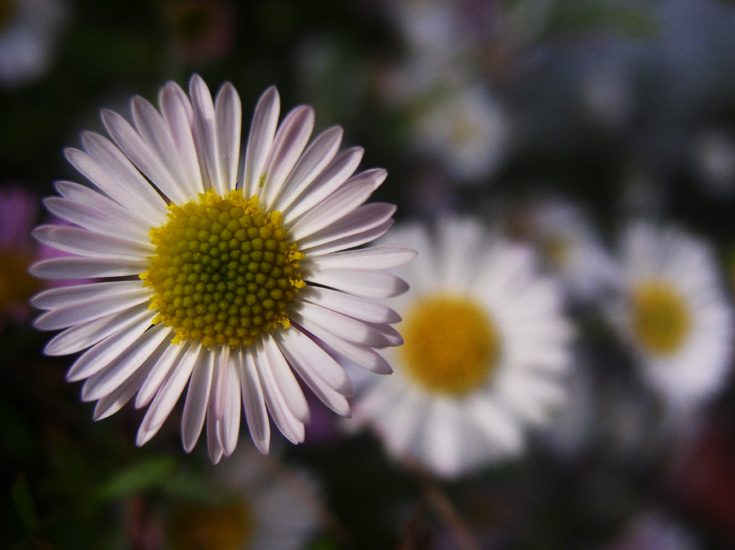 A child kicks its legs rhythmically through excess, not absence, of life. Because children have abounding vitality, because they are in spirit fierce and free, therefore they want things repeated and unchanged. They always say, Do it again; and the grown-up person does it again until he is nearly dead. For grown-up people are not strong enough to exult in monotony. But God is strong enough… It is possible that God says every morning, Do it again, to the sun; and every evening, Do it again, to the moon. It may not be automatic necessity that makes all daisies alike: it may be that God makes every daisy separately, but has never got tired of making them. It may be that He has the eternal appetite of infancy; for we have sinned and grown old, and our Father is younger than we.
G.K. Chesterson

