
I heard a bird congratulating itself
all day for being a jay.
Nobody cared. But it was glad
all over again, and said so, again
William Stafford, News Every Day
photo Magnus Manske
I heard a bird congratulating itself
all day for being a jay.
Nobody cared. But it was glad
all over again, and said so, again
William Stafford, News Every Day
photo Magnus Manske
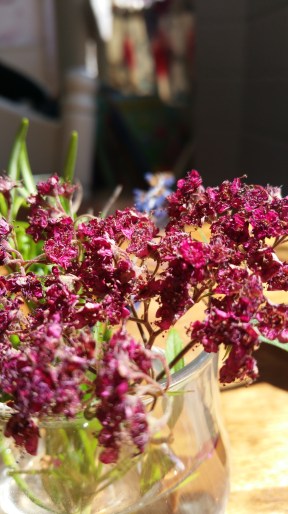
Day and night, gifts keep pelting down on us.
If we were aware of this, gratefulness would overwhelm us. But we go through life in a daze.
A power failure makes us aware of what a gift electricity is; a sprained ankle lets us appreciate walking as a gift, a sleepless night, sleep.
How much we are missing in life
by noticing gifts only when we are suddenly deprived of them.
David Steindal-Rast
photo: forS

Not the intense moment
Isolated, with no before or after,
But a lifetime burning in every moment
TS Eliot, Four Quartets

Philosophically, stress is a perverted relationship to time. So that rather than being a subject of your own time, you have become its target and victim, and time has become routine. So at the end of the day, you probably haven’t had a true moment for yourself. And you know, to relax in and to just be.
Because, you know, the way in this country — there’s all the different zones. I think there are these zones within us as well. There’s surface time, which is really a rapid-fire Ferrari time… over-structured, like, and stolen from you, thieved all the time.
And what I love in this regard is my old friend Meister Eckhart…..he said, “There is a place in the soul — there is a place in the soul that neither time, nor space, nor no created thing can touch.” And I really thought that was amazing, and if you cash it out, what it means is, that in — that your identity is not equivalent to your biography. And that there is a place in you where you have never been wounded, where there’s still a sureness in you, where there’s a seamlessness in you, and where there is a confidence and tranquility in you. And I think the intention of prayer and spirituality and love is now and again to visit that inner kind of sanctuary.
John O Donohue, Interview with Krista Tippett, On Being
photo AgCam

I am like the air on a calm day
as it holds itself still, letting nothing escape.
Colm Toibin, The Testament of Mary
photo of early morning fog University College Dublin by Crys83

According to the ancient Chinese, one of the main goals in life is to reach the evening of our life without regret. So we can ask: What fears hold us back from fully embracing what is offered now? What preoccupied thoughts hinder us from seeing the beauty that is before us in each moment?
When it’s over, I want to say: all my life
I was a bride married to amazement.
I was the bridegroom, taking the world into my arms.
When it is over, I don’t want to wonder
if I have made of my life something particular, and real.
I don’t want to find myself sighing and frightened,
or full of argument.
I don’t want to end up simply having visited this world.
Mary Oliver, When Death Comes

